
Travancore-Cochin: the Last Anchal and Its Integration
The United State of Travancore and Cochin, formed on 1 July 1949, joined two Anchal services: its converted stamps, the new rates, the agency of 1950 and the end of the Anchal in 1951.
Updated May 17, 2026
In this article
Two inherited postal systems, new values in a new currency, and a carefully staged end to an independent administration.
A union after independence
Travancore-Cochin belongs to Indian postal history as a successor union formed after independence. It was created on 1 July 1949 from Travancore and Cochin and inherited both their Anchal postal systems. These articles follow the union’s transitional stamps and the integration of its post; it was not a princely state before 1947.[1][11]
The United State joined the neighbouring south-western states of Travancore and Cochin. Its capital was Trivandrum, and Ernakulam remained an important inherited Cochin postal centre.
The rulers
Bala Rama Varma, the former Maharaja of Travancore, became Rajpramukh, the constitutional head under the covenant. Rama Varma, Maharaja of Cochin, signed the covenant on 29 May 1949 and transferred the former Cochin ruler’s authority to the United State from 1 July 1949. The Travancore ruler had signed at Trivandrum on 27 May.[12]
A union announced before the stamps could catch up
Behind the new political name stood two real Anchal services, with offices, staff, forms, stocks and customers. Merging them was an administrative task, not just a new heading on an album page. The postal conversion followed its own notices and practical timetable, and the dates of the covenant are not first days for every transitional stamp.[1][12]
Travancore used cash, chuckrams and fanams; Cochin used pies, annas and rupees. A notification of 28 June 1949 changed Travancore’s postal charges to the Indian currency from 1 July; the earlier Cochin tariff should not be assumed to be the same. That left the administration only a few days to prepare and distribute converted postal paper. The notice also announced more values and stationery than the Travancore authorities actually supplied, so an announced value is not necessarily an issued stamp.[1]
Currency and the first union rates
The change of currency and the change of postal charges had separate legal dates. Cowen and Devasya report a royal proclamation of 28 June 1949 making Indian currency legal tender in Travancore from 30 June. A postal notification of the same day revised the Anchal rules and brought the new charges into force on 1 July, the day the United State was formed. The original proclamation has not been found. The surcharged stamps belonged to a practical conversion of postal charges as well as to the creation of a new state.[1]
| Service | Rate | Further charge or condition |
|---|---|---|
| Letter, first tola | 1 anna | 6 pies for each further tola or part |
| Single postcard | 4 pies | 6 pies from 1 April 1951; extra postage could make an older card sufficient |
| Book, pattern or sample packet, first five tolas | 6 pies | 4 pies for each further five tolas or part |
| Registered newspaper, up to eight tolas | 2 pies | 4 pies over eight to twenty tolas; 4 pies for each further twenty tolas or part; weight steps changed from 1 April 1950 |
| Parcel, each forty tolas or part | 4 annas | Registration compulsory above 440 tolas; maximum 600, or 500 in the High Range Division |
| Registration | 3 annas | A fee, not the total postage of a registered letter |
| Acknowledgment of receipt | 1 anna | |
| Late letter or card | 6 pies an item | |
| Insurance up to Rs. 50 | 2 annas | 1 anna for each further Rs. 50 or part |
| Hundi or money order | Up to Rs. 5: 1 anna; Rs. 5–10: 2 annas; Rs. 10–15: 3 annas; Rs. 15–25: 4 annas |
Chronology
| Date | Event |
|---|---|
| 23 October 1939 | Nilakanta Pellai’s letter to J. Devasya describing the 1939 designs and their official colours |
| 28 June 1949 | Currency proclamation and the postal-rate notification |
| 30 June 1949 | Indian currency legal tender in Travancore; notification Fin:7251 on surcharge inks and type |
| 1 July 1949 | Union; new Anchal rates; the first five converted values and the provisional card and envelope |
| 1949 | Stamps Validation Ordinance, 1124, recognising the predecessors’ Anchal and revenue stamps across the union |
| 5 August 1949 | Notice of the three-anna and six-anna surcharges, issued soon after |
| 15 October 1949 | One-anna farmer-and-oxen envelope |
| 6 January 1950 | Four-pies palm postcard (announced for 5 January) |
| 1 April 1950 | The Anchal becomes an agency of the Indian Posts and Telegraphs Department |
| 5 June 1950 | Anchal stamps accepted at Anchal and Indian offices for any destination |
| 7 September 1950 | Inherited Cochin envelope paper authorised |
| 30 September 1950 | Free carriage of Anchal departmental business defined |
| 24 October 1950 | Nasik two-pies and four-pies stamps on sale |
| 10 November 1950 | Nasik one-anna arms envelope |
| 5 December 1950 | Notice of adhesives printed on Cochin paper |
| 14 December 1950 | Nasik four-pies arms postcard |
| 1 April 1951 | Direct central administration (notice of 5 April); postcard rate 6 pies |
| 1 May 1951 | Local letter concession withdrawn; its restoration dates are disputed |
| 30 June 1951 | Last day of validity for ordinary Anchal stamps and stationery |
| September 1951 | Official stamps reportedly no longer accepted; savings-bank accounts transferred on 1 September |
| 30 September 1951 | Last day for exchanging unused postal paper |
| 11 June 1952 | Final change of the letter rate, in a later account |
| 1 April 1953 | Statewide single local-delivery area withdrawn, in a later account |
The stamps
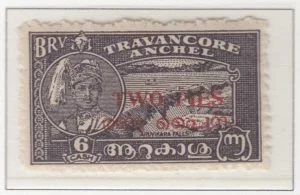
The issues and their values, from the research checklist, without the official stamps: the seven Travancore stamps converted to Indian currency, the provisional and permanent stationery, and the two Nasik agency stamps of 1950. Claude Scott identified the seven ordinary conversions as SG 1–7 in 1953; Burgess numbered the Nasik pair 8 and 9, while a later source gives 12 and 13. Historical numbers are not current catalogue numbers.[6][9]
| Period | Issue | Values |
|---|---|---|
| 1949 | Travancore converted-currency stamps | 2 pies on 6 cash, 4 pies on 8 cash, ½ anna on 1 chuckram, 1 anna on 2 chuckrams, 2 annas on 4 chuckrams, 3 annas on 7 chuckrams, 6 annas on 14 chuckrams |
| 1949 provisionals, as later catalogued | Provisionally converted postal stationery (postal stationery) | ½ anna on 1 chuckram envelope, 4 pies on 6 cash plus 2 cash card, 4 pies on 8 cash card, 4 pies on 8 cash SERVICE card |
| 24 October 1950 | Nasik agency adhesives | 2 pies, 4 pies |
| 15 October 1949; 6 January 1950; official card January 1950 (?) | Permanent Anchal stationery (postal stationery) | 1 anna farmer-and-oxen envelope, 4 pies coconut-palm postcard, 4 pies coconut-palm SERVICE postcard |
| 10 November; 14 December 1950 | Nasik arms stationery (postal stationery) | 1 anna blue envelope, 4 pies blue postcard |
| 1949–1950; status disputed | T.-C. on Cochin ANCHAL AND REVENUE stock (disputed postal-fiscal / revenue) | 6 pies on 1 anna, 9 pies on 1 anna |
| 1949–1950; status disputed | U.S.T.C. / NINE PIES on Cochin one-anna stock (disputed postal-fiscal / revenue) | 9 pies on 1 anna |
Sources
- [1] Frank M. Cowen and J. Devasya, “Travancore-Cochin: Its Postage Stamps and Postal History”, The Collectors Club Philatelist, vol. 32, no. 6 (1953), pp. 287–302.
- [6] Harry N. Burgess, “The Travancore-Cochin Overprints of 1949–50”, with Claude Scott, “Notes on S.G. Nos. 1 to 7”, Stamp Collecting, 5 June 1953, pp. 415, 417.
- [9] Latin American Philatelics, IND 12889: Travancore-Cochin 1950 pair, SG 12–13.
- [11] Government of India, White Paper on Indian States (1950), Appendix XLII, Article I, p. 286.
- [12] Government of India, White Paper on Indian States (1950), Appendix XLII, p. 293: signatures at Trivandrum, 27 May 1949, and Ernakulam, 29 May 1949.
- Indian Feudatory States Stamps, online exhibition: Travancore-Cochin.
Notes 0
Add what you know: a cover or stamp in your collection, a date or source, a correction or a question.
No notes yet.
Sign in to add a note.
Notes show straight away. Keep them kind and about the article; anyone can report one that isn't. House rules
