
Alwar: Two Values, Many Printing Stones
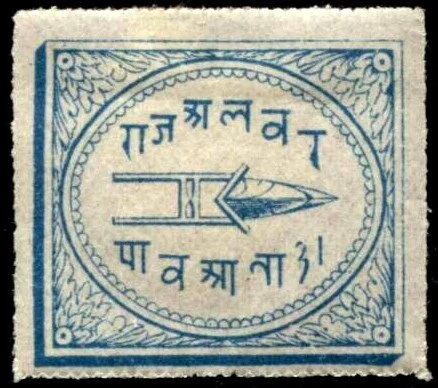
Alwar in Rajputana ran its own Raj Dak until 1 July 1902; its lithographed dagger stamps, a quarter anna and a one anna of 1877 and a redrawn quarter anna, fill a large specialist field.
Updated September 21, 2026
In this article
The state behind the stamp
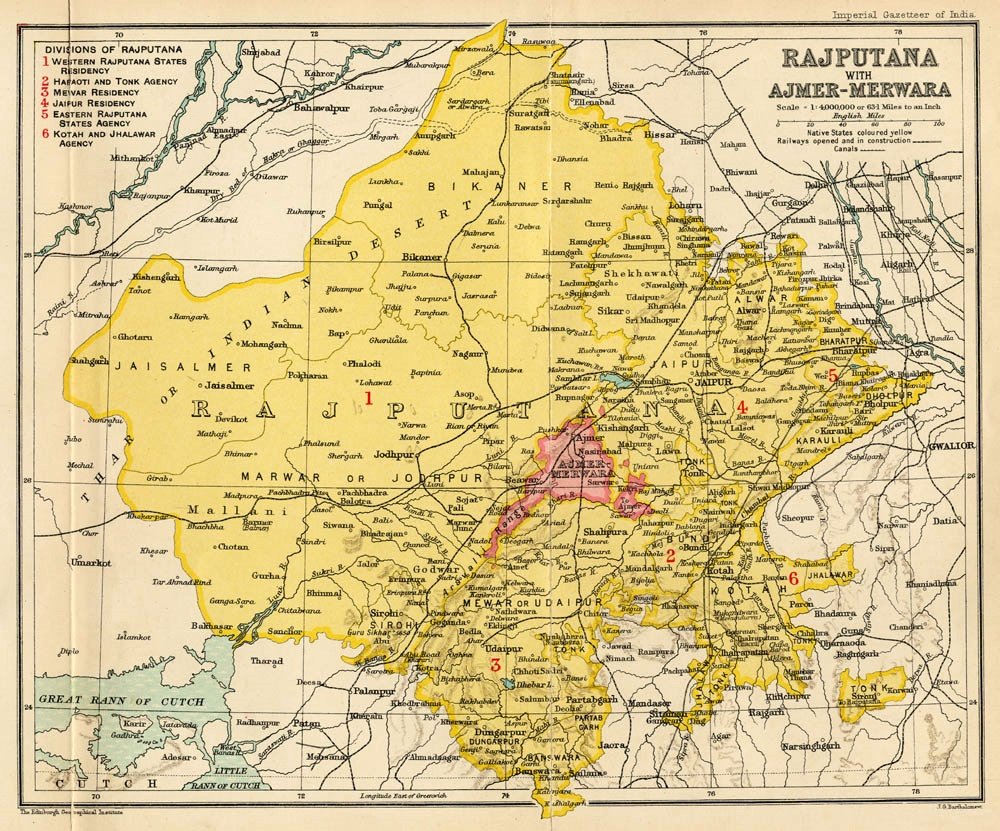
Alwar lay in north-eastern Rajputana, north of Jaipur, with the Aravalli hills to the west and cultivated plains to the east. Its capital stood below a hill fortress. The ruling house was Naruka Rajput. Pratap Singh founded the independent state in the eighteenth century; the stamp period belongs to the later rule of Mangal Singh and Jai Singh. The old spelling Ulwar (or Ulwur) survives in the cancellations.[3][4]
The rulers
Jai Singh received full ruling powers in December 1903, after the postal change of 1902. During his minority Alwar was governed by a council under the Political Agent’s general supervision. A ruler’s reign and the dates a stamp was issued or valid are different kinds of evidence.[A15]
| Reign | Ruler | Note |
|---|---|---|
| 18th century; died 1791 | Pratap Singh | Founder of the independent state; took Alwar fort in 1775 and made it his capital |
| Died 1892 | Maharaja Mangal Singh | Seated December 1874; ruling powers 1877; the first stamps belong to his reign |
| Succeeded 1892; full powers 1903 | Maharaja Jai Singh | The redrawn stamps and the postal change of 1902 fell in his minority |
The danger of a short catalogue list
At first sight Alwar seems complete after two values: a blue quarter anna and a brown one anna, each with a dagger. But the State used those designs for years, and new lithographic transfers, recurring flaws and changing sheets left a far richer record. Dawson’s study makes this its central point: a short catalogue list can hide a large collecting field.[1]
The redrawn quarter anna adds a second chapter, first widely spaced, then in closer green printings. On a page of singles they look like small variations; a block can keep the guide marks, separation and arrangement that show how the stamp was made.
Chronology
| Date | Event |
|---|---|
| 31 May 1872 | The Indian Postal Guide lists the Imperial offices Ulwur and Tijara |
| 1872–73 and 1873–74 | The State’s accounts include the post office |
| September 1876 | Powlett lists the Council, with the Political Agent as president |
| February 1877 | Le Timbre-Poste shows the blue dagger stamp, value unidentified |
| March 1877 | A mistaken reading of nine annas |
| May 1877 | The quarter anna blue and one anna brown reported |
| 10 November 1877 | The French philatelic society identifies the Indian dagger and the values |
| 1892–93 | Sudder office at Ulwur, 18 branch offices, 35 runners |
| 1896 | Experimental reform of the Raj Dak |
| 1899 | Redrawn quarter anna, wide spacing |
| 1900–1901 | Redrawn quarter anna, close-spaced green printings |
| 1 July 1902 | Alwar accepts Imperial postal unity |
| September–October 1902 | The takeover reported in the philatelic press |
| December 1903 | Jai Singh receives ruling powers |
What to record
Start with the value, the original or redrawn design, the shade, the paper, the separation and the margins. Record a sheet watermark only as far as it shows: a part watermark on one stamp is not a separate stamp watermark. Dawson records large papermakers’ inscriptions, so whole sheets matter. The best additions are often margins, multiples and properly described covers.[1]
The chapters that follow take the Raj Dak and its figures, the people around it, the stamps of 1877, how they were printed, the redrawn quarter anna, the postmarks, the covers and the change of 1 July 1902.
The stamps
The issues and their values, from the research checklist. Stones, settings, shades and papers are described in the chapters on printing and on the redrawn quarter anna; no official stamps or overprints are recognised.
| Period | Issue | Values |
|---|---|---|
| 1877–1898 | Original dagger, quarter anna | ¼ anna |
| 1877–1898 | Original dagger, one anna | 1 anna |
| 1899 | Redrawn quarter anna, wide spacing | ¼ anna blue-grey, ¼ anna emerald-green |
| 1900–1901 | Redrawn quarter anna, close spacing | ¼ anna emerald-green, ¼ anna pale yellow-green |
Sources
- [1] L. E. Dawson, “Alwar: This Indian Feudatory State’s Postage Stamps”, The Collectors Club Philatelist, vol. 39, no. 3, May 1960, pp. 111–115 and 120.
- [3] Encyclopædia Britannica, 11th edition (1911), “Alwar”.
- [4] The Imperial Durbar Album of the Indian Princes, Chiefs and Zamindars, Alwar: the Naruka lineage, Mangal Singh and Jai Singh.
- [A13] P. W. Powlett, Gazetteer of Ulwur (1878), pp. 25–26, 74, 100–101, 114.
- [A15] Imperial Gazetteer of India, new edition, vol. V (1908), Alwar, pp. 259, 263–265.
- Rajputana with Ajmer-Merwara, Imperial Gazetteer of India, 1909, via Wikimedia Commons.
Notes 0
Add what you know: a cover or stamp in your collection, a date or source, a correction or a question.
No notes yet.
Sign in to add a note.
Notes show straight away. Keep them kind and about the article; anyone can report one that isn't. House rules
