
1946: The Victory Issue
Four values marking the Allied victory, a design of globe and sword, and the private first-day covers that show how the issue was received.
Updated May 23, 2026
In this article
A commemorative after the war
The Victory issue commemorated the Allied victory in the Second World War. It was issued on 2 January 1946, after the fighting had ended in 1945, so both years appear on related material for different reasons: the event and the date of issue. A cachet reading Victory 1945 does not prove a stamp issue in that year.[1][2]
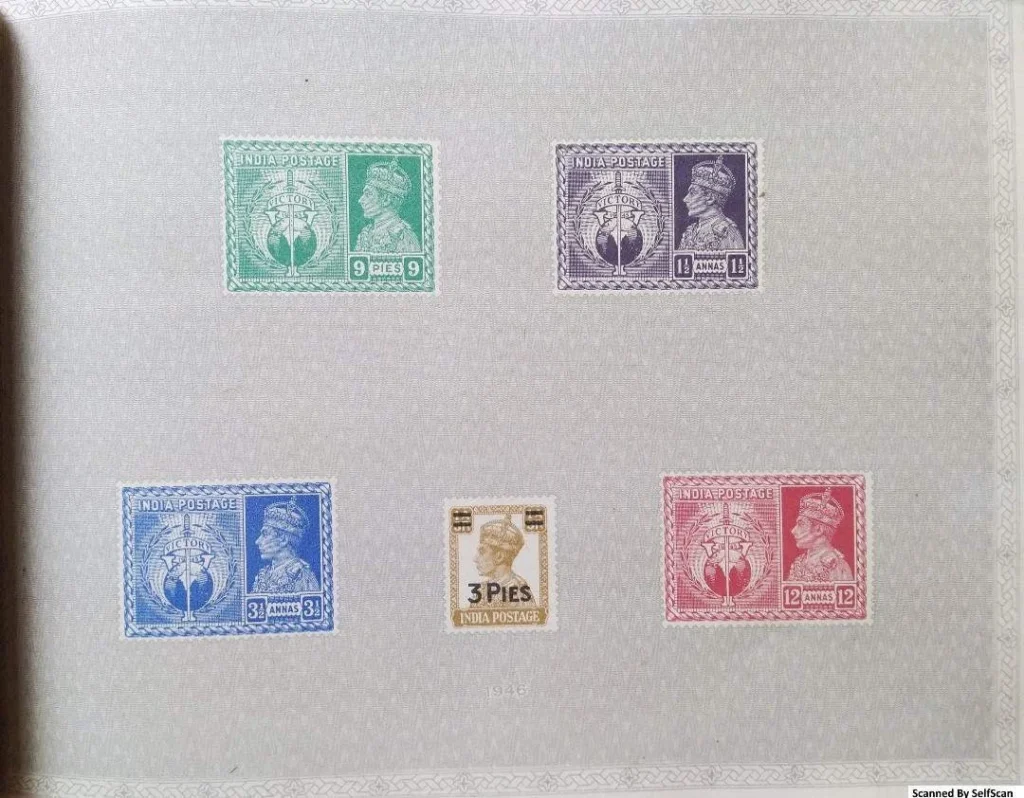
The official centenary album places the four stamps on its 1946 plate and links them to the end of the war. They are the last commemorative series of British India, but not its last stamp issue: the 3 pies surcharge on the 1 anna 3 pies definitive followed later in 1946. The two share the album plate without becoming one set.[1][2]
Four values, one design
The values are 9 pies, 1½ annas, 3½ annas and 12 annas, in yellow-green, dull violet, bright blue and claret. All share the same design: the crowned George VI at the right and a Victory emblem over a globe at the left, with India Postage across the top and the value in separate panels below. The large V is part of the symbolic design, not a surcharge.[1][4]
The globe, the upright sword and the surrounding leaves can be seen in the album’s reproductions. They set the victory in a worldwide frame while keeping the imperial portrait. None of the four shows a particular battle or unit, and a thematic reading should not invent a campaign from a coastline, a branch or a background line.[1][4]
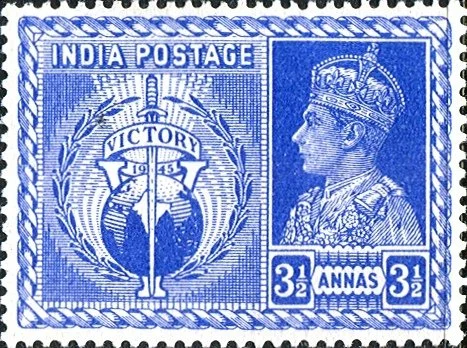
The blue 3½ annas makes the design especially clear. VICTORY crosses the top of the V, 1945 sits inside it, a sword runs down through the globe and a wreath surrounds the emblem. The year is the year of victory; the stamp was issued in 1946. The King has his own framed panel at the right.[1][4]
| Value | Colour | Design |
|---|---|---|
| 9 pies | Yellow-green | Globe, Victory emblem, sword and King |
| 1½ annas | Dull violet | The same |
| 3½ annas | Bright blue | The same |
| 12 annas | Claret | The same |
A commemorative, not a provisional
The issue is a commemorative designed for the purpose, in a horizontal pictorial format. Shah records sheets of 128 stamps, sixteen by eight, perforated 13. The same picture is used for every value, with value and colour as the practical differences, which sets the group apart from the small wartime portrait definitives that went on serving ordinary mail.[1][2]
A commemorative is not a surcharge just because it carries a prominent word such as Victory: the word is part of the design. The 3 pies provisional of 1946, by contrast, has a new value in black printed on a brown 1 anna 3 pies stamp already made. Keeping the two kinds apart stops an ordinary commemorative being called an overprinted definitive, or the other way round.[1][2]
Postal use, and why the whole cover matters
The four values gave different sums for franking, but a stamp’s place in the set does not fix one service for every use. Nine pies is three quarters of an anna, and 3½ annas is not three rupees fifty. On an envelope, add all the stamps in the currency of the day, then compare the total with the date, weight, destination and any registration or air fee.[1][2]
A whole set on one envelope may record collectors’ enthusiasm and pay more than was needed; a single value on everyday mail may say more about ordinary use. Both have their place, but a good description says whether it is showing how the issue was received, commercial use or a particular rate, rather than letting a colourful cachet stand in for postal history.[1][2]
A first-day cover from Madras
A private cover on public display carries the 1½ annas violet and 3½ annas blue, tied by a Madras circular cancellation of 2 January 1946 at 10 a.m. At the left a large V and Allied flags make a private Victory cachet, and the addressee is described as a philatelist. It is good evidence of a cover prepared by a collector and cancelled on the first day.[3]
The two stamps add up to five annas. Without working out the rate and the route, that should not be called an exact commercial franking. The private design is also not an official special postmark: the dated Madras device tying the stamps is the postal mark.[3]
Dates, and the issue’s place
The same public collection includes a cover listed with a strike of 31 December 1945. A date that early could mean use in advance or a wrongly set datestamp; the description alone cannot decide. The established opening in January is kept here, and one cover is not proof of a different date for the whole country.[1][3][2]
The Victory stamps close the commemoratives of British India, just before the very different national symbols of 1947. Differences in release between the values, full printing records, watermark positions and a body of documented commercial uses are still to be studied.[1][3][2]
Sources
- [1] Indian Posts and Telegraphs Department, India Postage Stamp Centenary 1854–1954: Souvenir Album (1 October 1954), plates 7–17 and printed commentary pp.2–4.
- [2] M. J. Shah, Indian Postage Stamps, “India Victory Issue”
- [3] First Day Covers of India, “1946 KGVI—Victory Stamps—2-Jan-1946 First Day Issue”
- [4] Wikimedia Commons, Post of India stamp scan: 1946 Victory, 3½ annas.
Notes 0
Add what you know: a cover or stamp in your collection, a date or source, a correction or a question.
No notes yet.
Sign in to add a note.
Notes show straight away. Keep them kind and about the article; anyone can report one that isn't. House rules
