
The Elephant’s Head Watermark Stamps, 1865–1876
A watermark that ties together several designs and new values: how the Elephant’s Head paper came in value by value, the changed dies of the four and eight annas, and the six annas eight pies.
Updated June 20, 2026
In this article
What the Elephant’s Head identifies
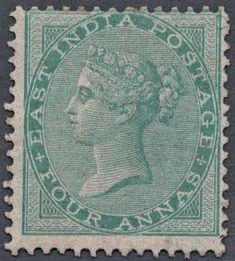
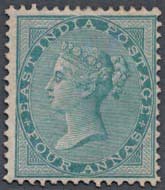
The Elephant’s Head is a watermark in the paper, not something printed on the face of the stamp. The same familiar Victorian design can therefore belong to different paper issues. Compare an unwatermarked four annas green with its watermarked successor before treating the colour as decisive.[1][2][3]
The dates in the sources need care. The Bombay catalogue of 1947 heads the first group 1866–67 and lists the changes of die and the later additions separately; the centenary commentary places the change to this paper from 1865; Clarke gives 1866. These short headings should not be forced into one exact first day. For single values, use dated examples and a specialised catalogue.[1][2][3]
A family that grew over time
The half anna, eight pies, one anna, two annas and four annas are the core of the lower values. Six annas eight pies, eight annas, nine pies, six annas, twelve annas and one rupee widen the field. Clarke’s text runs “2 annas 9 pies” together, but the catalogue and the album clearly separate the two annas and the nine pies.[1][2][3]
The catalogue of 1947 lists separately an eight annas rose, Die II, in 1868; the half anna Die II, with a wider opening, in 1873; the nine pies and one rupee in 1874; and the six and twelve annas in 1876. These are useful headings for reference, not a licence to date every loose stamp by its shade.[1][2][3]
| Value | What to know |
|---|---|
| Six annas eight pies | Slate; a value of 80 pies, not the same as six annas |
| Nine pies | Bright or pale mauve in the catalogue of 1947; three quarters of an anna |
| One rupee | Slate, in the catalogue’s group for 1874 |
| Later half anna | Die II, catalogued separately from the first portrait |
The watermark came in value by value
J. A. Tilleard states that the Elephant’s Head paper was first used in 1865, but warns against giving the whole group an issue date early in 1865. His printed table of plates records the fourth plate of the one anna on this paper in December 1865, the fourth plate of the two annas in May 1866 and the second plate of the eight pies in January 1868. These registrations belong to particular printing plates; they do not give the first day of postal use for every value.[5]
The evidence points to a gradual change from the unwatermarked stock. It also explains why a catalogue’s range of dates can differ from a short official summary without either being a complete day-by-day history of issue.[5]
Four annas and eight annas: the design changed too
The watermark is not the only difference within this family. The earlier four annas keeps the compact oval portrait; the later green four annas has a round portrait field with a pearl border and scalloped corners. The Bombay catalogue calls the later head types the pointed-chin and rounded-chin varieties.[3][6]
G. B. Pai describes the change in the eight annas as a different diadem and bolder lettering in the inscription, and the catalogue lists Die II separately under 1868. A collection arranged only by paper would hide these differences in design. Take the whole frame as the first division, then study the head on clear examples printed in a similar way.[3][6]
Six annas eight pies
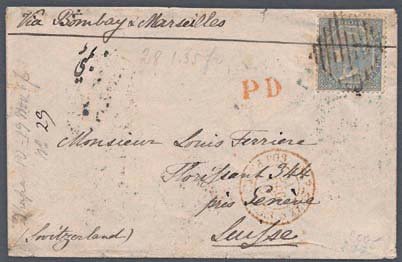
Six annas eight pies is eighty pies, not six and a half annas. Its long inscription of value fills a stretched octagon around the portrait, unlike the later six annas. Tilleard corrected an old printed date of registration to 1866 and reported delivery in October of that year; Clarke places the issue in 1867. Delivery and issue should be kept apart rather than forced into one false date.[5][1][4]
Gärtner lot 164 is a cover to Switzerland with this slate stamp, a route written by hand “via Bombay and Marseilles”, a travelling post office mark and a Geneva arrival mark. It shows why the route and the payment for each country have to be worked out, rather than assuming that every use of this value paid one and the same letter rate to Britain.[5][1][4]
The additions of 1874 and 1876
The nine pies lilac has an oval portrait with a prominent tablet of value below it; the one rupee slate has a stretched octagon and a band of key pattern. The six annas, added in the catalogue’s group for 1876, has a portrait field with an arched top; the twelve annas has a more angular frame with notched corners, in red-brown. These are separate values and designs on the same paper.[3][6]
The watermark seen from the back cannot identify any of these values, and a confident identification from the front cannot show which way the watermark runs. Keeping the two kinds of evidence apart matters most for official overprints and for stamps used at Indian post offices abroad, where the stamp underneath has to be identified before any official or geographical use is added.[3][6]
Looking at the back
Use a sound reference, and note whether the watermark is seen from the front or the back. Thin paper, a hinge, heavy gum or a cancellation can hide part of the head, and a doubtful fragment is not safe evidence of an unusual orientation. What the watermark is and which way it faces are two separate observations.[3][2][4]
Watermarked lettering in the margins and whole sheets of paper are valuable evidence for the layout, but they must be kept apart from the Elephant’s Head in each stamp. This article sets out the family and its main additions; a complete count of orientations is a subject for specialist study, and changes of die cannot be diagnosed from an enlarged, colour-adjusted picture on the internet.[3][2][4]
Sources
- [1] Geoffrey Clarke, The Post Office of India and Its Story, London: John Lane, 1921, chapter XIX, pp. 181–184, with passages from chapters III–IV on franking and postal legislation.
- [2] Indian Posts and Telegraphs Department, India Postage Stamp Centenary 1854–1954: Souvenir Album, 1 October 1954, plates 2–6 and commentary pp. 1–2.
- [3] Bombay Philatelic Company, Catalogue of Postage Stamps 1947, Bombay, 1947, India, pp. 47–52.
- [4] Auktionshaus Christoph Gärtner, India: Park Collection, auction catalogue, 7 March 2011, plates pp. 23, 25, 27 and descriptions pp. 70–72, 82–83.
- [5] J. A. Tilleard, Notes on the De La Rue Series of the Adhesive Postage and Telegraph Stamps of India, London: Philatelic Society, 1896.
- [6] G. B. Pai, “Stamps of India—Pre-Independence Issues”, India-80 handbook, pp. 44, 51–62.
Notes 0
Add what you know: a cover or stamp in your collection, a date or source, a correction or a question.
No notes yet.
Sign in to add a note.
Notes show straight away. Keep them kind and about the article; anyone can report one that isn't. House rules
