
British India: Stamps and Postal History, 1852–1947
From the Scinde Dawk of 1852 to the transport designs of George VI: the stamps, rates, registration, railway and sea post, stationery and official mail of British India, and how its post met the princely states.
Updated August 1, 2026
In this article
A British Indian stamp is a receipt for a service in a particular postal system. Its portrait and value tell part of the story; its printing, watermark, cancellation, cover and route can tell much more. This article follows the main families of stamps and the running of the post through the colonial period, while keeping provincial issues, official mail, revenue and telegraph use, stationery and the agreements with the princely states apart. Where the evidence allows an exact date it is given; where it does not, a broader range is.
A postal administration, not a map of all princely India
The postal history of British India covers a network whose organisation, routes and reach changed again and again. The broad sequence runs from the East India Company’s arrangements, through the single department of 1854 and Crown rule, to the transfer of power in 1947. Period names such as Calcutta, Bombay, Madras, Kurrachee and Scinde are kept when discussing documents of the time; they say nothing about present borders or official spellings.[1]
Before the reform, provinces and districts could have their own rules and charges by distance. The reforms of 1854 brought a Director-General, common procedures and postage stamps for general use. A stamp did not create the post from nothing: it changed how an established service collected and accounted for payment. Handstruck PAID and BEARING marks therefore belong to the same history as the stamps that followed.[1]
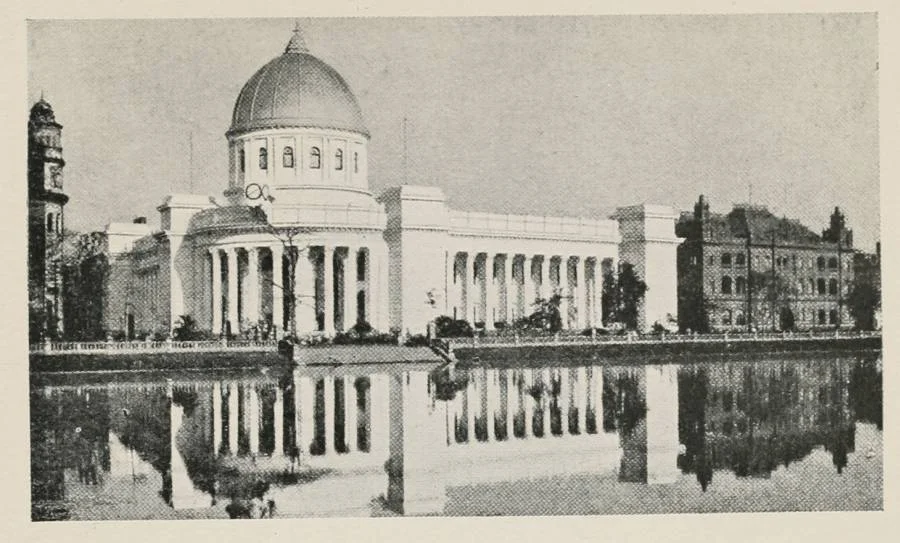
The hierarchy of offices shaped the paperwork that survives. Head offices controlled the accounts and the offices below them; smaller agencies took the service where a full departmental office was impractical. A place name on a cover has to be read with the office’s status and its postal circle, not taken to mean a separate territory with stamps of its own.[1]
1852: the provincial Scinde Dawk
The Scinde District Dawk of 1852 was a provincial experiment under the Commissioner, Bartle Frere, working with the Karachi postmaster, Edward Lees Coffey. All three forms of the stamp paid the same value, half an anna. Their round inscription encloses the East India Company’s merchant’s mark; the prominent sign like a figure 4 in that emblem is not a value.[3][11]
The red is embossed in brittle wafer. The white is a colourless embossing on paper, and the blue is embossed in colour on paper. How each was made matters as much as its colour: calling all three “wax stamps” hides a basic physical difference, and cracking, flattened embossing and damaged edges affect what can actually be seen.[3][11]
Pradip Jain’s study of 2017 discusses an unused red and cites Frere’s correspondence for the attribution to De La Rue; the article on the Scinde Dawk also sets out the contrary letters of 1950. The Smithsonian’s National Postal Museum describes the fragility of the red wafer and the recall of 1854.[3][11]
1854: three lithographed values and one typographed
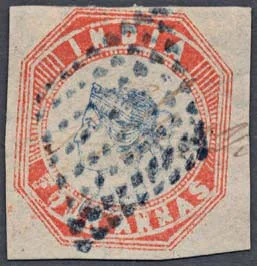
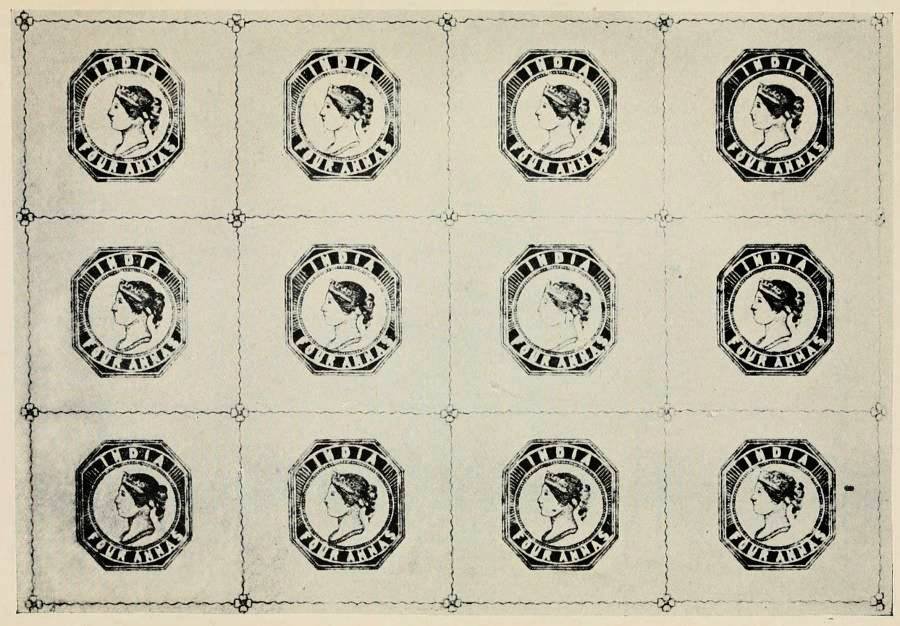
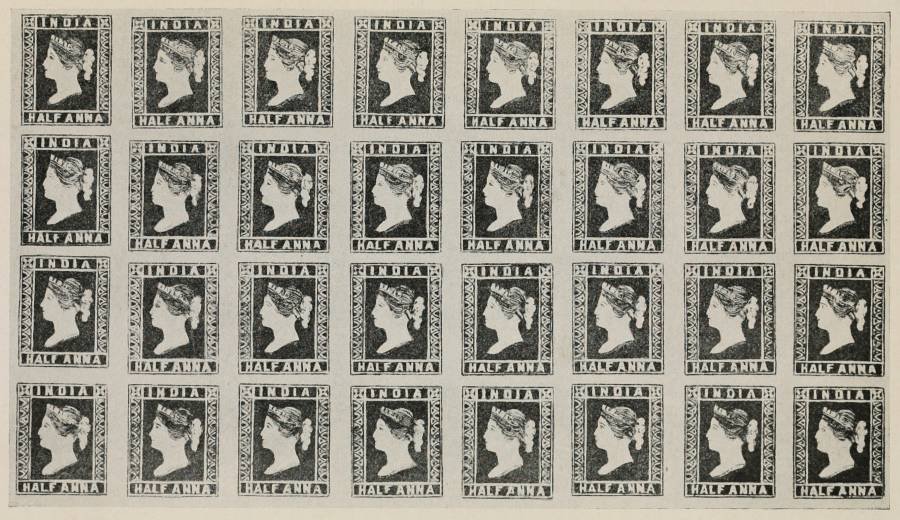
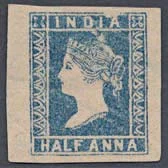
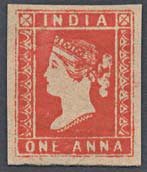
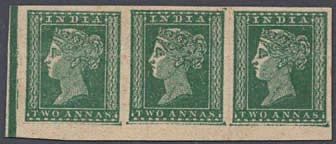
The first general issue had four values: half, one, two and four annas. The half anna blue and one anna red show a strong white profile of Victoria against colour, and were lithographed at the Surveyor-General’s Office in Calcutta. The octagonal four annas was lithographed too, in blue and red. The green two annas was typographed at the Stamp Office from a plate prepared at the Calcutta Mint. “The 1854 lithographs” is a handy name for a collecting field, but it does not describe how every value was printed.[4][2]
The rejected red half anna with nine and a half arches belongs among the preparatory material, not with the issued blue half anna with eight arches. An account of 1968 dates the issued half anna and one anna to 1 October, the two annas to 6 October and the four annas to 15 October 1854, so the anniversary of 1 October should not be given to all four values.[4][2]
These stamps were normally issued without perforations or gum. Their large sheet watermark, the East India Company’s arms, with extra inscriptions on some papers, must not be confused with a small watermark repeated in every stamp. Dies, transfers, retouches and sheet settings give the half anna, one anna and four annas their specialist structure.[4][2]
The head and frame of the four annas were printed separately, which made the famous inverted head physically possible, though that explanation does not authenticate any example offered. Stamps cut to shape, stamps cut square with margins, later separation and forged combinations all need different descriptions. Black-and-white illustrations from old books cannot show the shades of the blue and red inks.[4][2]
1855–1900: regular production, watermarks and changing charges
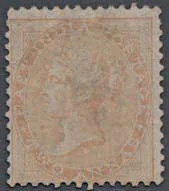
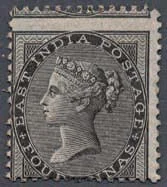
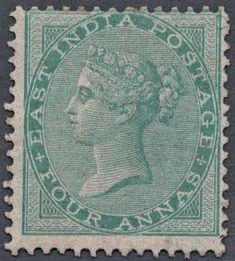
The move to De La Rue brought regularly perforated, gummed stamps inscribed EAST INDIA POSTAGE. The first half, one, two, four and eight annas were followed by more values and colours. Early unwatermarked paper and the later Elephant’s Head paper make two different groups, even when the portraits look alike.[2][1]
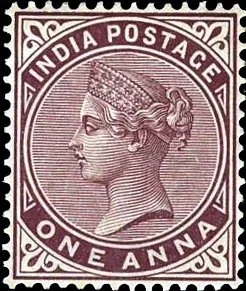
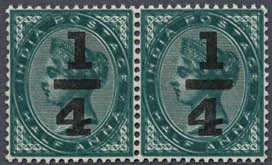
The INDIA POSTAGE designs of 1882–1888 brought in the single-star paper used in the following period. Fractional values were practical tools: a change of rate could call for a new value before a new design was ready, as with the two and a half annas surcharged on four annas six pies in 1891 and the quarter anna on half an anna in 1898.[2][1]
The two, three and five rupees of 1895 widened both the range of values and the size of the stamps. A high value does not by itself identify a service; the franking has to be read with the document. A rupee stamp on a heavy registered packet, on an accounting document or later on a telegraph form each raises different questions.[2][1]
Edward VII and George V: new portraits, new inscriptions, printing in India
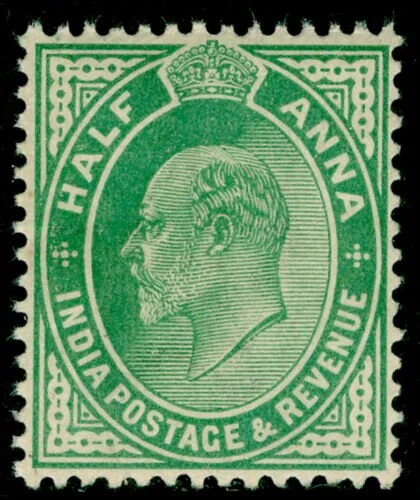
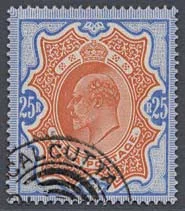
Edward VII’s definitives kept a broad range of anna and rupee values. The change of inscription on the half anna and one anna reflected permission to use postage stamps for revenue: POSTAGE AND REVENUE describes what the stamp was allowed to pay, not an official overprint. The ten, fifteen and twenty-five rupees of 1909 were linked with the replacement of separate telegraph stamps by postage stamps.[2][1]
George V’s designs began in 1911. The later period needs more than one album heading: single-star and multiple-star watermarks, changed colours and inscriptions, fractional values and surcharges all have to be separated. Even the wording of one value was corrected, from ONE AND HALF ANNA to ONE AND A HALF ANNAS, and that grammatical change is part of the design.[2][1]
In 1926 the Security Printing Press at Nasik took over Indian stamp printing from the De La Rue contract. That did not make every old design vanish on the day. Later types and colours went on answering changes in postal and revenue policy: the low-value changes of 1932–1936 included one anna three pies and three annas six pies, and the return from combined postage and revenue wording to POSTAGE on some values.[2][1]
Airmail, New Delhi and the Silver Jubilee
The AIRMAIL issue of 1929 gave the aeroplane and the service a design of their own. Markand Dave’s exhibit synopsis separates the five values issued on 4 November, three, four, six, eight and twelve annas, from the two annas issued on 20 December, so a set of six is no evidence that all six appeared on one day. He describes them as lithographed on multiple-star paper, in sheets of 144, perforated 14.[12][2]
The New Delhi set of 1931 made government buildings and the old fort into postal images, in six values: quarter, half, one, two and three annas and one rupee. The Silver Jubilee set of 1935 used Indian and Burmese buildings, rather than simply the common Windsor Castle design used elsewhere in the Empire. These pictorial issues sit beside the working definitives, not in place of them.[12][2]
The centenary album suggests that India was probably the first country in the world with a special set of six airmail stamps. That is not adopted here as an established fact: the documented sequence of issue and the features of production are more useful than a claim of “first” without a worldwide comparison.[12][2]
1937–1947: transport designs, wartime economy and a political boundary
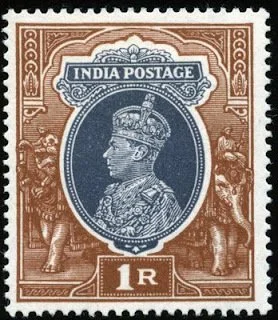
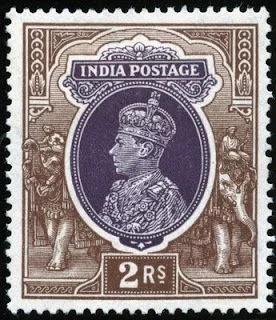
The George VI series of 1937 put the carrying of mail on view: runner, bullock cart, tonga, camel, train, steamer, lorry and aircraft. Portrait low values and rupee stamps went with the larger transport designs. These are separate groups within one definitive programme, not eight different postal administrations.[2]
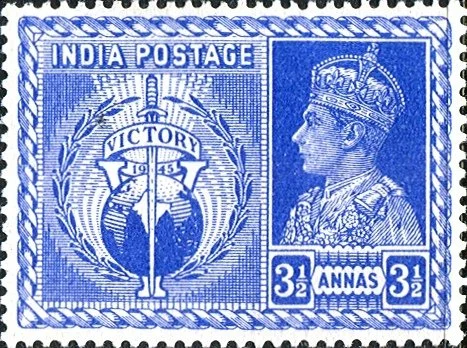
The official retrospective of 1954 explains the wartime return to smaller stamps as a response to the shortage of paper. The group of 1940–1943 must therefore be identified by its own designs and values, not treated as small versions of the transport set of 1937. The large fourteen annas paid an Empire airmail rate but could also be used for ordinary postage. The Victory issue of 1946 and the three pies surcharge on one anna three pies add further families.[2]
Independence on 15 August 1947 is where this account of British India ends. It is not a last day of validity for every George VI stamp or piece of stationery: later use and the issues of independent India belong to the history that follows, and the Independence commemoratives of 1947 should not be relabelled British colonial issues just because George VI stamps went on being used.[2]
Rates: give the date, the weight and the service
Before decimal money, a rupee was sixteen annas and an anna twelve pies. One anna three pies is therefore one and a quarter annas, and two annas six pies two and a half. Pies, pice and annas are not interchangeable words. Keep the units printed in a rate table and the units on a stamp as they are before converting anything.[5][6]
L. G. Shenoi’s compilation sets out inland letter rates by dated steps of weight. After 1854 a light letter could travel further without extra charge for distance, but a heavier letter still cost more, and registration, insurance, routes overseas and airmail could each add their own charges. The examples in the table are a help in reading an object, not a complete tariff for every class of mail.[5][6]
The postcard rate changed on its own timetable: Shenoi records a quarter anna from 1 April 1879, half an anna from 24 April 1922, three quarters of an anna from 15 December 1931 and half an anna again from 1 April 1946. A card’s printed value and any added stamp must be checked against its actual date and destination; an underpaid card, a reply card or a card sent abroad may not fit the sum for an ordinary inland card.[5][6]
| From | Service and first weight step | Charge |
|---|---|---|
| 1 October 1854 | Inland letter, not over ¼ tola | ½ anna |
| 1 April 1869 | Inland letter, not over ½ tola | ½ anna |
| 1 October 1907 | Inland letter, not over 1 tola | ½ anna |
| 1 April 1936 | Inland letter, not over 1 tola | 1 anna |
| October 1854 | Registration fee, in addition to postage | 4 annas |
| April 1881 | Registration fee | 2 annas |
| 1 October 1931 | Registration fee | 3 annas |
Registration and the evidence of postmarks
R. S. Nuttall separates the early practice of entering letters in a register from the later paid registration service. The rules of 1854 required a fee of four annas and a receipt; early instructions required the fee to be paid in money, and told the officer to write “Registered Letter” on the front. A cover can therefore carry sound early evidence of registration without any standard registration label.[7][6]
His study of 1973 records separate devices for large offices, types linked to postal circles, special forms for foreign mail and entries by hand; he found no single national handstamp. The inscription, size, office, date, ink and position against the stamp all matter: an obliterator cancels a stamp, a dated town mark records handling, and a registration mark identifies a service. One strike can do more than one job, but which job it did has to be shown.[7][6]
Nuttall’s earliest examples and his counts describe the material he studied, not a fixed census. Registration did not mean insurance either: he places the separate fee for insuring inland letters and parcels against loss at 1 January 1878. A registration charge should not be read as a statement of insured value without the evidence to support it.[7][6]
On land and at sea: sorting was part of the route
A bag carried by train and a letter sorted in a travelling post office are different stages of development. Clarke describes the sorting section of 1863 between Allahabad and Cawnpore and the later organisation of the Travelling Post Office, which grew into the Railway Mail Service. A railway mark can therefore record postal work done on the way, not just the town where the sender lived.[1]
For mail by sea, the key difference is between a ship carrying bags and an office sorting them on board. Clarke describes experimental sorting between Bombay and Suez in 1868 and its continuation after the report of 1870. Sorting at sea cut the work after arrival and linked the sea route with distribution inland, and a Sea Post Office mark belongs to that history.[1]
Endorsements, transit marks, arrival dates and extra stamps on a cover can support a route; an attractive stamp alone cannot. And a cancellation of an Indian office abroad does not mean that the issuing country changed: Indian stamps used abroad and expeditionary overprints need their own geographical and administrative records.[1]
The envelope or card is the object to collect
Higgins & Gage record embossed Victoria envelopes from 1857, among them half anna blue and one anna forms, on different papers and sizes and with different seals and flaps. Those features tell apart items with the same impressed stamp, and cutting out the embossed stamp throws away the evidence of how the whole envelope was made and used.[8]
Their list of postcards of 1879 includes a quarter-anna inland card and a one and a half anna card for abroad, followed by reply cards and later changes. A reply card has two prepaid halves; it is not one card with a mysteriously doubled value. The catalogue also separates registered envelopes and service stationery from ordinary envelopes and cards.[8]
For a whole envelope or card, record the printed stamp, the heading, the printed instructions, the paper, the size, the shape of the flap and the added stamps, and the postal marks on both sides. That is why a stationery catalogue can list several different items under what seems at first to be the same sovereign and value, and why the checklist below, which lists stamps, does not repeat them as stamp entries.[8]
Official mail, telegraphs and revenue stamps
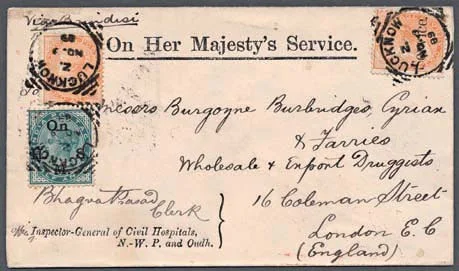
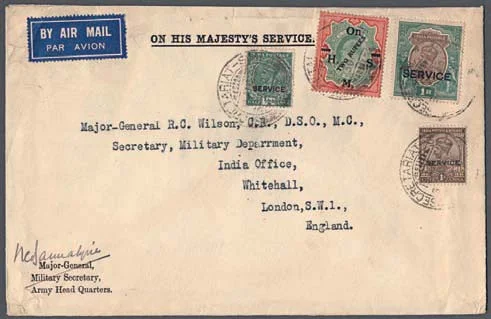
M. M. Inamdar’s study of the Act of 1854 and its rules explains the years before official stamps. Certain authorised letters on public service went under official signatures, while their postage was charged to the departments concerned; they were not private letters travelling free for want of stamps. The SERVICE overprints of 1866 brought in a different way of paying for official mail.[9][2][1]
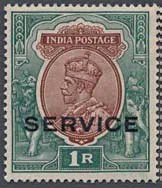
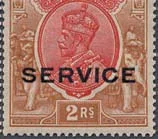
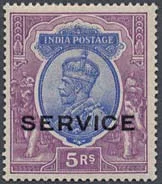
The later ON H.M.S. and SERVICE forms each need classifying by date, type and the stamp underneath. A state’s name overprinted, a surcharge of value and an official overprint do different jobs, even when several appear together, and a specimen or a revenue cancellation should not be taken for ordinary postal use.[9][2][1]
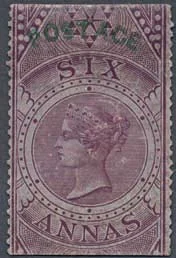
The six annas provisional of 1866 was made from Foreign Bill revenue stamps, with the labels above and below removed and POSTAGE overprinted. It records one particular authorised conversion, not permission to treat every revenue stamp as postage. On the other hand, once separate telegraph stamps were withdrawn, postage stamps could properly pay telegraph charges, and a telegraph cancellation proves that use, not a letter’s journey.[9][2][1]
The British network and the princely posts
The Convention States kept their own state administrations while using Indian stamps and stationery overprinted for them. Their postal agreements set out services on both sides and the arrangements for accounts. Patiala’s convention of 1884, for example, named Umballa and Patiala as the offices of exchange for accountable mail, supplied overprinted stamps at cost and required them to be sold at face value.[10]
That was different from a state with its own post and its own designs, whose letters needed Indian stamps as well for a journey outside the state. Even the convention stamps had limits: Patiala’s treaty required unoverprinted Imperial stamps for letters abroad, so the acceptance of a state overprint for inland mail cannot be stretched to every destination.[10]
The Indian States section of this site covers the states in their own right, as separate issuers and administrations. A British India collection can include mail exchanged with the states, Indian post offices in princely territory and covers with stamps of both, as long as each piece keeps the evidence of which administration supplied the stamp and which carried, cancelled or delivered the letter.[10]
How this section is arranged
The articles of British India follow the research one study at a time. Foundations and Early Issues covers the post before stamps, the Scinde Dawk, each value of 1854, the stones and transfers, the essays and proofs, the first De La Rue stamps and the change from Company to Crown. Queen Victoria covers the Elephant’s Head and INDIA POSTAGE issues, the portraits, low and high values, provisionals, official stamps and printings. The reigns of Edward VII, George V and George VI, and the Specialist Subjects (watermarks, perforations, postmarks, rates, covers, stationery, routes and military mail), have sections of their own.
The stamps
The issue groups and their values, from the research checklist. Official stamps, and the shades, papers, watermarks, perforations and errors within each group, are not listed; essays and provisionals are marked as such.
| Period | Issue | Values |
|---|---|---|
| 1852 | Scinde District Dawk (provincial postage) | ½ anna — white paper, ½ anna — blue paper, ½ anna — red wafer |
| 1854 preparation | Red half-anna, nine-and-a-half arches (essay / unissued) | ½ anna |
| October 1854 | First general issue | ½ anna blue, 1 anna red, 2 annas green, 4 annas blue and red |
| 1855–1864 | De La Rue, EAST INDIA POSTAGE | ½ anna, 1 anna, 2 annas, 4 annas, 8 annas, 8 pies added 1860 |
| 1865–1876 catalogue period | Elephant-head watermark families | 8 pies, ½ anna, 1 anna, 2 annas, 4 annas, 6 annas, 8 annas, 12 annas, 9 pies, 6 annas 8 pies, 1 rupee |
| 1866 | POSTAGE on cut-down Foreign Bill stamps (postal fiscal provisional) | 6 annas |
| 1882–1888 | INDIA POSTAGE, single-star watermark | 9 pies, ½ anna, 1 anna, 1½ annas, 2 annas, 3 annas, 4 annas, 4½ annas, 8 annas, 12 annas, 1 rupee |
| 1891 | 2½ annas on 4 annas 6 pies (postage surcharge) | 2½ annas |
| 1892 | Queen Victoria new definitive values | 2½ annas yellow-green, 1 rupee bicoloured |
| 1895 | Larger Queen Victoria rupee values | 2 rupees, 3 rupees, 5 rupees |
| 1898–1900 | Quarter-anna provisional and late Victoria changes (postage / surcharge) | ¼ anna on ½ anna, 3 pies, ½ anna, 1 anna, 2 annas, 2½ annas |
| 1902–1911 | Edward VII definitives | 3 pies, ½ anna, 1 anna, 2 annas, 2½ annas, 3 annas, 4 annas, 6 annas, 8 annas, 12 annas, 1 rupee, 2 rupees, 3 rupees, 5 rupees |
| 1905 | Quarter-anna provisional on half anna (postage surcharge) | ¼ anna on ½ anna |
| 1906 onwards | Edward VII combined-use inscription (postage and revenue) | ½ anna, 1 anna |
| 1909 | Edward VII added high denominations (postage / telegraph payment) | 10 rupees, 15 rupees, 25 rupees |
| 1911–1926 | George V, single-star families | 3 pies, ½ anna, 1 anna, 1½ annas, 2 annas, 2½ annas, 3 annas, 4 annas, 6 annas, 8 annas, 12 annas, 1 rupee, 2 rupees, 5 rupees, 10 rupees, 15 rupees, 25 rupees |
| 1921–1922 | George V revised-value provisionals (postage surcharges) | 9 pies on 1 anna, ¼ anna on ½ anna |
| 1926–1936 | Nasik George V, multiple-star families | 3 pies, 9 pies, ½ anna, 1 anna, 1¼ annas, 1½ annas, 2 annas, 2½ annas, 3 annas, 3½ annas, 4 annas, 6 annas, 8 annas, 12 annas, 1 rupee, 2 rupees, 5 rupees, 10 rupees, 15 rupees, 25 rupees |
| 4 November /20 December 1929 | Aircraft design (airmail) | 2 annas, 3 annas, 4 annas, 6 annas, 8 annas, 12 annas |
| 1931 | Inauguration of New Delhi (commemorative) | ¼ anna, ½ anna, 1 anna, 2 annas, 3 annas, 1 rupee |
| 1935 | George V Silver Jubilee (commemorative) | 9 pies, ½ anna, 1 anna, 1¼ annas, 2½ annas, 3½ annas, 8 annas |
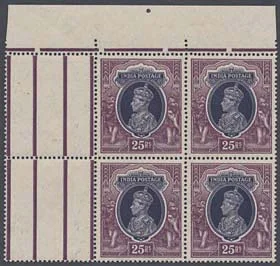
| 1937–1940 | George VI portrait, transport and rupee families | 3 pies, 9 pies, ½ anna, 1 anna, 2 annas, 2½ annas, 3 annas, 3½ annas, 4 annas, 6 annas, 8 annas, 12 annas, 1 rupee, 2 rupees, 5 rupees, 10 rupees, 15 rupees, 25 rupees |
| 1940–1943 | Smaller George VI wartime designs | 3 pies, 9 pies, ½ anna, 1 anna, 1¼ annas, 1½ annas, 2 annas, 3 annas, 3½ annas, 4 annas, 6 annas, 8 annas, 12 annas |
| 1940–1943 family | Large George VI fourteen-anna design (postage / airmail rate) | 14 annas |
| 1946 | Victory (commemorative) | 9 pies, 1½ annas, 3½ annas, 12 annas |
| 1946 | 3 PIES on 1 anna 3 pies (postage surcharge) | 3 pies on 1 anna 3 pies |
Sources
- [1] Geoffrey Clarke, The Post Office of India and Its Story, John Lane/The Bodley Head, London, 1921, chapters I, VI, XIV and XIX.
- [2] Indian Posts and Telegraphs Department, India Postage Stamp Centenary 1854–1954: Souvenir Album, issued 1 October 1954, plates 1–16 and commentary pp. 1–3.
- [3] Pradip Jain, “India, 1852 Half Anna Red ‘Scinde Dawk’”, The London Philatelist, vol. 126, September 2017, pp. 338–339.
- [4] “India 1854”, Gibbons Stamp Monthly, February 1968, p. 106.
- [5] L. G. Shenoi, “Postal Rates (Mainly Inland) of the Indian Post Office (1854–1957)”, Ind Dak, November 1998, p. 197, reprinting work of 1987.
- [6] L. G. Shenoi, “Postal Rates (Mainly Inland) of the Indian Post Office (1854–1957)”, Ind Dak, November 1998, p. 198 (letter, postcard and registration rates).
- [7] R. S. Nuttall, India: Registration Markings, Handbook of Indian Philately, India Study Circle, December 1973.
- [8] Higgins & Gage, World Postal Stationery Catalogue, India section (1857 envelopes, 1879 cards, registered and service stationery).
- [9] M. M. Inamdar, “Treatment of Articles on Public Service After 1854”, Ind Dak, May–June 1988, p. 52.
- [10] Government of India and Patiala State, Postal Convention 1884, articles 1–30 (signed 15 September, ratified 3 October 1884), printed pp. 176–180 of a treaty compilation.
- [11] Smithsonian National Postal Museum, object 2011.2005.6, “½ a Sindh Dak District Post single”, 1852.
- [12] Markand Dave, The 1929 Air Mail Stamps of India, exhibit synopsis, Museum of Philately/Philatelic Archives, collection 136.
- [13] Auktionshaus Christoph Gärtner, India: Park Collection, auction catalogue, 7 March 2011.
- [14] Bombay Philatelic Company, Catalogue of Postage Stamps 1947, Bombay, 1947, India, pp. 47–52.
- [15] Richter Stamps, “India Official Stamps” (1912, 1932, 1937 and 1939 sections).
- [16] Post of India stamp scan, 1 rupee George VI elephant definitive, via Wikimedia Commons (public domain).
- [17] Post of India stamp scan, 2 rupees George VI elephant definitive, via Wikimedia Commons (public domain).
- [18] Post of India stamp scan, 3½ annas Victory stamp of 1946, via Wikimedia Commons (public domain).
- [19] StampWorld, India, Service stamps 1920–1929, entries 66 and 74–86.
- [20] StampWorld, India, Service stamps 1930–1939, entries 97–115.
- [21] Post of India stamp scan, Victorian one anna INDIA POSTAGE, via Wikimedia Commons (public domain).
- [22] Post of India stamp scan, Edward VII half anna INDIA POSTAGE & REVENUE, via Wikimedia Commons (public domain).
Notes 0
Add what you know: a cover or stamp in your collection, a date or source, a correction or a question.
No notes yet.
Sign in to add a note.
Notes show straight away. Keep them kind and about the article; anyone can report one that isn't. House rules
