
Danish India: the 1845 Transfer and a Guide to Collecting
The sale of 1845 came before Denmark’s first stamps; a good collection records each whole letter and the evidence it carries.
Updated May 4, 2026
In this article
The settlements change hands
The sale of Tranquebar and Serampore to the British East India Company in 1845 closed the Danish period covered in this section. The National Museum of Denmark links the sale with falling trade returns after the British occupations and the growing British hold on commerce. The towns themselves continued, so the political boundary is not the end of their letters.[1][2]
A letter written after the transfer can still matter to a town’s history, but it belongs in a clearly labelled later section. A place-name alone does not make it Danish-period; the date, the government and the postal evidence decide.[1][2]
Why a stamp checklist would mislead
Denmark introduced adhesive stamps and flat-rate inland postage in 1851, after the sale. That chronology, from PostNord’s own history, is for Denmark itself; it does not create a Danish India stamp series or make Danish stamps valid on earlier Indian letters.[3][1]
A Danish-period catalogue therefore describes letters, handstamps, forwarding and documents. A later Indian stamp used in a former Danish town is successor postal history. A modern commemorative picture of Dansborg or of a missionary is a commemoration, not a stamp the settlement’s letter-writers could have used.[3][1]
Say what the object is
Start each entry by saying whether you have a complete folded letter, an address panel, a front, a fragment, a copy of the time or a later photograph. Add whether the contents, dateline, seals and back markings survive. This matters here: the 1806 Martyn letter is shown unfolded, while the 1837 address photograph is clearly only part of the front.[4][5]
A photograph can document a letter you cannot see in person, but it is not a second surviving letter. An archive’s copy can restore context without restoring the missing postal evidence. Keep those two contributions apart, in the inventory and in the story.[4][5]
Take the stages one at a time
The letters in this section suggest a useful set of questions. Where was the letter written? Where did an office accept it? Which ship is named? Where was it handled next? What charge was recorded? Is delivery shown? The answers may involve more than one administration.[4][8][6]
The 1803 regulation offers further possible evidence: authorised offices, registers, receipts, manifests and delivery charges. Compare its rules with a letter only when the date and the service fit. A modern reconstruction of a route should be called a reconstruction, not written in the same voice as a readable date of the time.[4][8][6]
| Date | Connection | What stays open |
|---|---|---|
| 20 October 1792 | Tranquebar–Copenhagen, von Scholten | No proven ship or full route |
| 10 October 1800 | Tranquebar–Cochin, POST PAID | Nine-fanam reading is the exhibit’s; route suggested |
| 30 May 1806 | Serampore–Cornwall, Martyn | Calcutta date disputed; London 21 November is not delivery |
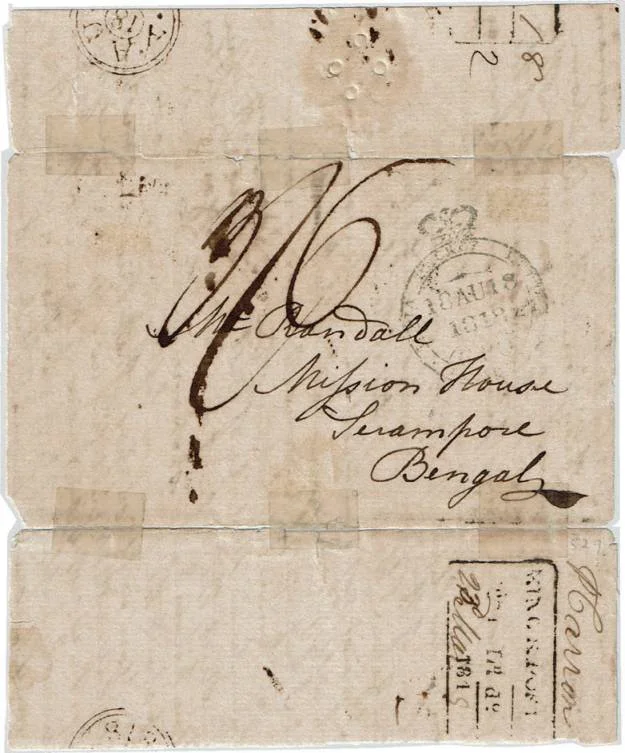
| 10 August 1818 | Salisbury–Serampore, Randall | Ship and charges as identified by the exhibit |
| 19 May 1822 / 1823 | Tranquebar–Pondicherry, POST NOT PAID | Mount heading and manuscript disagree |
| 14 August 1837 | Serampore–Calcutta, publishing inquiry | Part of the front and the back; no weight conversion |
Condition changes what a letter can prove
A missing panel can take a transit mark with it; opened folds can separate an address from its contents; a mended tear can hide a charge. The exhibit describes the Randall letter as completely split. That does not lessen its importance, but it belongs in the description.[4][7]
The archive’s conservation report is a further reminder that ink damage and old storage affect what can be read. A good image is useful, but it cannot always show how a letter was put together, the paper or an old repair. Keep claims about construction and condition apart from what a picture shows.[4][7]
A first reference
This section brings together the administrative framework, selected clauses and charges from the law of 1803 and specific Danish-settlement letters, shown in photographs of the letters themselves rather than redrawn. The evidence does not yet support a full census of surviving letters or a complete sequence of local handstamps.[6][4][8]
The open research is concrete: match more letters with dated records, find clearer pictures of the disputed unpaid Tranquebar letter, identify the packet sailings that actually took place and confirm each letter’s tariff. Those tasks can extend the reference without filling uncertain dates, routes or charges with guesses.[6][4][8]
| Field | Record | Keep apart from |
|---|---|---|
| Object | Entire, front, fragment, copy or reproduction | The number of physical letters that survive |
| Chronology | Dates of writing, dispatch, transit and arrival | A planned sailing schedule |
| Place | The written dateline and the identified town | A country label alone |
| Carriage | An explicit endorsement or matching record | A merely plausible route |
| Accounts | Each amount, its currency and purpose | A later or different administration’s tariff |
| Reference | Archive or publication and exact location | An identification repeated without its evidence |
Treaty, possession and proclamation
The official reprint of 1862 dates the treaty to Calcutta, 22 February 1845. Article I sets the price at 12,50,000 Company’s rupees (not 1,25,000). Article II covers Tranquebar and its dependencies, Frederiksnagore (Serampore) and named districts, and the former factory ground at Balasore; the Nicobar Islands are not included.[9][10][11]
The English text names Peter Hanson, Henry Hardinge, Frederick Millett and George Pollock. Keep the spelling Hanson when quoting, without implying that the usual Hansen is a different man. Danish ratification is dated 30 May, and the printed certificate of exchange records 6 October 1845, naming T. H. Maddock, F. Millett, C. H. Cameron and L. Lindhard; a later date of 3 October given elsewhere does not displace it without further evidence.[9][10][11]
The Calcutta Gazette proclamation of 29 November records Serampore’s transfer on 10 October; that of 13 December records Tranquebar’s transfer on 7 November and its annexation to Fort St. George. Both are signed in print by the government secretary, G. A. Bushby. Signing, ratification, exchange, possession, proclamation and publication are separate dates, and none of these documents sets a new tariff or the day an office changed its handstamp.[9][10][11]
Articles III and VI protect named churches, Serampore College, the Native Hospital and parts of the mission’s work and charter privileges. They help explain why letters continued after the transfer, but they grant no missionary postal exemption, and the pensions of Article VII are not postal concessions.[9][10][11]
Sources
- [1] National Museum of Denmark, “Danmarks glemte by i Indien”, 7 June 2018.
- [2] Rigsarkivet, Danish National Archives, “Trankebar og Serampore”, official collection introduction.
- [3] PostNord, “PostNord’s history—Stamps”, section “Flat-rate postage introduced 1851”.
- [4] Postal History of the Danish Settlements in India and Africa, publicly hosted sixteen-page exhibit, India leaves, pp. 1–9; exhibitor and date not given.
- [5] Rigsarkivet, Arkivalieronline, “Trankebar”, series inventory: Frederiksnagore incoming and outgoing copybooks (1772–1777, 1776–1777), Tranquebar governor and factory correspondence, European letter copybooks and mission records.
- [6] Christian VII, Reglement for offentlige og private Breves sikkre Befordring … imellem Kjøbenhavn og de danske Etablissementer i Ostindien …, Copenhagen, 23 February 1803, 27 clauses, pp. 3–12 and title. Facsimile hosted by Dansk Posthistorisk Selskab.
- [7] Francke Foundations, “Restoration of manuscripts”: Tranquebar Archive, correspondence and other documents, 1706–1830.
- [8] Henry W. Heath, “Danish Settlements—Tranquebar”, collection mount numbered 12, undated.
- [9] A Collection of Treaties, Engagements, and Sunnuds, vol. I, Calcutta, 1862, Bengal no. XIII, pp. 70–75.
- [10] Calcutta Gazette, 3 December 1845, p. 1312: proclamation and Order in Council of 29 November.
- [11] Calcutta Gazette no. 101, 17 December 1845, p. 1368: proclamation of 13 December.
Notes 0
Add what you know: a cover or stamp in your collection, a date or source, a correction or a question.
No notes yet.
Sign in to add a note.
Notes show straight away. Keep them kind and about the article; anyone can report one that isn't. House rules
