
Danish India Before the Packets: Company and Private Letters
A Tranquebar letter of 1792 and the surviving letter-copybooks show why a trading link is not yet a proven postal route.
Updated November 9, 2026
In this article
Start with the 1792 letter
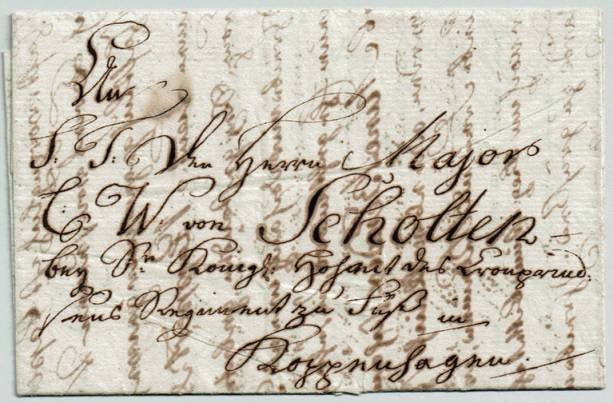
The address panel shown here belongs to a letter datelined Tranquebar, 20 October 1792, addressed to C. W. von Scholten in Copenhagen. The exhibit that shows it names the writer as Jost Heinrich von Scholten. The handwriting, address and folds are what can be seen; the writer’s name is the exhibitor’s identification.[1]
No dispatch or arrival handstamp is visible. That does not make the letter dull for a postal historian; it makes the contents, address, endorsements, folds and provenance more important. Name a ship or a route only when another part of the letter, or a matching record, supports it.[1]
Company business kept its own records
The Danish National Archives list incoming and outgoing letter-copybooks from Frederiksnagore, as well as factory, governor and Copenhagen correspondence. These records let you study communication even when the sent letter is lost. A copybook may keep a date, a recipient and a text that can be compared with a loose letter or a docket.[2]
They are different objects, though. A letter copied into a bound volume is not another surviving postal item, and the date of the entry is not necessarily a sailing date. Note the archive reference and the kind of record before using it to fill out a chronology.[2]
A possible carrier is not a proven carrier
The exhibit suggests that some early letters went by company or government ships. That is reasonable for a Danish trading settlement, but a blank address panel cannot choose one ship among several. A letter could also pass to another European or Indian service after a private stage.[1][3]
The regulation of 1803 shows the distinctions officials themselves made: it speaks both of packet ships and of other Danish vessels, and it controlled who could take in letters and how mail was handed over. A later rule cannot prove the route of a letter of 1792, but it shows why “carried by a ship” and “accepted through the authorised letter office” are two different statements.[1][3]
A dateline is a start, not an arrival
The written year and place tell you when and where the writer composed the letter. A continuation inside can show that the letter was kept open; a recipient’s docket can give a later date of receipt. Either is more useful than guessing a voyage from the usual sailing season.[1][2]
If the contents survive, copy out the whole dateline and any additions. If only the address panel survives, say so. A missing sailing endorsement should stay missing, not become an excuse to draw a complete route on a map.[1][2]
The 1800 Cochin letter: a different kind of evidence
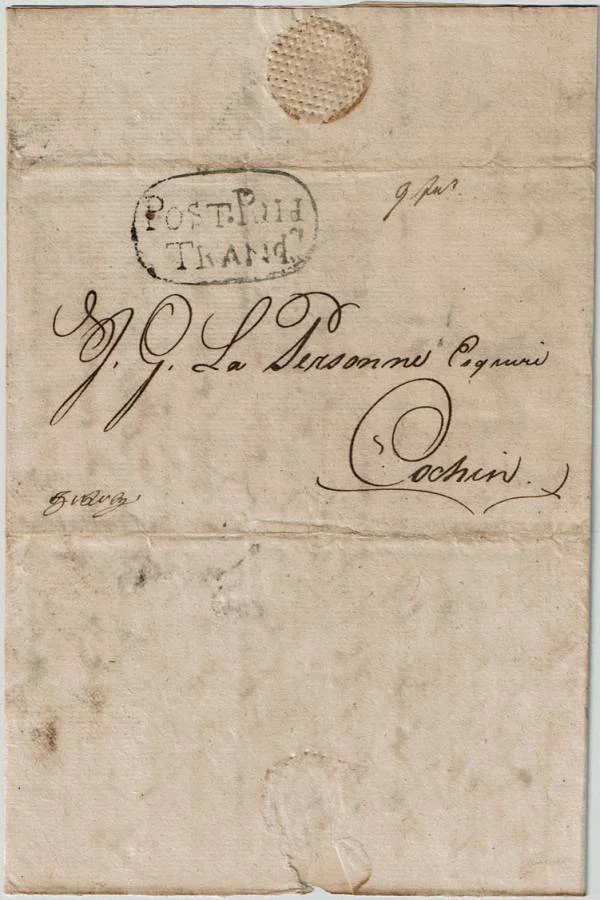
A letter dated Tranquebar, 10 October 1800, and addressed to Cochin carries a POST PAID marking. It gives a clue to payment that the 1792 Copenhagen panel lacks. The exhibit suggests a route through Madras and round southern India, but calls the route an assumption rather than showing each stage.[1]
The comparison matters. One unmarked letter does not show that all Tranquebar mail was unmarked, and a mark on another does not reveal the whole organisation behind it. Both belong in a study of trade and private letters, each with its own strengths.[1]
An inventory that keeps things apart
For these early letters, record the writer and recipient separately, then the written date, any postal markings, any explicit mention of a ship and any match in the archives. Add the language and whether the contents are complete. With those fields you can compare a sent letter with a copy kept at the time.[2][1]
A good collection can hold original letters, photographs of identified letters and archive references, without treating them as the same kind of survival. It grows in value when another reader can follow your identification, not when an attractive but unproven route is repeated.[2][1]
Sources
- [1] Postal History of the Danish Settlements in India and Africa, publicly hosted sixteen-page exhibit, India leaves, pp. 1–9; exhibitor and date not given.
- [2] Rigsarkivet, Arkivalieronline, “Trankebar”, series inventory: Frederiksnagore incoming and outgoing copybooks (1772–1777, 1776–1777), Tranquebar governor and factory correspondence, European letter copybooks and mission records.
- [3] Christian VII, Reglement for offentlige og private Breves sikkre Befordring … imellem Kjøbenhavn og de danske Etablissementer i Ostindien …, Copenhagen, 23 February 1803, 27 clauses, pp. 3–12 and title. Facsimile hosted by Dansk Posthistorisk Selskab.
Notes 0
Add what you know: a cover or stamp in your collection, a date or source, a correction or a question.
No notes yet.
Sign in to add a note.
Notes show straight away. Keep them kind and about the article; anyone can report one that isn't. House rules
