
Dutch India: the Letter as a Record of the Voyage
Cochin, the Coromandel factories, Bengal and Surat survive in letters that record ships, copies, arrivals and official decisions.
Updated June 17, 2026
In this article
Dutch India belongs to the history of communication before stamps. The Dutch East India Company (VOC) and its successors linked scattered Indian establishments with Batavia and the Netherlands, and those links can be seen in the letters themselves. The subject is separate from the Dutch East Indies in the Indonesian archipelago and from the later stamps of the Netherlands.
Scattered establishments, not one territory
The Dutch establishments in India were a network of trading places on the coasts and inland. The archives group them as Bengal, Coromandel and Madura, and Surat; Cochin was a separate centre on the Malabar coast. Give a document to its own establishment, not to a vague “Dutch colony” covering all of India.[4][5]
The Nationaal Archief’s history dates the transfer of the remaining establishments to the British to 1825, while its inventory uses 1824 for the agreement and the grouping. Do not flatten those into one invented day for every place. Cochin’s records had already stayed with the British administration after 1795.[4][5]
A port tied to local and ocean networks
R. Vaidyanadhan’s study of 1997 describes letters reaching Dutch Cochin from Batavia, Colombo, Malacca, Amsterdam and the Cape of Good Hope, and contacts within the Indian Ocean with Goa, Surat and Bengal. These are the links in the letters he examined, not proof of a fixed public packet between each pair of towns.[2]
The Malabar letters connect Cochin with Quilon, Calicut, Cranganore, Kayamkulam, Chettva and other places. These nearby exchanges belong beside the long sea voyages; a collection arranged only by European destination would leave out the everyday administrative and trading work that kept the network going.[2]
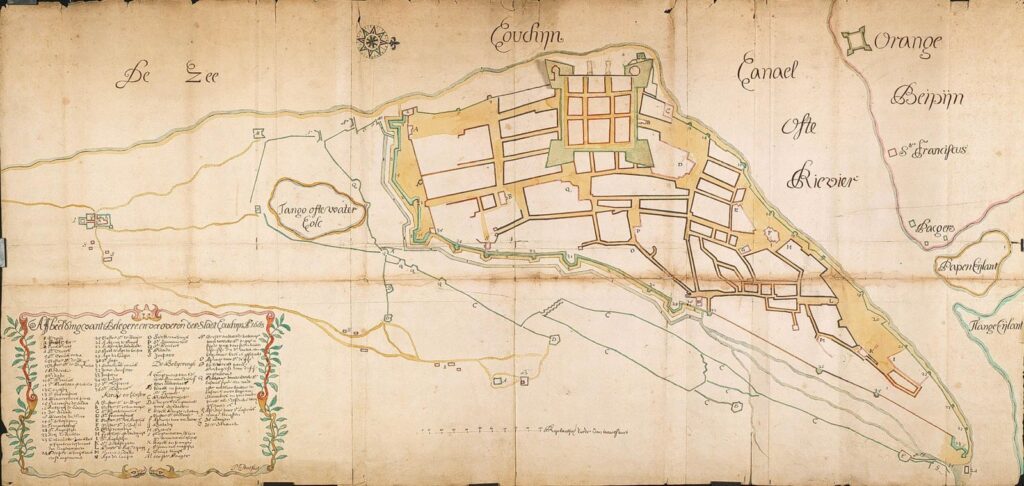
The study’s frame of 1663–1795 for Dutch power at Cochin also keeps it apart from the later Anchal post of Cochin State and its stamps. The same place-name can turn up in separate postal administrations centuries apart; the Indian States section deals with the Anchal on its own terms.[2]
Read the address panel as evidence
The early letters Vaidyanadhan studied often name the writer on the address panel, by signature, office or town. Official letters may carry the signatures of the governor and council. Salutations and titles can help identify the recipient’s role, but check the handwriting and titles on the document itself rather than borrowing them from a list of office-holders.[1]
Arrival notes, carriage endorsements and notes of action taken add a second chronology to the writer’s dateline. A date on the back may record receipt or filing, not dispatch. Keep each note in its original place and give your reason for calling it postal or administrative.[1]
The article’s view that Dutch correspondence was especially elaborate is its author’s comparison, not a claim that Dutch officials invented letter writing in India. What can be shown is a particular body of letters and the unusually useful evidence it keeps.[1]
Why an original and a duplicate can both be genuine
“Original” and “Duplicate” are endorsements of the time. Vaidyanadhan reports letters sent in separate copies on different ships, so that the news would not be lost with one vessel. Two versions of a message can therefore show a deliberate practice; one need not be a modern reproduction.[1]
Compare the paper, signatures, dates, address, ship endorsement and archive context of each copy. The same wording does not mean the same journey: a duplicate sent later or by another ship may have different arrival notes. The interest lies in that separate physical and administrative history.[1]
A ship’s name beats a plausible route
The study lists ship names found on letters from Cochin, among them Amsterdam, Hoorn, Doggersbank, Bombay and Ganges. They are endorsements seen in one group of letters. A ship that appears in a port’s history did not necessarily carry a particular letter unless the letter or another record of the time links them.[2][3]
“Overland” endorsements show that the sea was not the only way. Local couriers and exchanges between ports belong beside company shipping. But an unmarked letter between two towns on the same coast should not be given an overland route just for that reason.[2][3]
The study reports short local journeys of about a day, and much longer ocean passages: about three months from Batavia or Malacca to Cochin, and about six months from Amsterdam, in its sample. These are observations, not schedules. The dates of writing, departure, arrival and filing may all differ, and each letter has to be judged on its own evidence.[2][3]
The archive is part of a letter’s history
After the cession of 1825, some records from Coromandel, Surat and Bengal went through Batavia and were later sent to the Netherlands in 1863. Much of what stayed in India passed into British custody, and the surviving groups are now scattered. Where a document is kept today need not be where it began or where it was going.[5][6]
The Nationaal Archief’s index of incoming letters covers letters, journals, resolutions and other papers from the VOC’s establishments in Asia and Africa. Keep those categories apart: an archive copy or an enclosed report is not automatically a letter carried on its own. An inventory reference is good provenance; the scan of the original shows the address, folding and endorsements.[5][6]
For each letter, keep its archive and inventory number, physical form, language, writer, addressee, dates and any carriage instruction of the time. A machine transcript is a finding aid; check it against the scan before accepting a doubtful place or ship name.[5][6]
A postal history without an invented stamp list
The Netherlands issued its first stamps on 1 January 1852, as the Royal Philatelic Society London’s display of the original issues documents. The last Dutch establishments in India had left Dutch hands decades earlier. This section is therefore a guide to correspondence, not a Dutch India stamp series.[7][5]
A later Netherlands stamp, a Netherlands Indies stamp and an Indian stamp used in a former Dutch trading town are three different collecting categories. They can throw light on later links, but they do not become stamps of the old establishments. For the earlier period the letter, the docket and the recorded voyage are what we collect.[7][5]
In this section
Eight articles follow: the places and a collecting guide; Cochin and Malabar; reading addresses, signatures and dockets; originals and duplicates; ships, routes and shared carriage; Indian rulers and languages; finding letters in the archives; and the treaty of 1824, the transfers of 1825 and the boundary with the stamp era.
Sources
- [1] R. Vaidyanadhan, “The Dutch—Pioneers of Letter Writing in India”, IND DAK, December 1997, p. 159.
- [2] R. Vaidyanadhan, same article, IND DAK, December 1997, p. 160.
- [3] R. Vaidyanadhan, same article, IND DAK, December 1997, p. 161.
- [4] Nationaal Archief, inventory 1.04.19, Nederlandse Bezittingen in Voor-Indië, 1703–1826.
- [5] Nationaal Archief, introduction to the VOC archives, section 3, “Archives in India”.
- [6] Nationaal Archief, “VOC: overgekomen brieven en papieren, 1609–1795”, research guide to incoming correspondence.
- [7] Gerard van Welie, “1852: The First Postage Stamps of the Netherlands”, Royal Philatelic Society London display handout, 9 April 2015, frames 13–15.
- [8] M. E. Proot, the siege and capture of Cochin in 1663 under Ryckloff van Goens. Atlas of Mutual Heritage and Nationaal Archief, via Wikimedia Commons.
Notes 0
Add what you know: a cover or stamp in your collection, a date or source, a correction or a question.
No notes yet.
Sign in to add a note.
Notes show straight away. Keep them kind and about the article; anyone can report one that isn't. House rules
