
Dutch India: Indian Rulers, Languages and the Correspondence
Olas, translated letters and diplomatic forms show a network that reached far beyond the European offices.
Updated July 20, 2026
In this article
An archive in more than one language
Dutch Indian correspondence includes letters to and from Indian rulers, officials and trading intermediaries. The old Madras list keeps separate descriptions for olas, translations and letters with regional courts. These are not side additions to a European archive; they record the relationships through which news, negotiation and authority moved.[1]
A text in Dutch may therefore be a translation, not a Dutch original. What survives matters: an original letter in an Indian language, a translation made at an office and an extract copied into a European register are three different documents, even when they carry the same message.[1]
Olas in the Cochin records
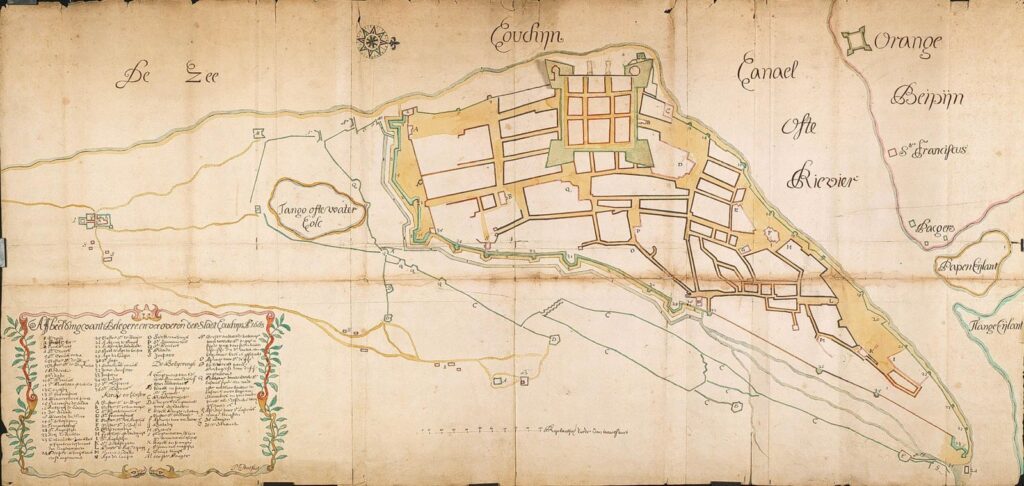
Printed page 11 of the list of 1916 gives concrete examples. Entry 533 records olas to the kings and chiefs of Malabar for 1752, and entry 534 incoming olas for 18 February to 21 December 1752. Entry 553 lists olas to and from the kings of Malabar for 1753. Nearby entries concern correspondence with Travancore, Batavia and other establishments.[1]
These headings point to series worth examining; they do not translate the letters or name every messenger. A label such as ola should be checked against what actually survives: a translated paper copy may belong to a palm-leaf tradition without being a palm-leaf original.[1]
The same page also lists records of the sale and transfer of enslaved people, at entries 554 and 567. Trade and administrative correspondence belongs within that coercive colonial setting, and it should be acknowledged; the circumstances of any one letter still need direct evidence.[1]
| Entry | Description | Year or dates |
|---|---|---|
| 533 | Olas to kings and chiefs of Malabar | 1752 |
| 534 | Olas from kings and chiefs of Malabar | 18 February–21 December 1752 |
| 549 | Letters to and from Travancore | 1753 |
| 553 | Olas to and from kings of Malabar | 1753 |
Two Marathi letters kept in Indonesia
Nikhil Bellarykar’s study of 2019 describes two Marathi letters in Modi script kept in Indonesia. One was sent by Peshwa Madhavrao Narayan, the other by ministers of the Thanjavur ruler Amarsingh, to Dutch authorities connected with Nagapattinam and Pulicat. The study examines their envelopes, translations and documentary conventions.[2]
These letters show why the place a document is kept today is not its historical address: being in Indonesia does not make them Indonesian letters. The identification here follows the published study.[2]
Names and titles need translating in context
A title in a salutation can express diplomacy as well as rank. Translating every high-ranking recipient simply as “governor” can erase a distinction that mattered to the writers; equally, a long honorific does not show how far the recipient’s authority actually reached.[1][3]
Keep the original term where its meaning is uncertain, explain the translation you propose and name your source. The same goes for personal names: a modern spelling helps readers find a ruler, but it should not replace the historical form in a transcription or hide a doubtful identification.[1][3]
Language does not tell you the carrier
Whether a letter is in Marathi, in Dutch or a translated copy, its language does not identify who carried it. That evidence may be on the outside, in a receipt note, in a list of enclosures or in an account kept alongside. A local message could join an overseas packet later, while a translation might never leave the office that made it.[3][1]
In the same way, a ruler’s or an official’s signature does not fix the postage. A treaty, a diplomatic letter or an order may have travelled under different arrangements from ordinary private letters. The context should guide the enquiry without supplying a messenger or a rate that the evidence does not show.[3][1]
A record that keeps both sides
Describe the language and script, the material, the outside address, the sender and recipient, and how the date was converted. Say whether a translation is of the time or modern. Where the original is missing, say that what survives is a translation or copy, and give its archive reference.[1][2]
Done this way, an Indian ruler’s letter stays at the centre of the study instead of becoming a footnote under a European office. Later readers can compare the message, its form and the evidence of how it travelled. Full translations and a complete census of these exchanges in many languages are still to be done.[1][2]
A ruler’s letter, an envoy and the sabandar
On the same page as the emergency Colombo dispatch (p. 170), Moens describes the Maldive Sultan’s letters recommending arriving ships. The bearer, styled an ambassador, was escorted to the audience by an official with an umbrella and a corporal with six men; Moens says the honour was paid to the letter, and the escort withdrew once it had been presented. This is practice described in a memorandum written later and printed in translation, not a regular yearly series or a registered-mail service.[4]
When the envoy left, a courteous reply was handed to him through the sabandar, whom the edition explains as a native customs officer. Keep that title rather than calling him a “postmaster”; the passage names neither the officer nor the Sultan. Moens presents the relationship as mutual help for shipping, an administrative argument, not proof of equal standing or a duty to carry mail. The envoy’s arrival, the reply and the emergency Colombo letter were three separate operations.[4]
The people who made the letters understood
On page 248 Moens connects the Political Secretariat’s work with interpreting letters from Indian rulers and drafting replies, stressing language, customs and ceremony. He names Gerrit van Waardenburg and Jacob Goliath as apprentices to the second interpreter, learning to read and write what the source calls the Malabar language. That does not tell us their exact skill, the script, or which letters they wrote.[5]
Batavia’s decision (Dutch pp. 258–259; English p. 263) orders Van Angelbeek to keep the two European youths trained at Moens’s direction, to use them as interpreters and to propose their pay. The council does not repeat their names; that they are the same pair is a strong inference from the same document. No salary, later appointment or handwriting is known.[5]
Moens’s preference for European trainees and his sweeping criticism of local interpreters are colonial judgments, not conclusions taken up here. The local interpreters of the time, and the second interpreter who trained the youths, should stay in view. A general remark about boys arriving by ship no older than ten does not give either trainee’s age.[5]
Sources
- [1] Madras Record Office, List of Volumes of Dutch and Danish Records Preserved in the Madras Record Office (Madras, 1916), Dutch Records pp. 1–30.
- [2] Nikhil Bellarykar, “Two Marathi Letters from the Arsip Nasional Republik Indonesia”, Itinerario 43 (1), April 2019, pp. 14–31, DOI 10.1017/S0165115319000032.
- [3] R. Vaidyanadhan, “The Dutch—Pioneers of Letter Writing in India”, IND DAK, December 1997, pp. 159–161.
- [4] Adriaan Moens, memorandum of 18 April 1781, in The Dutch in Malabar, Dutch Records No. 13 (Madras, 1911), p. 170.
- [5] Galletti, van der Burg and Groot, The Dutch in Malabar (Madras, 1911), Appendix X pp. 254–264 and memoir pp. 134, 248.
Notes 0
Add what you know: a cover or stamp in your collection, a date or source, a correction or a question.
No notes yet.
Sign in to add a note.
Notes show straight away. Keep them kind and about the article; anyone can report one that isn't. House rules
