
Dutch India: Ships, Routes and Shared Carriage
A Surat letter of 1630 went east to Java before it went west to London: the nationality of a ship is not the nationality of the letter.
Updated May 25, 2026
In this article
A letter leaves Surat
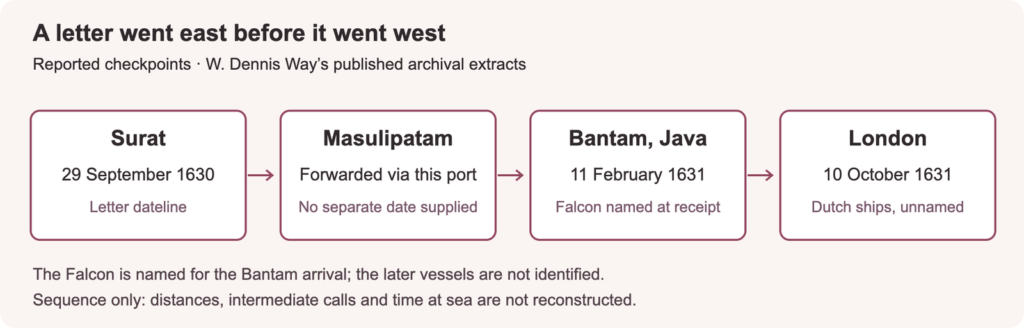
A letter dated 29 September 1630 at Surat did not go straight to England. W. Dennis Way reproduces a calendar entry describing its movement by Masulipatam to Bantam in Java, where it was received on 11 February 1631 by the Falcon; it reached London on 10 October 1631 by Dutch ships. The account keeps a sequence of reported checkpoints, not the letter itself.[1]
This is English Company correspondence using Dutch carriage. It belongs in a study of shared networks without being relabelled as a letter of a Dutch Indian government. Sender, intended recipient, carrier and territorial administration are separate facts, and one document can connect several of them.[1]
Follow the recorded checkpoints
The striking thing is that the letter first went east. Java offered onward shipping, so a letter bound for London could begin by travelling away from Europe. The recorded sequence is worth more than an attractive modern route drawn along the shortest line from Surat to London.[1]
Masulipatam is a forwarding point in the entry, with no date of its own. The London stage is credited to Dutch ships without a name. Those gaps stay gaps in the table below, and the Falcon must not be carried forward as the ship for every later stage.[1]
| Place or stage | Reported date | Limit of the evidence |
|---|---|---|
| Surat | 29 September 1630 | Dateline of the reported letter |
| Via Masulipatam | Not given | Forwarding point, not a dated arrival |
| Bantam, Java | 11 February 1631 | Receipt credited to the Falcon |
| London | 10 October 1631 | Arrival by Dutch ships; names not given |
One example does not prove a faster national service
Way contrasts this journey with a letter dated 23 January 1632 at Surat that reached London on 9 April 1633 by the Blessing, and uses the pair to discuss Dutch and English speeds. Read the comparison with care: the two intervals do not start at the same kind of checkpoint, and waiting and forwarding time are not recorded separately.[1]
A collector can use the examples to ask better questions without turning them into a timetable. Compare origin, departure, receipt by an agent and final receipt one by one. Two covers with similar total times may have spent very different times at sea or waiting for a connection.[1]
Ship names in the Cochin letters
Vaidyanadhan records ship names found on Cochin letters of 1726–1789, among them Amsterdam, Hoorn, Doggersbank, Bombay and Ganges. They come from endorsements in one group of letters; they are not a full list of the fleet and do not prove that a ship carried every letter between two ports.[2]
Several ships could share a name, and names were spelt in different ways. Keep the inscription, date and context before matching it with a shipping register. A ship appearing in a port’s trading history is weaker evidence than an endorsement on the letter itself or a record of the time naming its packet.[2]
The sea was not the whole network
The same study reports “overland” endorsements and short exchanges along the Malabar coast. A coastal origin and destination do not show whether a letter went by sea or by land, and a destination in another continent does not mean every stage was on a ship.[2]
That is why the wording of an endorsement matters. A carriage instruction, a statement of receipt and a historian’s later reconstruction do different jobs; give each its own standing in the description. Where a sheet has no route endorsement, comparisons can suggest a line of enquiry but should not become facts about that letter.[2]
A voyage account that stands up
A good account of a voyage starts with the document and works outwards. Record its dates and inscriptions, identify the ship or agent if you can, then compare departures and arrivals of the time. An onward forwarding date may explain an interval that would otherwise look like an unusually slow voyage.[1][2]
The Surat example shows that letters could cross between national trading networks. It does not show a public Dutch packet tariff, every ship’s identity or a standard journey time. Keeping those distinctions lets the story stay interesting while its strongest statements stay tied to evidence.[1][2]
A route via England, hoped for
The Nationaal Archief’s inventory of the Moens family papers lists a letter about the conflict with Haider Ali (archive 1.10.100, inventory 13, scan 0003). The closing leaf, reproduced on Wikimedia Commons, is dated Cochim, 15 December 1776, and its postscript reads: “P.S. Als er gelegenheid is, zal ik over Engeland nog tragten te Schrijven” — “If there is an opportunity, I shall try to write again via England.” The old spelling and the reading would benefit from a second expert look.[3][4]
The words are conditional and look ahead. They do not show that this family letter itself went through England, or its ship, postage, arrival date or a scheduled packet. The leaf shown is the end of the letter, not an envelope or an address panel.[3][4]
An emergency Company letter to Colombo
In his memorandum of 18 April 1781, Adriaan Moens recalled the crisis of October 1776: heavy surf blocked the river mouth before the favourable monsoon, and a Maldive trader lay in the backwater. At Moens’s request the trader took a Company letter to Colombo, put to sea and, the memoir says, delivered it in a few days. Moens linked this help with the reinforcements later received from Ceylon.[5]
This is a participant’s account, written years later and printed in an English translation of 1911 (p. 170); it is not the letter, a register entry or a receipt. The trader, his vessel, the exact days of dispatch and arrival, any payment and any stops are unknown, and “a few days” has no dated ends. No tariff, standing post office, free carriage or regular packet follows from it, and this Colombo letter is not the separate letter of 17 October to Hyder Ali.[5]
The book was printed at the Government Press, but its preface (p. x) expressly says it is not published “By Authority” and that the government takes no responsibility for its translation, history or opinions. The memorandum (1781), the events it recalls (1776), the preface (1910) and the imprint (1911) are four different dates. The passage in its original language and the Colombo receipt records are still wanted.[5]
Sources
- [1] W. Dennis Way, “The Hon. John Company Uses Dutch Ships”, Quaint Tales from the Postal Past, no. 49, p. 571, citing the Calendar of State Papers and The English Factories in India.
- [2] R. Vaidyanadhan, “The Dutch—Pioneers of Letter Writing in India”, IND DAK, December 1997, pp. 159–161.
- [3] Nationaal Archief, family Moens archive 1.10.100, inv. 13, scan NL-HaNA_1.10.100_13_0003.
- [4] Wikimedia Commons, Letter of Adriaan Moens (reproduction of the closing leaf).
- [5] Adriaan Moens, memorandum dated 18 April 1781, translated by P. Groot and A. Galletti, in The Dutch in Malabar, Dutch Records No. 13 (Madras: Government Press, 1911), p. 170, “The Maldive Sultan”.
Notes 0
Add what you know: a cover or stamp in your collection, a date or source, a correction or a question.
No notes yet.
Sign in to add a note.
Notes show straight away. Keep them kind and about the article; anyone can report one that isn't. House rules
