
Bamra Covers, Postmarks and Routes
Registered and local covers, the Raipur covers of 1893, the 27 mm Deogarh datestamps P1–P7, and how to recognise stamps cancelled to order.
Updated October 31, 2026
In this article
A readable cancellation is evidence to investigate, not a guarantee of commercial use.
Follow the whole envelope
Singhee illustrates a registered half-anna envelope of 4 August 1892, impression state IIb, sent by the head postmaster of Bamra from Deogarh to Dalhousie by way of Sambalpur. It carries the state impression and British Indian half-anna and two-anna stamps for the onward service. Record the stages that are known, and do not fill the gaps with a presumed modern route.[2]
The Ipswich envelope of 30 July 1891 helps date the broken-trunk state of the envelope impression. That is an observation from use, not an order fixing the day the printing part was damaged.[2]
Two locally addressed envelopes
Spink records an envelope dated 21 February 1891 with a framed quarter anna on rose-lilac paper, with a capital P in Postage, tied to the envelope by a circular datestamp. Stamps Inc. describes a separate half anna on blue-green paper on a locally addressed cover, expressly called philatelic, with a 2025 ISES certificate cited. Whether the certificate matches an earlier sale still needs checking.[10][11]
When comparing such covers, record the design and setting, the tie and any dispatch, transit and receiving marks separately. A local address gives a destination; it does not tell the service, the motive or the rate.[10][11]
Cancelled to order is a separate category
The stationery study warns of cards and envelopes cancelled to order, to which invented addresses or text were added later. Look at handwriting, postal markings, dates, registration and arrival marks together: a neat address does not prove the cover was carried, and a dealer’s address does not prove it was not.[2]
Seven types of datestamp
The common circular mark is about 27 mm across, with Deogarh in Odia above BAMRA and an English date below; two forms also have an Odia date. Benns classified seven varieties, P1–P7, while allowing that changes of lettering might make one handstamp look like more than one type. In his first group BAMRA sits above the centre of the circle; in the second it is nearer the middle. Lettering, date arrangement, dividing lines and damage to the ring matter more than general likeness.[M6]
P1–P3 have changeable dates and may have been postal devices, but they were also used extensively to cancel stamps to order. P4 has a fixed date, 1 March 1894, and the second group has fixed or garbled dates. A date in a cancellation is therefore not proof of a journey at that date, and even a genuine state handstamp could be used later or by favour.[M6]
Recognising a cancelled sheet
Complete sheets explain why so many loose Bamra stamps carry parts of neighbouring circular strikes. A 27 mm device struck once on each smaller stamp overlapped all four edges. That pattern is strong evidence of cancelling to order; its absence does not prove postal use, since strikes could also be applied less regularly.[M6]
Benns warned that addressed covers could be philatelic too. Address, contents, independent transit or arrival marks and a plausible charge of the time must be weighed together. His estimates of how much material was genuinely used have no defined census or sampling behind them and are not measured percentages.[M6]
Covers in the Park Collection
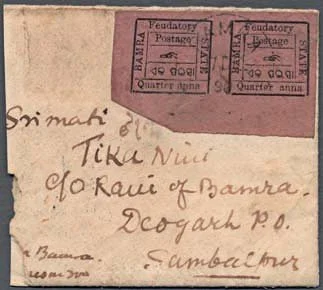
Gärtner describes covers of 1893 to Raipur. Lot 579, without stamps, went from the ruler to the Political Agent: Bamra and Sambalpur exchange marks come before a charge of one anna altered by hand to four annas, and a Raipur arrival mark. Lot 580 bears a Bamra quarter anna and a British Indian half anna; recognising the prepayment reportedly reduced one anna due to half an anna. Its dispatch date as transcribed, 31-9-1893, is impossible.[M9]
The quarter anna of lot 560 has an unidentified circular cancellation dated in Odia; a note by Benns assigns it to Setting IIId, cliché 15. Lot 561, the palace envelope with two quarter annas, is dated 7 December 1890 and reportedly encloses its original official letter. Local lot 562 has an inverted AMRA and a cancellation of 3 February 1893. A cover of 1893 from Ramsaihat is classified as philatelic. Lot 581, without stamps, has a large single-ring cancellation of 5 October 1897, and lot 582 is a royal crested envelope of 1910 with British Indian stamps and Calcutta and Deogarh marks.[M9]
The catalogue gives the Queen of Bamra at Sambalpur as the addressee of the palace envelope, but the face reads care of the Rani of Bamra, Deogarh P.O., Sambalpur, so the person it was meant for is uncertain.[M9]
These covers do not give a complete tariff, a general rule for charges or a census of offices and devices. Auction descriptions and photographs do not by themselves prove ordinary commercial carriage, and later covers do not show that state stamps stayed valid. Who used the later handstamp, and why, is not known.[M9]
The Imperial leg to Ipswich, 1891
On the Ipswich envelope, compare the half-anna plus two-anna Indian franking with Clarke’s rate of two annas six pies to the United Kingdom from 1 January 1891, and record the half-anna Bamra impression separately. Neither the weight nor the full native tariff can be worked out from it.[8][9]
Sources
- [2] A. R. Singhee, Bamra State Postal Stationery, pp. 83–90, illustrated extract with its own bibliography and catalogue.
- [8] Sandeep Jaiswal, India Postal Stationery, Royal Philatelic Society London display, 26 February 2026; Bamra envelope caption.
- [9] Geoffrey Clarke, The Post Office of India and Its Story, 1921, chapter XII, pp. 112–118 (p. 116).
- [10] Spink, sale 6016, lot 910: locally addressed envelope of 21 February 1891.
- [11] Stamps Inc., lot 22, locally addressed half-anna cover, 22 March 2025, with a 2025 ISES certificate cited.
- [M6] R. J. Benns, Bamra, Handbook of Indian Philately, India Study Circle, January 1982.
- [M9] Christoph Gärtner, Park Collection: Indian States, 7 March 2011, lots 559–582.
Notes 0
Add what you know: a cover or stamp in your collection, a date or source, a correction or a question.
No notes yet.
Sign in to add a note.
Notes show straight away. Keep them kind and about the article; anyone can report one that isn't. House rules
