
Bamra in 1895 and 1948: the End of the State Post and of the State
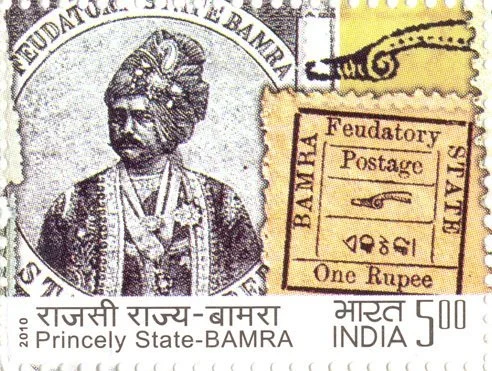
The Imperial post took over Bamra’s post on 1 January 1895, while the state survived until its merger with Orissa on 1 January 1948; the 2010 commemorative.
Updated June 1, 2026
In this article
Bamra survived as a state long after its own stamps ended.
The post and the state had different closing dates
Singhee gives 1 January 1895 for the Imperial takeover of the post, and the official history of Deogarh district also places the merger of the postal system in 1895. Dawson’s earlier account, quoting Evans, uses 1894 more broadly. We keep the last year of the state’s stamps separate from the date of the takeover that followed.[2][4][1]
The Government of India’s White Paper records the political merger with Orissa on 1 January 1948. That date cannot be used to stretch the period of the state’s stamps.[5]
Deogarh, the handover and the later map
The Gazetteer reports the headquarters office at Deogarh, branch offices it does not name, the merger in 1894 and integrated service from 1 January 1895; its range of one anna to one rupee gives no weights, dates or services.[6] Clarke places Bamra among the states that followed Kashmir’s unification of 1894, a policy promoted by the Director-General, Sir Arthur Fanshawe. The takeover order and its local terms have not been found.[9]
With covers franked at a quarter and half an anna in the state post, a dated native tariff would be especially valuable, but none is known. The names and pay of Bamra’s runners and office staff are also unknown. The offices named in Cobden-Ramsay’s account of 1910 belong to the later Imperial network.[M30]
Survey of India sheets of 1933 give a later map series to compare with the Gazetteer map: the repository lists several sheets under Bamra State in block 73 C. Boundaries and the route of a cover of 1891 still need their own evidence.[12]
News of the takeover travelled slowly
The Monthly Journal of 28 February 1895 still spoke of the takeover as a rumour, beside reports of fresh supplies and settings. That shows how uncertain the philatelic news was, not that the state post stayed open after 1 January. When supplies reached collectors, when later material was made and when stamps were valid for postage are separate questions.[M21][2]
The wider policy behind postal integration
Geoffrey Clarke’s history of the Indian Post Office (1921) puts Bamra in the wider move to unify the posts. After the absorption of Mysore’s service, Sir Arthur Fanshawe sought similar arrangements elsewhere: Kashmir followed in 1894, and Bamra, Nandgaon and Pudukkottai shortly after. Clarke gives no exact date for Bamra, no tariff and no signatory of its agreement, so 1 January 1895 rests on Singhee’s attribution until the original order is found.[9][2]
Remembering Bamra in 2010
India Post’s commemorative of 2010 recalls Bamra’s postal history. Its five-rupee value belongs to the Republic of India, and the historical one-rupee stamp pictured in its design is not a newly discovered Bamra issue.
What is still to be found
The original instrument setting up the Bamra post, the Imperial transfer order or agreement that fixed its date, the native tariff with its weights, registration charges and postage-due rules, a register of offices opening and closing, the names of postmasters, clerks, compositors and engravers, and the meaning of the press’s disappearance and return in the provincial reports. The British Library catalogue lists Bamra administration reports for 1938–1946, but they are too late for the native post. A search of the Central Provinces reports for 1894–96 found no Bamra transfer instrument or tariff, which does not prove that none exists.[M32][M34]
Sources
- [1] L. E. Dawson, “The Stamps of Bamra”, The Philatelic Journal of India, 1938, serial study, with the first-issue plate and the final erratum.
- [2] A. R. Singhee, Bamra State Postal Stationery, pp. 83–90, illustrated extract with its own bibliography and catalogue.
- [4] Government of Odisha, Deogarh district, History: Bamanda rulers, local press and the postal merger in 1895.
- [5] Government of India, White Paper on Indian States, 1950, Appendix XLIII, printed p.294: merger of Bamra with Orissa on 1 January 1948.
- [6] Deogarh District Gazetteer, pp. 18–20 and 170–171.
- [9] Geoffrey Clarke, The Post Office of India and Its Story, 1921, chapter XII, pp. 112–118 (p. 116).
- [12] Survey of India, 1933 Bamra State sheets 73 C/02, /05, /07, /09, /10, /11, /14 and /15, John Brown’s Block 73 inventory.
- [M21] Stanley Gibbons Monthly Journal, vol. 5, 28 February 1895, p. 114.
- [M30] L. E. B. Cobden-Ramsay, Bengal Gazetteers: Feudatory States of Orissa, Calcutta, 1910, Bamra chapter pp. 119–125, and pp. 122 and 341.
- [M32] Bamra Administration Reports, 1938–1946, British Library catalogue record.
- [M34] Report on the Administration of the Central Provinces, 1894–95 to 1895–96, bound volume.
Notes 0
Add what you know: a cover or stamp in your collection, a date or source, a correction or a question.
No notes yet.
Sign in to add a note.
Notes show straight away. Keep them kind and about the article; anyone can report one that isn't. House rules
