
Bamra: the Printer’s Type and the Postmaster’s Letter
Bamra in Odisha ran its own post from 1888 to 1895, with stamps set in type at the Deogarh press: the state, its Rajas, a chronology and the checklist of its stamps.
Updated August 27, 2026
In this article
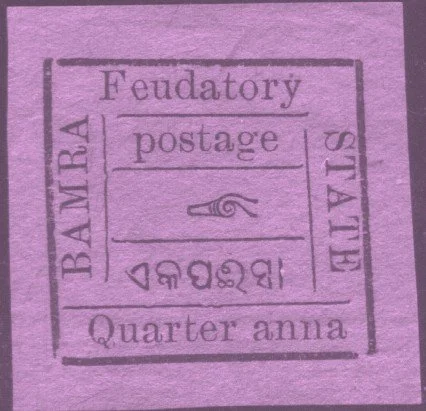
Bamra issued two adhesive designs, changed their settings again and again, printed postal cards with the Raja’s portrait and hid an envelope’s value on its sealing flap, all in a state post that lasted only from 1888 to 1895. Then came reprints, and a philatelic afterlife much larger than the post itself.
The state behind the stamp
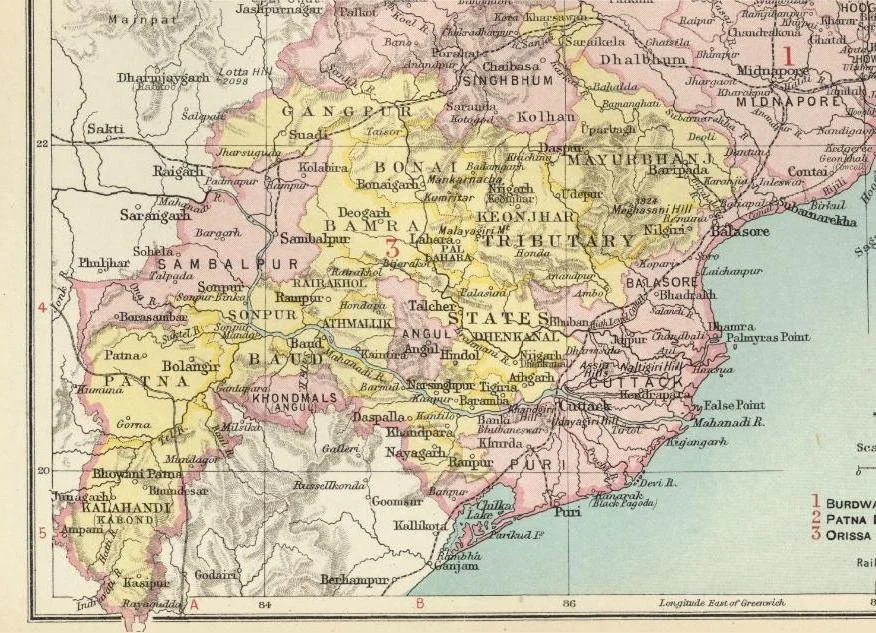
The former state lay around Deogarh (Debagarh) and Kuchinda in what is now Odisha. Its capital was Deogarh, and its ruling house was the Ganga dynasty, whose rulers took the title Raja. The 1901 Imperial Gazetteer map, published in 1909, shows Bamra among the Orissa Tributary States and their neighbours; it is a map of that time, not of a modern district.[3]
Bamra, also known as Bamanda, had a local printing establishment and a short period of its own stamps. Raja Basudeo Sudhal Deo’s administration developed both the post and the Jagannath Ballabh Press at Deogarh. The state post was merged into the Imperial system in 1895, long before the state itself merged with Orissa in 1948.[4]
The correspondence published in 1890 separates the ruler’s reported decision to change the form of the stamps from the work of whoever designed or set them, who is not named. The private secretary’s signature was printed as illegible, and the quantities in the letters are shipments to a dealer, not the total printed.[M18]
The rulers
Tradition names nine rulers before 1545, undated: Saraju Deb, Raj Narayan Deb, Jagannath Deb, Gangadhara Deb, Jag Jyesthi Tribhuban Deb, Rudranarayan Deb, Kanphoda Sudhal Deb, Raghunath Deb and Kasturi Deb. The Gazetteer’s succession from 1545 follows. A ruler’s reign and the dates a stamp was issued or valid are different kinds of evidence.[3]
| Ruler or administration | Dates |
|---|---|
| Ram Chandra Deb | 1545–1578 |
| Bikram Deb | 1578–1625 |
| Haru Deb | 1625–1641 |
| Chandra Sekhar | 1641–1673 |
| Bhagirath Deb | 1673–1713 |
| Pratap Deb | 1713–1745 |
| Sidasar Deb | 1745–1779 |
| Arjun Deb | 1779–1819 |
| Balunkabrusabha Deb | 1819–1834 |
| Khageshwar Deb | 1832 |
| Braja Sundar Deb | 1832–1869 |
| Regency | 1869–1871 |
| Basudeo Sudhal Deo | 1871–1903 |
| Sachchidananda Tribhuban Deo | 1903–1916 |
| Dibyashankar Sudhal Deb | 1916–1920 |
| Bhanu Ganga Tribhuban Deo | 1920–1948 |
| Regency (within Bhanu Ganga’s reign) | 1920–1935 |
The overlap of 1832–34 is unresolved, and some portrait captions do not agree with this sequence. Lethbridge dates Basudeo’s accession to 12 May 1869; the Census Handbook starts his rule in 1874. When he took full powers is uncertain.[3][7]
Basudeo ruled through the whole period of Bamra’s own adhesives, and Singhee identifies his portrait on the quarter-anna postal card. His successor Sachchidananda continued the state’s industrial development, but there was no new period of state stamps. Dibyashankar followed; the Census Handbook records his death in 1920 and his son’s succession. Bhanu Ganga was the last ruling Raja, and Bamra merged with Orissa on 1 January 1948, decades after its post had been integrated.[2][4][7][5]
A remittance sent back
In April 1890 the Bamra authorities answered a request from Stanley Gibbons in an unexpected way: they returned the money and sent samples free. Their letter explained the local stamps as practical products of the printing press. A later request was met with stock of the old design and hundreds of the new type. The correspondence, reproduced by Dawson from Evans, tells a more interesting story than the plain verdict that all Bamra stamps were either commercial or speculative.[1]
The stamps themselves keep another history. Letters moved in their printing formes; central ornaments changed direction; some original settings gave way to resets and reprints. A postal card could show the Raja while an envelope hid its value on the sealing flap. Together they describe a small administration whose short stamp period produced a surprisingly complex philatelic afterlife.
Chronology
| Date | Event |
|---|---|
| 1888–1890 | First design; the traditional year of issue and the first reports in the journals are different things |
| March 1890 | The Philatelic Record reports the four- and eight-anna first design; the frame round its illustration was the engraver’s addition |
| 21 April 1890 (printed 20 October 1890) | The private secretary returns a remittance and sends free samples; his signature is printed as illegible |
| July 1890 | The framed second design introduced, according to Dawson |
| 5 August 1890 (printed 20 October 1890) | A second reply credits the Rajah with the new form and says the earlier samples are no longer used |
| 20 September 1890 | A journal describes four 20-subject quarter-anna blocks side by side, and blocks one above the other for other values |
| 27 December 1890 | A second-type half-anna envelope used to Calcutta |
| 30 January 1891 | A journal reports eight type varieties among sixteen stamps, and envelopes with 23 or 24 ornaments |
| 30 April 1891 | Four-by-four framed settings with capital-P and lower-case-p subjects mixed |
| 30 May 1891 | A complete 96-subject eight-anna sheet and blind impressions discussed; new corner-stamped stationery reported |
| 1891–92 reporting year | The provincial report says the Bamra press no longer exists and the Sambalpur Patriot has ceased |
| 1892–93 reporting year | The provincial report says the local press has come into existence again |
| 1 January 1895 | Imperial takeover of the state post, as dated by Singhee |
| 28 February 1895 | The Monthly Journal still calls the takeover a rumour |
| 31 October 1902 | The Monthly Journal reports a violet-on-white four anna as a supposed essay |
| 1910 | The Gazetteer lists Imperial sub-offices at Bamra and Deogarh, branches at Kuchinda and Barkut, and mail between Deogarh and Bamra station |
| February 1941 | Stoney publishes his measured strips and his reconstruction of the parent sheet |
| 1 January 1948 | Political merger with Orissa |
The stamps
The issues and their values, from the research checklist. The first typeset issue had six values and the framed issue seven; the first-design resettings and reprints are listed separately. Typesetting errors, all ten settings of the framed issue and the paper shades are not listed. No separate series of Service overprints is established.[1][M6]
| Period | Issue | Values |
|---|---|---|
| 1888–1890 | First typeset issue | ¼ anna, ½ anna, 1 anna, 2 annas, 4 annas, 8 annas |
| 1890, attributed | First design, small resettings (reprint / reset) | ¼ anna, ½ anna |
| 1891, recorded | First design, twenty-subject reprints (reprint) | ¼ anna, ½ anna, 1 anna, 2 annas, 4 annas, 8 annas |
| July 1890–1894 | Framed Feudatory State design | ¼ anna, ½ anna, 1 anna, 2 annas, 4 annas, 8 annas, 1 rupee |
Sources
- [1] L. E. Dawson, “The Stamps of Bamra”, The Philatelic Journal of India, 1938, serial study, with the first-issue plate and the final erratum.
- [2] A. R. Singhee, Bamra State Postal Stationery, pp. 83–90, illustrated extract with its own bibliography and catalogue.
- [3] The Imperial Gazetteer of India, 2nd edition, vol.2, Bamra, digitised page 51: historical location and extent.
- [4] Government of Odisha, Deogarh district, History: Bamanda rulers, local press and the postal merger in 1895.
- [5] Government of India, White Paper on Indian States, 1950, Appendix XLIII, printed p.294: merger of Bamra with Orissa on 1 January 1948.
- [7] Census of India 2011, Debagarh District Census Handbook, Part XII-A, pp. 11–12: district history.
- [M6] R. J. Benns, Bamra, Handbook of Indian Philately, India Study Circle, January 1982.
- [M18] Stanley Gibbons Monthly Journal, vol. 1 (1890–91): 20 September 1890 p. 51; 20 October 1890 pp. 81–82 (Chas. J. Phillips, Notes and News); 30 January 1891 p. 150; 30 April 1891 pp. 233–234; 30 May 1891 pp. 255–256.
- Great Britain India Office, Imperial Gazetteer of India, Orissa Tributary States map (1901 map, published 1909), via Wikimedia Commons.
- Roper Lethbridge, The Golden Book of India, 1893, p. 50, Bamra.
- StampWorld, Bamra: the first six values and the capital-P and lower-case-p framed families.
Notes 0
Add what you know: a cover or stamp in your collection, a date or source, a correction or a question.
No notes yet.
Sign in to add a note.
Notes show straight away. Keep them kind and about the article; anyone can report one that isn't. House rules
