
Barwani’s First Stamps: the Ranjit Singh Portraits, 1917–1931
The disputed first issue of 1917 or 1921, the 1921 notices, booklets worth one rupee, four-subject panes, sheet watermarks, faulty perforators and the one anna and two annas of 1922.
Updated June 28, 2026
In this article
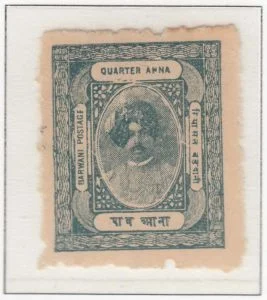
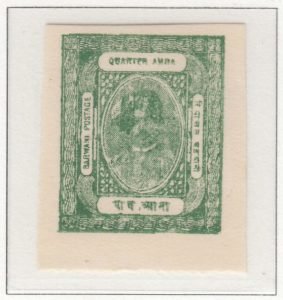
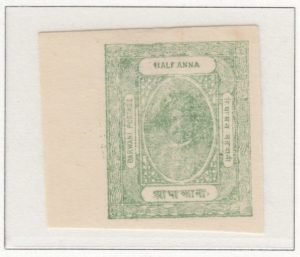
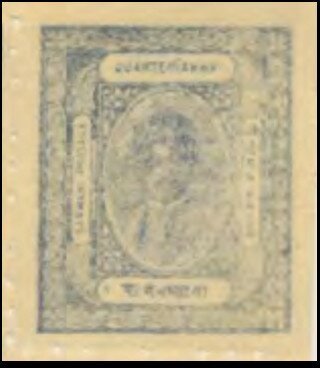
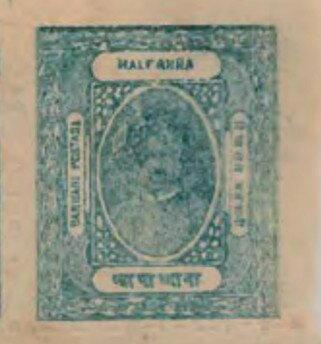
Barwani’s first stamps show Rana Ranjit Singh, who had come to the gadi as a minor in 1894. They were small typographed stamps, made up into tiny panes and booklets, and almost everything about them, from the first day to the order of printing, has been argued over.
Why the first issue date needs care
Harkawat’s opening instalment gives 1 April 1921 for the first stamps, the date also used in older collection descriptions. The introduction to David Feldman’s Indian States sale of 2017 reports research that moves the earliest issue back to May 1917. The disagreement stands: a catalogue label of 1921 is no proof that no adhesive existed earlier.[1][3]
A handmade postcard in Köhler’s sale 377, lot 10029, bears a quarter anna and a sender’s date of 15 May 1917. The catalogue reports a British Philatelic Association certificate and takes that first-day date from the Barwani State Gazette. The Barwani cancellation itself is undated. The sender’s date and the catalogue’s report of the Gazette are two different pieces of evidence, and the Gazette page has still to be found. A second card in the sale, lot 10030, carries a sender’s date of 31 August 1917.[13]
The first notice, hidden among the advertisements
The first printed notice is earlier than the June 1921 reference repeated in later accounts. In the May 1921 issue of the Philatelic Journal of India a short Barwani item appeared on advertisement page iv. It thanked Ram Gopal & Co., stamp dealers of Alwar, for showing the quarter anna and half anna portrait stamps. Jno. Godinho explained in July that the note had been put among the advertisements by mistake.[17][19][18]
This corrects the history of the notices, not the day the stamps went on sale; the reported issue of May 1917 still needs its own archival proof. The June notice names Ranjit Singh as the portrait and describes sheets of four stamps with irregular perforation.[17][19][18]
| Date | Notice |
|---|---|
| May 1921 | Philatelic Journal of India, advertisement p. iv: specimens shown by Ram Gopal & Co., Alwar |
| June 1921 | New Issues, p. 85: names the portrait and describes four-subject sheets |
| July 1921 | Godinho explains the May placing, describes two printings and booklets worth one rupee |
| September 1921 | A third printing reported, on thick surfaced paper; not an issue date |
| May 1922 | One anna and two annas values forecast; not an issue notice |
Printings, rulers and small panes
The early stamps were typographed, in small panes with uneven separation. The 2017 account describes four clichés and booklet panes of normally four stamps, with some of two or three. That is the stated format, not a claim that every printing used four loose clichés. Paper, perforation and frame lettering matter as much as the portrait, and a ragged edge is no sign of a different value or a forgery.[3]
The checklist keeps the Ranjit Singh types apart from the Devi Singh issue of 1932 and from the later printings of the Ranjit design. Whose portrait it is, when it was issued and who was ruling are separate questions: a design could stay in production after the man it shows had died.[4]
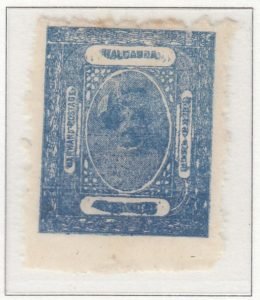
Read the whole sheet before naming a printing. R. F. Stoney’s study of 1943 records very different strengths of colour within one eight-stamp sheet, and ink soaking so far through thin paper that it could pass for printing on the back. Neither shade nor apparent back impression should become a separate issue or error on that alone.[22][9]
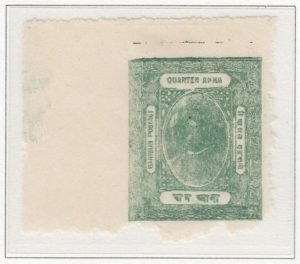
Stoney’s drawings of neighbouring groups printed upside down are a valuable record of the multiples he saw, but his explanations of how they arose have to be read with later work. A repeated four-subject arrangement does not by itself prove that one loose group was printed twice; A. MacGillycuddy’s later study of copied plates deals with that separate question.[22][9]
Booklets worth one rupee
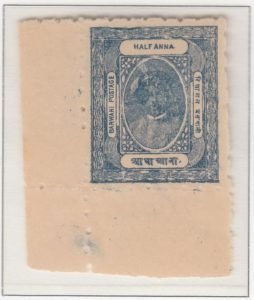
Godinho’s article of July 1921 gives a practical measure of the early booklets. Each small sheet held four stamps. A quarter anna booklet held sixteen sheets and a half anna booklet eight, so either gave one rupee of postage. These are the booklets he reported, not every later format.[19][20]
He contrasts clear impressions on thick white paper with blurred ones on thin wove paper, and in September reported another printing on surfaced paper. These notices record what reached the editor; their colour names and order are not a press ledger and should not be used to date every surviving single.[19][20]
Booklets, paper and the change to gum
The early printings were issued without gum. Gummed paper came in 1932 with the smaller Devi Singh design. A specialist collection’s chronology puts the return of the Ranjit Singh designs in July 1933, while the catalogue lists a later group as 1935–1948. Later printings used both close and wide settings. Gum, size and spacing help identify a stamp, but its date should be checked against the particular printing, not read from the portrait.[4][7]
Harkawat describes blocks of four combined into larger sheets, three side by side or two placed horizontally or vertically. A sheet of twelve fits that account, but does not prove that every printing used four clichés; later work also describes copied plates. Booklet making also explains why a stamp may be perforated on only two or three sides. Both pin perforation and sewing-machine perforation are reported, so look at the separation on the actual piece.[6]
Watermarks belonged to the paper sheet
Some early quarter anna papers carry a sheet watermark. MacGillycuddy records seated Britannia in a crowned oval, with GUARANTEED and BRITISH MAKE elsewhere on the sheet, on the rose quarter anna on laid bâtonné paper. On a blue quarter anna on vertically laid paper he records a shell above the word SHELL. These belong to particular paper stocks; there is no watermark common to all Barwani stamps.[9]
A small stamp may show only a fragment of a sheet watermark, or none at all, so paper structure, colour, thickness and the whole multiple have to be read together. The later settings also used different wove papers, from fine-grained stock to coarser paper with visible fibres. A photograph of the face cannot show all of this.[9]
A perforator that left a fault behind
The rose quarter anna shows how a perforation listing can hide a mechanical story. MacGillycuddy describes a line perforator whose alternate pins, along part of its length, only dented the paper, which is how gauges of 12 and 6 can appear together. He also records double perforations, and leaves unresolved an older report of pin perforation 7.[9][24]
Keep these observations with the printing they belong to: they do not identify a sewing machine, or prove that every missing hole has the same cause. Robert Bateman’s suggestion of hand-roller inking and a screw press was his deduction from uneven impressions, not a record of the equipment.[9][24]
Four clichés did not always mean one printing unit
Typography means printing from raised surfaces; it does not mean the portraits were set from loose type. MacGillycuddy works with four distinguishable clichés for each value and portrait family, but he also finds exceptions where new plates were copied from earlier subjects.[9][7]
For two of his quarter anna printings, constant spacing and repeated differences between the two halves of eight-stamp sheets led him to a second plate used beside the first. In his setting III he argued that the half anna, one anna and four annas Ranjit designs were printed from new plates copied from one chosen original cliché. These are physical arguments from the stamps. They name no craftsman or copying method, and his setting dates have to be checked against the later chronology drawn from the State archive.[9][7]
The one anna and two annas before 1932
The early Ranjit Singh stamps include more than the quarter and half anna. MacGillycuddy treats a one anna vermilion and a two annas purple or violet as part of the 1922 group, and distinguishes them from the later Devi Singh stamps. Harkawat independently reports the introduction of one anna and two annas values in 1922. Both belong in the early checklist, whatever the starting date of the first stamps turns out to be.[9][6]
Paper and reporting dates complicate the two annas. MacGillycuddy compares glazed paper with toned unglazed paper, noting that the second had been reported earlier, though recurring flaws suggested the two belonged to related printings. He also describes a run from purple to violet with no clean dividing line. This supports a study of papers and flaws, not an exact issue day or a separate printing for every shade.[9][6]
The Philatelic Journal of India said in May 1922 that a Mr. deSouza had reported forthcoming one anna and two annas values. It is a contemporary forecast to set beside the later studies, but it gives neither an issue day nor an order of printing.[21]
A four annas in a frame inscribed BARWANI STATE is catalogued as 1927.[4]
Sources
- [1] N. J. Harkawat, “Postal History of Barwani State”, IND DAK, April 1979, p. 74 (opening instalment).
- [3] David Feldman SA, Indian States, December 2017 auction catalogue, Barwani introduction.
- [4] StampWorld, Barwani postage-stamp catalogue, issue listings.
- [6] N. J. Harkawat, “Postal History of Barwani State”, IND DAK, April 1979, p.88, continuation from p.74.
- [7] David Feldman SA, “Indian Feudatory States – Barwani: award-winning collection”, lot 60070, June 2019.
- [9] A. MacGillycuddy, “The Stamps of Barwani”, The Collectors Club Philatelist, vol. 57 (1978), March pp. 83–89 and 118, May pp. 170–177, July pp. 240–247, September pp. 316–321.
- [13] Heinrich Köhler sale 377, Gems of Indian States, Barwani, pp. 22–27 and 50–54.
- [17] Philatelic Journal of India XXV(5), May 1921, advertisement p.iv.
- [18] Philatelic Journal of India XXV(6), June 1921, New Issues, p. 85.
- [19] Jno. Godinho, Barwani, Philatelic Journal of India XXV(7), July 1921, p. 97.
- [20] Jno. Godinho, Barwani, Philatelic Journal of India XXV(9), September 1921, p. 118.
- [21] Philatelic Journal of India XXVI(5), May 1922, Notes, p. 61.
- [22] R. F. Stoney, “The Stamps of Barwani”, Philatelic Journal of India, vol. XLVII, July–October 1943.
- [24] Robert Bateman, “Indian Native States: Notes on Printing and Production — Barwani: A State Without a Press”, India Post, September 1968, pp. 106–107.
- Indian Feudatory States Stamps, “Barwani”, online exhibition of the early Ranjit Singh quarter anna and half anna designs.
Notes 0
Add what you know: a cover or stamp in your collection, a date or source, a correction or a question.
No notes yet.
Sign in to add a note.
Notes show straight away. Keep them kind and about the article; anyone can report one that isn't. House rules
