
Barwani: the Runners’ Post, Its Offices and the Imperial Network
How Barwani’s State post began in 1860–61 with police sepoys and runners, its routes and staff, the parallel State and Imperial offices, the 1921–22 charges and the end of the State post in 1948.
Updated August 23, 2026
In this article
A portrait stamp is a late chapter in Barwani’s postal story. For sixty years before the first adhesive the State carried its letters by runner, and for the whole stamp period its offices worked beside a separate Imperial network.
A runners’ post for official letters
N. J. Harkawat dates the State post to 1861, when it carried official correspondence. Police sepoys carried the bags at first; runners later took over. Seven offices were linked to police stations. It was an administrative network long before it became a stamp-issuing service.[1] The Western States Gazetteer of 1908 dates the first regular daily State mail to 1860–61, again well before the first adhesive.[26]
A British Library file holds an administration report on Barwani for 1864–65, compiled by Lieutenant Thomas Cadell V.C., Political Assistant at Manpur, with its correspondence. It is a lead for the early years of the post, not yet a source of any postal fact.[27]
The routes and the people who worked them
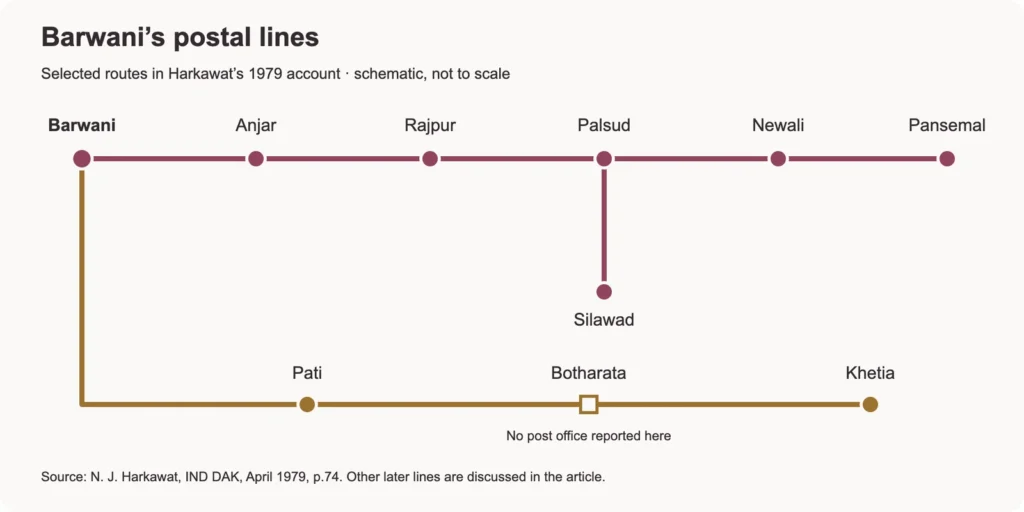
The main route ran from Barwani through Anjar, Rajpur, Palsud, Newali and Pansemal, with a branch to Silawad. A second line ran from Barwani through Pati and Botharata to Khetia; Botharata had no post office in Harkawat’s account. A staff return of 1905 lists sixteen runners, a clerk, a Dak Jamadar and a peon: the human labour behind the small stamps that came later.[1]
The Gazetteer records 66 miles of State mail routes in 1891 and 100 miles in 1901. A clerk in the kamasdar’s office of each pargana handled the despatches.[26]
The Gazetteer also mentions six Mankar runners and says the State Dak carried almost nothing but official letters. It does not explain how its six runners relate to Harkawat’s sixteen in 1905, so the two counts stand side by side. Its town entries name State post offices at Silawad, Palsud and Pansemal.[26]
Two networks: State offices and Imperial offices
Harkawat’s 1979 study names the State offices as Barwani, Anjar, Rajpur, Palsud, Newali, Pansemal, Khetia, Pati, Silawad, Talwada-bunjurg, Talwada-deb, Mandwada and Julwania, in the spellings of his sources. The list does not mean that all thirteen opened together or stayed open through the whole stamp period.[6]
The Imperial offices were a separate network. Harkawat lists Barwani, Anjar, Rajpura, Khetia and Julwania by 1939, and mentions Mandwada as well. Because the two services worked side by side, an office name alone cannot tell you which administration carried a letter; it also explains how Indian and State stamps came to circulate in the same territory.[6]
The Imperial Gazetteer of 1908 names four British India post offices in the State, at Barwani, Anjar, Rajpur and Khetia, and says State offices worked at other places. It lists the four pargana headquarters separately as Anjad, Pansemal, Silawad and Rajpur. Later covers confirm postmarks of Khetia, Pansemal, Rajpur and Barwani City. The Western States Gazetteer explains the Imperial connections: Khetia worked with Shahada in Khandesh, in the Bombay Presidency, while Barwani, Anjar and Rajpur came under the Rajputana and Central India Circle. Its “combined office” at Barwani means a post and telegraph office, not a merger of the Imperial and State posts.[26][23]
The State Council’s snapshot, 1930–1939
The State Council’s report for 1 October 1930 to 30 September 1939 gives a much fuller picture. It lists eleven Mulki, or State, post offices: Barwani, Anjar, Rajpur, Silawad, Pati, Palsood, Niwali, Pansemal, Khetia, Mandwada and Talwara Deb. Mandwada and Talwara Deb had opened during the nine years of the report. The department served mainly the State administration, and official letters and parcels travelled free. This is a dated list of offices and an official privilege, not a schedule of public postage rates.[26][23]
On the next page the report names Government post offices at thirteen places: Barwani, Anjar, Rajpur, Julwania, Palsood, Pansemal, Khetia, Niwali, Silawad, Pati, Talwara Deb, Talwara Buzurg and Mandwada. Telegraph offices worked at Barwani, Anjar and Khetia. Seven openings of Government offices are dated, as below. These are the dates of the Government offices; they do not date the State offices in the same towns, and they are no reason to doubt an earlier State postmark from one of them.[26][23]
| Office | Opened |
|---|---|
| Palsood | 5 December 1930 |
| Mandwada | 1 December 1938 |
| Silawad | 15 January 1939 |
| Pati | 1 February 1939 |
| Talwara Deb | 1 April 1939 |
| Niwali | 5 May 1939 |
| Talwara Buzurg | 1 June 1939 |
The report does not give the opening dates of the Mandwada and Talwara Deb State offices, and the passages that have been read name no State postmaster, runner, Dak Jamadar or press operator.[23]
What the 1921 and 1922 charges tell us
Harkawat gives the Imperial postcard charge in 1921 as a quarter anna and the letter charge as half an anna. He says both the Imperial and the Barwani posts doubled their charges the following year, and that Barwani kept its 1922 charges after the Imperial rates changed again in 1937. The table follows his comparison; the 1922 figures are worked out from the doubling he describes.[1][6]
| Period | Administration | Charge | Limit of the evidence |
|---|---|---|---|
| 1921 | Imperial | Postcard ¼ anna; letter ½ anna | Weight steps not stated |
| 1922 | Imperial and Barwani | Postcard ½ anna; letter 1 anna | Worked out from the reported doubling of 1921 |
| After the Imperial change of 1937 | Barwani | Kept its 1922 charges | No full later tariff or end date |
This is not a full tariff. It gives no weight steps, registration fees or parcel charges, and not every later change. A card or cover still has to be checked against its date, service and destination before its stamps are taken as the standard charge. No complete published table of Barwani rates has been found.
The end of the separate stamp system
The Smithsonian’s collection dates the replacement of Barwani stamps by Indian stamps to 1 July 1948. That postal event is a different thing from the founding of the runners’ post nearly ninety years earlier and from the State’s change of political status.[5]
The Madhya Bharat Covenant set 1 July 1948 as the latest date for handing over the State administration. A transport case of 1951 gives 29 June, and apparently 30 June, for Barwani’s merger; the district profile gives 1 June. Parliamentary answers of 14 March 1950 on the take-over of State posts concern the wider programme. The handing over of Barwani’s own offices and staff still needs a dated local record.
Sources
- [1] N. J. Harkawat, “Postal History of Barwani State”, IND DAK, April 1979, p. 74 (opening instalment).
- [5] Smithsonian National Postal Museum, “Feudatory States: A–D”, Barwani collection introduction.
- [6] N. J. Harkawat, “Postal History of Barwani State”, IND DAK, April 1979, p.88, continuation from p.74.
- [23] Barwani State, Report on the (Minority) Administration of Barwani State for Nine Years, Beginning on 1st October 1930 and Ending on 30th September 1939, prefatory note signed by Harilal N. Gosalia, Dewan and President, State Council, 17 June 1940; pp. 40–41, 67, 118–119.
- [26] C. E. Luard (compiler), Western States (Malwa) Gazetteer, Central India State Gazetteer Series, vol. V, Part A, Bombay: British India Press, 1908, pp. 578, 592, 596.
- [27] British Library, IOR/L/PS/6/538, Coll 71/10: Administration Report on Barwani State for 1864–65, compiled by Lieutenant Thomas Cadell V.C., Political Assistant, Manpur, with correspondence (November 1864 – July 1865).
- Imperial Gazetteer of India, vol. VII, “Barwani State” (1908).
Notes 0
Add what you know: a cover or stamp in your collection, a date or source, a correction or a question.
No notes yet.
Sign in to add a note.
Notes show straight away. Keep them kind and about the article; anyone can report one that isn't. House rules
