
Barwani’s Postal Cards, Covers, Postmarks and Forgeries
Half anna cards from 1922 or 1926, reply cards that must stay joined, a cut-out used as a stamp, registered and book-post covers, the only Barwani–India combination cover, and forgeries.
Updated May 13, 2026
In this article
Barwani’s cards and covers tell us more than its loose stamps can: which post carried a letter, what was paid, and how the clichés of the stamps were also used on stationery.
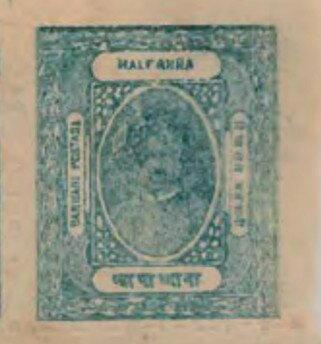
Stamps and cards could share the same clichés
The stationery study describes the four half anna clichés of each portrait family being used both for stamps and for printing the stamp on postal cards. Taking clichés out for card printing and resetting them for stamps could change their order in the forme. A changed position therefore need not mean a newly cut portrait or a new value.[10]
Compare repeated frame and letter defects across the whole object. The study records a short upper bar to the E of POSTAGE on one Ranjit Singh cliché and changes to the right frame on another, and notes that ink can fill a visible nick. A single feature is a lead; an attributed card, a multiple and several impressions give a firmer comparison.[10]
The half anna card and its first use
Harkawat dates a half anna postcard with four clichés to 1922. The stationery study instead proposes about 1926 for its first Ranjit Singh card group and records 15 February 1927 as the earliest used example it knew. These are an author’s issue date, a proposed chronology and an observed use. The later date of use does not disprove an earlier issue, and no first day is known.[6][10]
The study places the change to Rana Devi Singh cards around 1933, with 4 January 1934 as the earliest used example of that group. Headings, cliché defects and the position of the text help separate printings of the cards; a recorded use only shows that a form existed by that date. Harkawat’s statement that Barwani kept its 1922 charges after the Imperial increase of 1937 is a separate tariff question.[6][10]
Reply cards: keep the joined edge
The study distinguishes two kinds of reply card. In its Format A the message and reply halves join along their top edges; in Format B along their bottom edges. Separating them leaves a rough top or bottom edge, which is sometimes the only way to tell a detached half from an ordinary single card.[10]
Several pairings in the study are expressly guesses, because the author knew no unseparated pair. Keep complete joined cards and record both impressed clichés, the headings, the paper and the fold; a pairing in a reference list is no proof that an intact example has been seen.[10]
A cut-out used on a card
The study illustrates a private card sent from Barwani to Niwali on 11 December 1945, franked with a Rana Devi Singh stamp cut from a postal card and used as an adhesive. The author says plainly that it is not known whether State rules allowed such cut-outs or whether this was a one-off. Describe it as stationery used on another object, not as a new stamp, and do not make it a rule for all Barwani cut squares.[10]
Postcards and reply cards in the sale rooms, 1922–1944
A 2023 auction collection of 27 Barwani stationery items included a half anna message-and-reply card dated “1922 (?)”, two used half anna cards of 1927 and several single and reply cards of 1928, with envelopes. A 2024 sale offered 17 Devi Singh postal cards of 1934–44, used and unused, with a range of cancellations. The question mark on 1922 matters: the listing describes one collection, not the first day of the card or a complete census of the stationery.
Registered covers from Pansemal and Barwani City
Auction descriptions record a registered cover of 1933 from Pansemal to Barwani City with a boxed PANSEMAL registration strike and a Barwani City delivery mark, and a registered cover of 1934 from Barwani City to Pansemal with a pair of two annas Devi Singh stamps and dated Barwani City strikes. They show the State network and its registration markings; neither description breaks down the rate.
Book post and a heavy local letter, 1942
Köhler describes a handmade book-post wrapper of 10 September 1942 from Barwani City to Rajpur, franked with a half anna; the catalogue says the book-post charge was half the ordinary letter rate. A David Feldman lot describes a local cover of 6 July 1942 from Pansemal to Barwani’s revenue office with a block of four one anna stamps, which it explains as the rate for a heavy local letter. Each is a rate example for one object, not a schedule.[13]
An overweight letter, 1944
A local cover of 31 August 1944 bears three half anna stamps, 1½ annas in all, with a Barwani City despatch mark and a delivery mark of the next day. The auction catalogue says the ordinary letter rate was one anna and suggests the extra stamp paid for weight; it does not record the weight, so that explanation stays tentative.
A Barwani–India combination cover, 1947
A cover of 4 September 1947 from Barwani to Germany, later sent on to the United States, carries Barwani State stamps cancelled with the State’s Barwani device and Indian stamps cancelled the next day by the Imperial post office at Barwani. An expertised catalogue of 2021 calls it the only known cover with both Barwani and Indian stamps. The two cancelling devices make it a clear example of the two posts side by side; the claim of rarity is the catalogue’s.
Philatelic covers are not ordinary letters
A 2024 sale offered four covers of 1933–47 addressed care of the Barwani Postmaster, with sheetlets of four on the back, and described them openly as philatelic. They document the stamps and cancellations on them, but they are not commercial journeys and should not be used to work out the tariff.
Postmarks, proofs and later forgeries
MacGillycuddy warned that Barwani postal history is scarce and that the circular datestamps of some of the smaller State offices are especially hard to find. He gives no complete census of offices and devices. A town name and a portrait alone cannot show which of the two posts, State or Imperial, handled an item.[9]
He records proof material in his collection with a Kuala Lumpur cancellation. His section on forgeries describes later imitations with blotchy printing, features of the clichés in their late state and, often, faked postmarks. These are specific warnings, not a test that passes every better-printed stamp: study the paper, the printing, the whole cancellation and any independent evidence that the item was carried.[9]
What is still to be found
Much remains open: the State Gazette notice behind the date of 15 May 1917 and the certificate that cites it; the 1932 printing-transfer file, the die suppliers’ letters and any signed designs or staff records that would name the artist, the photographer of the portrait, the die cutter and the person who commissioned the work; a full table of rates; the opening and closing of every office; a census of cancellations; and an intact reply card. A magazine blog of November 2026 claims that printing blocks given by Santosh Rungta are held at the Calcutta GPO Museum; no inventory confirms it, so it is a lead, not a statement of where the blocks are.[23][27][9][7]
Sources
- [6] N. J. Harkawat, “Postal History of Barwani State”, IND DAK, April 1979, p.88, continuation from p.74.
- [7] David Feldman SA, “Indian Feudatory States – Barwani: award-winning collection”, lot 60070, June 2019.
- [9] A. MacGillycuddy, “The Stamps of Barwani”, The Collectors Club Philatelist, vol. 57 (1978), March pp. 83–89 and 118, May pp. 170–177, July pp. 240–247, September pp. 316–321.
- [10] Anonymous, “Barwani”, undated typescript study of the postal stationery (description, tables and illustrated catalogue).
- [13] Heinrich Köhler sale 377, Gems of Indian States, Barwani, pp. 22–27 and 50–54.
- [23] Barwani State, Report on the (Minority) Administration of Barwani State for Nine Years, Beginning on 1st October 1930 and Ending on 30th September 1939, prefatory note signed by Harilal N. Gosalia, Dewan and President, State Council, 17 June 1940; pp. 40–41, 67, 118–119.
- [27] British Library, IOR/L/PS/6/538, Coll 71/10: Administration Report on Barwani State for 1864–65, compiled by Lieutenant Thomas Cadell V.C., Political Assistant, Manpur, with correspondence (November 1864 – July 1865).
- Grosvenor Auctions, sale 151, Barwani lot 1345: a 27-item postal stationery collection.
- David Feldman SA, Spring 2025, Barwani lot 80030: 6 July 1942 local cover from Pansemal to Barwani with a block of four one anna stamps.
- David Feldman SA, Spring 2024, Barwani lot 70090: four philatelic covers addressed care of the Barwani Postmaster.
- David Feldman SA, June 2024, Barwani lot 70126: 17 Devi Singh postal cards of 1934–44.
Notes 0
Add what you know: a cover or stamp in your collection, a date or source, a correction or a question.
No notes yet.
Sign in to add a note.
Notes show straight away. Keep them kind and about the article; anyone can report one that isn't. House rules
