
Charkhari’s Crossed Swords, 1909–1945: Lithographs, Settings and the State Press
The crossed-swords stamps of 1909 printed in Calcutta, designs A and B, the CHARKHAPI error, a value changed on the stone, the oblong one anna and the State Press typography of 1930.
Updated October 23, 2026
In this article
The new design of 1909
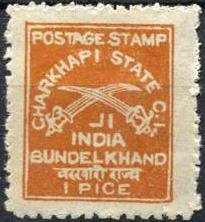
The Postage Stamp first reported the crossed-swords stamps on 24 April 1909, from stamps supplied by Whitfield King & Co.: white inscriptions on a coloured ground, in English and Devanagari, naming Charkhari, India and Bundelkhand, on thin wove paper, perforated 11 and apparently lithographed. An illustration followed on 1 May, and on 29 May the journal corrected the colour of the lowest value: the one pice was turquoise-green, not chestnut. The correction does not create a chestnut one-pice issue, and Whitfield King were the journal’s suppliers, not the makers.[4][1]
The modern catalogue gives the smallest value as one pice and gauges the 1909 issue 11½; the two measurements stay with their sources. Benders gives sheets of sixty-four, eight by eight, for the family of 1909–1919. The values are one pice, half anna, one, two, four and eight annas and one rupee.[5][1][3]
Röver says Maharaja Jujhar Singh ordered the new stamps from a Calcutta firm whose name he did not know. That is the ruler’s administrative role; the account names neither the designer nor the engraver. StampWorld places the first crossed-swords group in 1909, in Jujhar Singh’s reign, a double-frame one pice in 1912 and a single-frame one pice in 1917.[7][5]
Designs A and B, and the value drawn on the stone
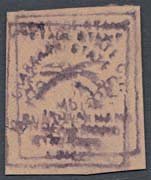
Douie separated two underlying designs, A and B, mainly by the height of the A in POSTAGE and of the first A in CHARKHARI, alongside the dots on the sword hilts, the placing of the value and the spacing between stamps. His A and B are not the numbered catalogue dies based on the vernacular value, and not the two later emergency handstamps.[12]
He thought the vernacular value was drawn into each impression on the stone separately, which would explain why the characters vary within a sheet. He also inferred 64 direct transfers from an original die, without an intermediate stone, with the vernacular values and probably the English figures added one by one. That is his reconstruction; he himself warned that his order of settings was partly arbitrary and needed evidence from covers.[12]
Two sizes in 1922
In May 1922 P. N. deSouza supplied blocks of the half anna and one anna in two designs. The journal measured the larger at 19½ × 23 mm and the smaller at 19 × 22½ mm; in the larger the letters TAG of POSTAGE were evenly spaced, in the smaller they touched. DeSouza had received the larger in 1919 and the smaller in March 1922, so he took the smaller to be later. Those are dates of receipt, not issue dates.[21]
CHARKHAPI
The same notice reported a one pice reading CHARKHAPI, with P for R. It also said that one-pice “Service” stamps had been abolished, without describing any design or overprint, so that sentence cannot support a separate list of official stamps.[21]
Douie placed CHARKHAPI at position 37 of his chestnut one-pice Setting II, a sheet he first saw in 1926. Its 5½ mm spacing and pattern of hilt dots do not match the blue error shown here. In blue Setting VII both hilts have dots at positions 35, 37, 45 and 46, and a pair imperforate between is reported for Setting V. These observations belong to particular settings; they are not a general dot test.[12]
The chestnut one pice reprint
Douie compared original chestnut one-pice stamps, spaced 3½ mm apart, with a later printing spaced 5½ mm. On his originals both sword hilts have dots; on the later printing they are absent except at positions 8 and 15, where only the left hilt has one. He dated the reprint tentatively about 1922 and did not know whether it was used in the state. The test applies to that chestnut setting only.[12]
A value changed on the printing stone
Not every change of value was an overprint. Douie describes a pale yellow-green one anna, his Setting V, made from a two-anna lithographic stone: the two horizontal vernacular strokes were joined into one thick stroke, the English 2 was altered to 1, and the final S of ANNAS was removed. Traces of the old 2 and S remain on many impressions. This is a retouched stone, quite different from the surcharges applied later to finished stamps. Keep multiples: the traces help relate positions, while one weak figure can mislead.[12]
The large oblong one anna
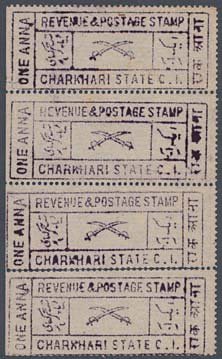
A much larger oblong one-anna handstamp needs its own identification. Douie gives 63 × 25 mm and dates it from 1925; Steiner’s album puts the oblong one anna under 1922, Klaseboer under 1926, and the Park sale under 1921. The dates conflict and none is settled here. The stamp is inscribed REVENUE & POSTAGE STAMP, and the same sale warns that two pen-cancelled value surcharges may be fiscally used.[12][3][13][14]
The State Press and the typography of 1930
According to Röver the state installed its own printing press in 1930. Douie describes the larger crossed-swords stamps of 1930 as typography, and his two-anna and four-anna blocks included vertical tête-bêche pairs, one stamp upside down to its neighbour. He thought half the sheet was printed from a block of stereos and the sheet then turned for the other half; his block of sixteen does not give the full sheet size. The 1930 values are one pice, half anna, one, two and four annas, a separate group from 1909 despite the same emblem.[7][12][5]
Stoney’s study of 1944 names G. G. Field as his source for blocks of sixteen stereos in two rows of eight, one for each value, used for the State’s imperforate typography of 1930; he thought they derived from Douie’s Die B. For the one pice, sheets of eighty were printed as five separate groups of sixteen; inverted groups came, in his view, from feeding the sheet from opposite sides, and he also reports printing on both sides. The half anna was reported in deep-olive sheets of sixty-four, then in red-brown wartime sheets of eighty.[23][29]
Field reportedly bought a chocolate one-anna half-sheet and centre-pane half-sheets of the two and four annas from the State Treasury in August 1941. A modern Feldman description gives a later one-pice sheet of four panes of sixteen, sixty-four stamps; it stands beside Stoney’s eighty, not in place of it.[23][28]
The last crossed swords
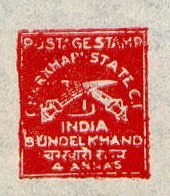
StampWorld’s later crossed-swords group, 1940–1945, has one pice, half anna, one and two annas. The period runs across the death of Arimardan Singh in 1941 and the succession of Jayendra Singh, and does not date use under either ruler.[5]
Sources
- [1] Dr A. M. Benders, “Some Notes on the Stamp of Charkhari State”, Ind Dak, January 1979, p. 3.
- [3] Evert Klaseboer, online catalogue, “Indian States, Charkhari”, early and pictorial issue listings.
- [4] The Postage Stamp, vol. 4 (April–September 1909), “New Issues and Old”, Charkari: 24 April 1909, p. 44; 1 May, p. 56; 29 May, p. 104.
- [5] StampWorld, Charkhari, issue listings 1909–1945.
- [7] Peter Röver, “Charkhari: A Provisional Definitive Stamp”, Stamp Monthly, July 1975, p. 30.
- [12] Lt.-Col. F. M. Douie, “The Stamps of the Indian Feudatory States: Charkari”, The Philatelic Journal of India, vol. XXXIX, 1935, parts 1 and 2, with a plate in February 1935, no. 2.
- [13] William E. Steiner, India—Feudatory States, album pages, Charkhari, pp. 29–31.
- [14] Christoph Gärtner, Park Collection, 7 March 2011, pp. 120–121, Charkhari lots 861, 864, 865, 867, 869, 878, 881, 883 and 883A; photographs pp. 25 and 27.
- [21] The Philatelic Journal of India XXVI(5), May 1922, Charkhari, p. 69.
- [23] R. F. Stoney, “Charkhari, 1930–44” (concluded), The Philatelic Journal of India XLVIII, no. 10, October 1944, pp. 71–72.
- [28] David Feldman, 21 June 2024, lot 70205.
- [29] R. F. Stoney, “Charkhari”, The Philatelic Journal of India XLI, nos. 9–10, September–October 1937, pp. 60–62.
Notes 0
Add what you know: a cover or stamp in your collection, a date or source, a correction or a question.
No notes yet.
Sign in to add a note.
Notes show straight away. Keep them kind and about the article; anyone can report one that isn't. House rules
