
Charkhari’s Emergency One Pice, Manuscript Provisionals and the Surcharges of 1940
A one-pice handstamp that served for twenty years, its two dies, collectors’ sales, two manuscript provisionals and the State Press surcharges made in the shortage of 1939.
Updated September 27, 2026
In this article
A low-value shortage
The lowest value was the one most at risk of running out: a missing high value could be made up with several low ones, but not the other way round. Röver describes Charkhari’s answer: a one-pice handstamp, a negative version of the crossed-swords design, which he attributes to an unnamed Calcutta firm and to an order from Jujhar Singh. Its “provisional” life lasted far longer than the word suggests.[7]
Postmasters were told to stick the emergency stamps straight onto letters rather than sell them unused over the counter, which helps explain why early unused copies are scarce. Röver’s earliest date is 1912, the earliest he had seen, not proof of the first day. Douie had placed the handstamp around 1919; the two datings are attributions, not interchangeable announcements.[7][12]
Two dies
Röver reports wear and broken frame lines on the first handstamp, and a replacement in 1917 without the second frame line and with changed details in the swords. These features separate the dies better than the depth of the purple ink. In his account the handstamp was no longer needed once the state had its own press in 1930.[7]
Röver dates black examples of the second die to 1918–1919 and thinks a change of ink pad the probable reason. Douie reports three used black examples with a purplish tint under magnification, among them a vertical tête-bêche pair. The colour of the ink, the attribution and proof of carriage are three different questions.[7][12]
Douie’s violet one-pice sheets show why paper and layout belong together. His sheet on coarse toned wove had eight rows of eight, the lower half inverted, giving eight tête-bêche pairs across the middle. His sheet on thin white surfaced paper with the impressed elephant also had eight rows of eight, all the same way up. These are the sheets he saw, and they have nothing to do with the tête-bêche typography of 1930.[12]
Collectors’ sales
Later the administration allowed unused and cancelled-to-order copies of the second die to be sold freely; Röver places the change after Arimardan Singh came of age in 1924 (Röver ends his reign in 1942, where other sources give 8 November 1941). The same design can therefore be an emergency postage stamp or later collectors’ material, and a dated cancellation has to be judged with the printing and its history.[7]
Selling to collectors was not new. Evans reported in January 1900 that Charkari supplied stamps at face value, unused or cancelled to order, long before the pictorials of 1931. He did not think that ruled out real postal use, and not every cancelled early stamp was made for collectors.[19]
Two manuscript provisionals
Stoney’s article of September–October 1937 describes a half anna written in black on the one pice, and a one anna written on the half anna. He had an unused corner block of fifteen of one and a marginal strip of three of the other. These raised the face value, unlike the later surcharges, which lowered surplus high values.[29]
His authority for their official status was a reply from the Inspector of State Post Offices, dated 11 February 1936, reported through E. Franklin DeSouza. It gave the years 1922 and 1930 but did not say which provisional belonged to which. “Official” here means authorised; it does not make them service stamps. A Köhler lot shows a turquoise pair with the manuscript half-anna marks and cites Stoney as May 1937; the article is in fact September–October 1937.[29][27]
The surcharges of 1940
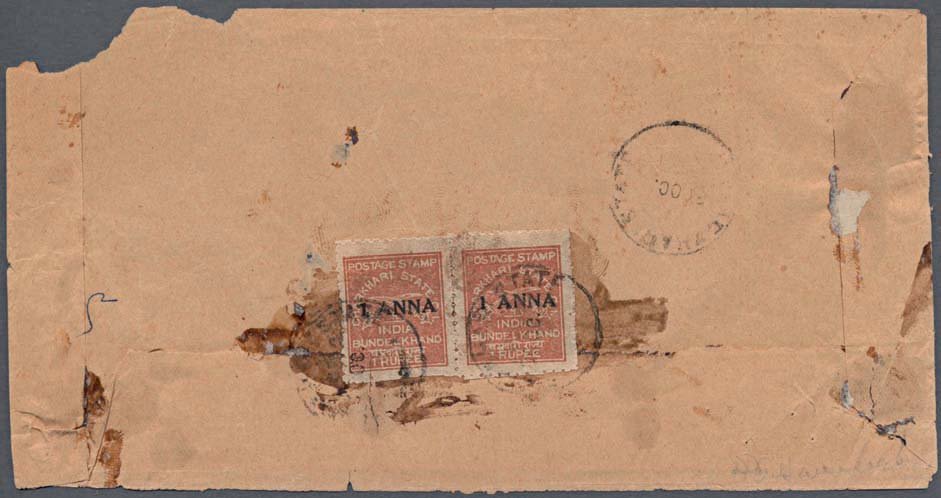
The later surcharges change the value of finished high-value crossed-swords stamps. Steiner’s album and Klaseboer list three: half anna on eight annas, one anna on one rupee as figure and abbreviation (1 As.), and a separate one-rupee stamp with the words 1 ANNA. StampWorld lists two in its 1940 group, its numbers 39 and 40. A Murray Payne sale of 1998 gives SG 56 for the 1 ANNA with a BPA certificate.[13][3][5][11]
In 1944 R. F. Stoney published an account obtained from Charkhari’s Dewan through the Political Agent, with the help of Sir Arthur Lothian: the surcharges were made at the State Press after a shortage in December 1939. The account described two rows of type and four applications to each sheet. Stoney’s own sheets did not quite agree: spacing and inverted rows suggested a single row for some half-anna sheets and four rows used twice for a one-rupee sheet. So there were several operations, not one fixed setting.[22]
A dealer gave totals of 2,129 half-anna and 2,435 one-anna copies; the authorities gave no figures, so these are dealer’s numbers, not official totals. The worded 1 ANNA sheet Stoney examined lacked its lower-right stamp and all margins, which limited what he could reconstruct. The Dewan’s account, the dealer’s figures and Stoney’s observations should stay separately attributed.[22]
Field found none of the surcharges at the Post Office or Treasury in August 1941 and doubted that many reached the offices. That does not prove that none were issued or used.[23]
Sources
- [3] Evert Klaseboer, online catalogue, “Indian States, Charkhari”, early and pictorial issue listings.
- [5] StampWorld, Charkhari, issue listings 1909–1945.
- [7] Peter Röver, “Charkhari: A Provisional Definitive Stamp”, Stamp Monthly, July 1975, p. 30.
- [11] “Charkari Pictorials”, letter from a member at Ahmednagar dated 27 July 1933, The Stamp Lover, October 1933, p. 117.
- [12] Lt.-Col. F. M. Douie, “The Stamps of the Indian Feudatory States: Charkari”, The Philatelic Journal of India, vol. XXXIX, 1935, parts 1 and 2, with a plate in February 1935, no. 2.
- [13] William E. Steiner, India—Feudatory States, album pages, Charkhari, pp. 29–31.
- [19] Edward B. Evans (the Editor), “The Stamps of some of the Native States of India: Charkari”, Stanley Gibbons Monthly Journal X, 31 January 1900, pp. 162–163.
- [22] R. F. Stoney, “Charkhari, 1930–44”, The Philatelic Journal of India XLVIII, no. 9, September 1944, pp. 65–66.
- [23] R. F. Stoney, “Charkhari, 1930–44” (concluded), The Philatelic Journal of India XLVIII, no. 10, October 1944, pp. 71–72.
- [27] Heinrich Köhler, sale 377, Gems of Indian States, lot 10543, pp. 104 and 110.
- [29] R. F. Stoney, “Charkhari”, The Philatelic Journal of India XLI, nos. 9–10, September–October 1937, pp. 60–62.
Notes 0
Add what you know: a cover or stamp in your collection, a date or source, a correction or a question.
No notes yet.
Sign in to add a note.
Notes show straight away. Keep them kind and about the article; anyone can report one that isn't. House rules
