
Charkhari’s Pictorials of 1931: a City in Miniature
The nine-value pictorial set of 1931 showing Charkhari’s lake, palaces, fort and temples: Batliboi proofs, inverted centres, cancelled-to-order sets and evidence of real use.
Updated June 28, 2026
In this article
The set
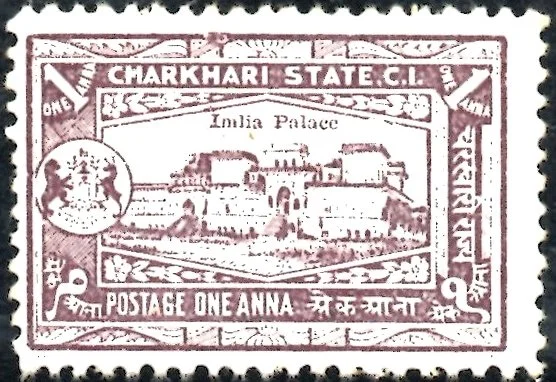
The pictorials of 1931 take the collector on a tour of the state: a lake, Imlia Palace, an industrial school, a view of the city, the fort, a guest house, a palace gate and two temples. The nine values are half, one, two, four and eight annas, and one, two, three and five rupees. The catalogue lists the set from 25 June 1931; another date of 23 June is also given, and the conflict is unresolved.[9][3][5]
Who made them
Auction records give leads: a marginal block with a partial Batliboi imprint (Feldman, 2024), four brown designs together with a separate 1 ANNA surcharge (Feldman, 2025), and a four-anna proof in red or rose with a broad blank surround, reported to carry BLW on the back (Stanley Gibbons Baldwin’s, November 2026). They connect the production with Batliboi Litho Works, but name no artist, engraver or official who commissioned the designs, and the decisive imprint and back are not visible in the published pictures.[24][26][25]
Inverted and displaced centres
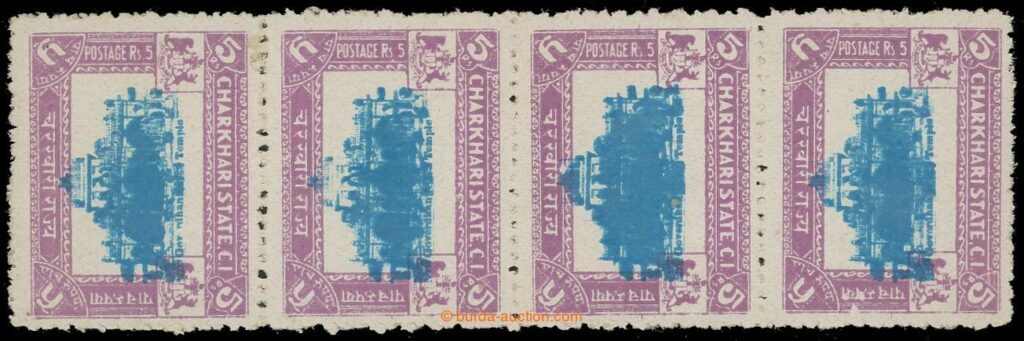
Stoney’s study of 1937 separates inverted centres, doubled centres, displaced centres and offsets on the backs of the pictorials, and reports three-rupee tête-bêche pairs in two arrangements. These are different faults, not names for the same one. He also describes a repaired handstamp, which shows why apparent design differences need checking for physical alteration.[29]
In the five-rupee multiple below, compare the direction of the building with the frame lettering on each stamp; the same relationship repeats through the block. It is a variety of the five rupees, not another value.[15]
Cancelled to order
Klaseboer warns that many pictorials were cancelled to order. A dated strike on a loose stamp is weak evidence of a journey compared with a whole cover whose origin, address and transit marks agree.[3]
A letter printed in The Stamp Lover in October 1933, written from Ahmednagar, describes complete used sets on the market at low prices. The writer had asked the state Postmaster-General about cancelled-to-order stamps and about getting examples on original covers; the reply offered pictorials at face value but named no local dealer in used stamps. The exchange shows the concern of the time; it does not prove who cancelled every set. Keep a cover’s address, dates and transit marks with the stamp.[11]
Did the high values reach the post offices?
Stoney reported that the low pictorial values reached post offices but believed the high values did not. He also described a period when they were used for judicial revenue, later prohibited by the Judicial Minister. His account of a black half anna on thin pelure paper is equally careful: he had been assured it was used but had not seen a used copy. These are his reports, not proof that every high value is non-postal.[23]
The end of the state stamps
On 13 March 1948 Charkhari was among the 35 states of Bundelkhand and Baghelkhand that agreed to unite, and the covenant forming Vindhya Pradesh was signed on 18 March 1948, ending the state as a separate administration. The Smithsonian dates the replacement of state stamps by Indian stamps to 1 May 1950.[6]
People and the limits of attribution
The sources name custodians, commissioners, informants, collectors and institutions far more readily than the makers of the stamps. No individual designer or engraver of any Charkhari stamp is known.
| Person or institution | Role in the sources |
|---|---|
| The Maharaja | Kept the early steel die in his personal custody (Douie); not its designer or engraver |
| C. L. Pigott | Supplied the notes and specimens for the March 1897 account, quoted by Douie and Evans |
| Major Evans | Philatelic author; passed on Pigott’s account and the Satwara cover |
| F. M. Douie | Specialist collector and author of the 1935 study of sheets and settings |
| Unnamed draughtsmen | Suggested by Douie from differences in the hand-drawn values; names unknown |
| Jujhar Singh | Ordered the crossed-swords stamps and the emergency handstamp (Röver) |
| Unnamed Calcutta firm | Printer of the crossed-swords stamps (Röver); name unknown |
| Arimardan Singh | Ruler under whom unused and cancelled-to-order sales grew after 1924 (Röver) |
| John Haddon & Co. | Name in a commercial paper watermark (Benders); papermaker, not printer |
| State Press | Printed the 1930 typography and the 1940 surcharges |
| Batliboi Litho Works | Linked to the 1931 pictorials by auction descriptions of an imprint and BLW on a proof |
| Dewan, Political Agent, Sir Arthur Lothian | Passed the 1939 shortage account to Stoney in 1944 |
| R. F. Stoney | Researcher of 1937 and 1944 |
| G. G. Field, I.P. | Informant and collector; bought from the State Treasury in 1941 |
| E. Franklin DeSouza | Sought the Inspector’s confirmation of the manuscript provisionals |
| Inspector of State Post Offices | Replied on 11 February 1936; name unknown |
| P. N. deSouza | Collector who supplied the 1922 blocks; not the same person as E. Franklin DeSouza |
| Whitfield King & Co. | Supplied stamps to The Postage Stamp in 1909 |
| C. Stewart-Wilson | Showed the first specimens to the journal in January 1897 |
What remains to be established
A dated table of postal rates, a complete census of offices and postmarks, and the full sequence of settings still need more evidence. Covers known only from reports should be treated as reports until the originals are seen. A 1933 census map of the Bundelkhand states, once available on Wikimedia Commons, was deleted there on 8 November 2026 for missing licence information.[30]
Sources
- [1] Dr A. M. Benders, “Some Notes on the Stamp of Charkhari State”, Ind Dak, January 1979, p. 3.
- [3] Evert Klaseboer, online catalogue, “Indian States, Charkhari”, early and pictorial issue listings.
- [4] The Postage Stamp, vol. 4 (April–September 1909), “New Issues and Old”, Charkari: 24 April 1909, p. 44; 1 May, p. 56; 29 May, p. 104.
- [5] StampWorld, Charkhari, issue listings 1909–1945.
- [6] Smithsonian National Postal Museum, “Feudatory States: A–D”, Charkhari.
- [7] Peter Röver, “Charkhari: A Provisional Definitive Stamp”, Stamp Monthly, July 1975, p. 30.
- [9] Wikimedia Commons, “Stamp of Charkhari – 1931 – Imlia Palace”: stamp image record and public-domain-in-India status.
- [11] “Charkari Pictorials”, letter from a member at Ahmednagar dated 27 July 1933, The Stamp Lover, October 1933, p. 117.
- [12] Lt.-Col. F. M. Douie, “The Stamps of the Indian Feudatory States: Charkari”, The Philatelic Journal of India, vol. XXXIX, 1935, parts 1 and 2, with a plate in February 1935, no. 2.
- [15] Burda Auction, Public Auction 59, object 208288, Charkhari five-rupees pictorial multiple with inverted centre (SG 53b as attributed).
- [16] The Philatelic Journal of India I(1), January 1897, “New Issues”, p. 22.
- [21] The Philatelic Journal of India XXVI(5), May 1922, Charkhari, p. 69.
- [22] R. F. Stoney, “Charkhari, 1930–44”, The Philatelic Journal of India XLVIII, no. 9, September 1944, pp. 65–66.
- [23] R. F. Stoney, “Charkhari, 1930–44” (concluded), The Philatelic Journal of India XLVIII, no. 10, October 1944, pp. 71–72.
- [24] David Feldman, 21 June 2024, lot 70206.
- [25] Stanley Gibbons Baldwin’s, Hambledon Part III, 17 November 2026, lot 464.
- [26] David Feldman, 30 May 2025, lot 80046.
- [29] R. F. Stoney, “Charkhari”, The Philatelic Journal of India XLI, nos. 9–10, September–October 1937, pp. 60–62.
- [30] Wikimedia Commons, deletion log of the file “Bundelkhand Agency, princely states map (early 20th century).jpg”, 8 November 2026.
- Supreme Court of India, Virendra Singh and Others v. State of Uttar Pradesh, 29 April 1954: Charkhari’s accession and the 1948 covenant of the Bundelkhand and Baghelkhand states forming Vindhya Pradesh.
Notes 0
Add what you know: a cover or stamp in your collection, a date or source, a correction or a question.
No notes yet.
Sign in to add a note.
Notes show straight away. Keep them kind and about the article; anyone can report one that isn't. House rules
