
Cochin’s Last Anchal Years: the ANCHAL Overprint, the 1949 Surcharges, Union and Collecting
The one-anna ANCHAL overprint separating postage from revenue, the bilingual surcharges of 1949 and their boundary with Travancore-Cochin, the union of 1 July 1949, the Anchal as an agency until 1951, traps and open questions.
Updated July 22, 2026
In this article
Postage or revenue: the one-anna ANCHAL overprint
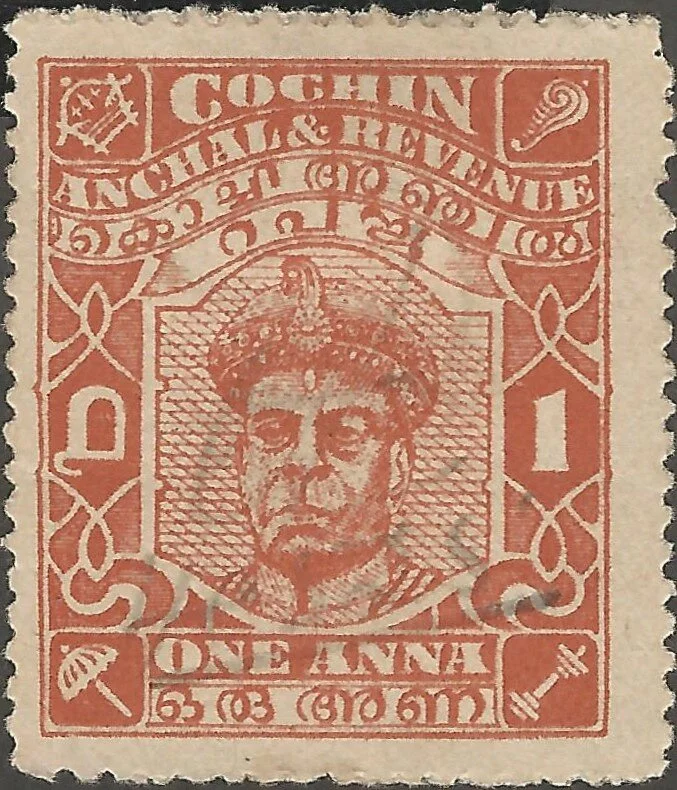
A specialist overview of the Cochin Maharaja stamps says that from 1939 the one-anna ANCHAL overprint marked the stamp for postage, while the same one-anna design without it served for revenue. StampWorld’s 1939 row 60 and its one-anna rows 68A–68D for 1939–44 identify several printings and perforations. A one anna inscribed for Anchal and revenue needs that overprint, or a whole document, before its use is decided.
The bilingual surcharges of 1949
The value changes of 1949 generally have English at the top and Malayalam below; the one-line NINE PIES is an exception. They are separate typeset forms, and the height and length of the Malayalam line separate some similar surcharges. The three pies on nine pies includes a Malayalam line about 19½ mm long with letters 2 mm high, and a smaller-lettered form with a 16 mm line; the official nine pies on four pies exists with a 22 mm line and with a 17½–18 mm line. The study’s form numbers belong to it, not to a universal catalogue.[5]
The Associated Printers used guillotine perforators gauging 11 and 13 for the late issues. Cowen and Devasya think the value and official overprints were probably applied at the Government Press, Ernakulam, from formes for a whole sheet and plates cast from them. They describe the late portrait sheets as forty-eight stamps, eight by six, lightly gummed, about 10½ × 8¾ inches; Luiz prints 18 × 8¾ inches, which is not adopted.[5][4]
Most, if not all, of these surcharges were thought to precede 1 July 1949, so putting every stamp dated 1949 under Travancore-Cochin would split Cochin issues. The three pies on nine pies with SERVICE in place of ON C G S is the boundary case: the change of wording reflects a changed government, but the authors would move it to the union only if a first date after the union were proved.[5]
Grosvenor’s sale 120, lot 507, describes a registered cover of 1949 from Trichur to Ernakulam with a pair of the two-anna 1949 stamps and two three-pie carmine stamps; the description does not name the two-anna design. Lot 1652 of sale 124 describes a registered cover from Alagappanagar to Trichur of 29 March 1951 with four three-pies-on-nine-pies stamps on the back, tied by the Alagappanagar Anchal Office datestamp. Grosvenor’s sale 58, lot 159, describes a commercial postcard of 6 December 1947 from Cochin City to Trichur with the four pies grey-green second portrait (SG 103) and an arrival datestamp.[22]
Union and the last Anchal years
The United State of Travancore and Cochin came into being on 1 July 1949. Cochin already counted in pies, annas and rupees, so it did not face Travancore’s urgent conversion from cash and chuckrams. The postal services continued; the Anchal became an agency of the Indian department on 1 April 1950 and was absorbed on 1 April 1951. On 14 March 1950 the Communications Minister, Rafi Ahmed Kidwai, told Parliament that the Union could go on running the Anchal after 31 March 1950 as the Government of India’s agent, selling its existing stamps meanwhile.[2]
Traps for the collector
Evans was shown one used half puttan on what was undoubtedly laid paper in January 1896, apparently genuine, and never saw another. He reported that The Indian Philatelist had chronicled imperforate half and two puttans that he had not seen, and only guessed that sheets had escaped by accident. He gave the perforation of the early stamps as 12, by a single-line machine, with gum applied after perforating, often spreading through the holes onto the face.[44]
Palmer described a perforated, unwatermarked six pies in green that seemed genuinely used, and suggested, with a question mark, a proof used by mistake. Pierre Couvreur’s reprint of Palmer’s table gives six annas ten pies in one row where Palmer’s original says six annas eight pies, as do Couvreur’s own notes: there is no six annas ten pies issue. Luiz’s suggestion that Ravi Varma disliked his first right-facing portrait is speculation.[51][52][4]
Mrs. Sathi V. Menon’s article of 1993 names Rama Varma I (1885–1914) as ruler at the first issue, which conflicts with the reign of Veera Kerala Varma, 1888–1895, documented elsewhere, and is not followed. Nankivell’s account of 1907 quotes Evans and is not independent of him.[46][27]
What is still to be found
The original notices of the 1860s, the Anchal Rules of 1892, a release order for 1892 that settles 1 April or 13 April, the dated notices of the late surcharges, a current catalogue of the official settings, and a proper census of offices and postmarks are all still needed. No designer or engraver of any Cochin stamp is named, and the passage from Perkins Bacon to the Associated Printers, the printer of the pictorials of 1949 (Nasik, according to Griffin) and the history of Griffin’s ten-design proof sheet remain open. The exact days on which authority passed between the rulers of 1941, 1943 and 1946 also need the original instruments.
Sources
- [2] Frank M. Cowen and J. Devasya, “Travancore-Cochin: Its Postage Stamps and Postal History”, The Collectors Club Philatelist, vol. 32, no. 6, 1953, part I, pp. 287–302.
- [4] S. P. Luiz, Stamps of Cochin, Kalamassery, 23 February 1972.
- [5] Frank M. Cowen and J. Devasya, “The Cochin Overprints, 1949”, in “Travancore-Cochin: Its Postage Stamps and Postal History”, The Collectors Club Philatelist, vol. 33, no. 2, 1954, pp. 100–104.
- [22] Grosvenor Philatelic Auctions, sale 58, sale-summary listing.
- [27] E. J. Nankivell, “Countries of the World: Cochin”, Gibbons Stamp Weekly, vol. 5, 1907, pp. 81 and 83.
- [44] E. B. Evans, Cochin, Stanley Gibbons Monthly Journal, 28 February 1900, p. 184.
- [46] Mrs. Sathi V. Menon, Early Cochin Stamps: A Brief Historical Background and Study, IND DAK, September 1993, p.115. Supplementary reading: One.
- [51] Derek Palmer, The Proofs of Cochin, Essay-Proof Journal no 94 (1967), pp 55–59 Supplementary reading: All five original pages.
- [52] The Proofs of Cochin, with notes by Pierre Couvreur.
- StampWorld, Cochin, 1930–1939, no. 60, and 1939–1944, nos. 68A–68D.
- The Postage Stamp, research archive: Cochin Maharaja stamps, the postal ANCHAL overprint and revenue use of the one anna.
- Grosvenor Sale 120, lot 507.
- Provisional Parliament debates, 14 March 1950, oral question 889, States Having Their Own Post Offices and Postage Stamps.
Notes 0
Add what you know: a cover or stamp in your collection, a date or source, a correction or a question.
No notes yet.
Sign in to add a note.
Notes show straight away. Keep them kind and about the article; anyone can report one that isn't. House rules
