
Cochin’s Royal Portrait Stamps, 1911–1949: Perkins Bacon, Madras and the Six “Rajas”
The six portrait families and why their numbers are not royal ordinals, the engraved portraits of 1911 by Perkins Bacon, proofs and a 1916 progress proof, the later Madras lithographs, and the late portraits.
Updated September 21, 2026
In this article
Six portrait labels, not six royal numbers
Collectors often call the portrait groups the first to the sixth Raja. Luiz makes clear that this is collectors’ shorthand. The names and numerals below identify designs; they are not the historical numbering of Cochin’s rulers, and the issue periods do not give dates of accession or death.[4][17]
The two public albums consulted group the Kerala Varma I ordinary family under 1943; Luiz’s printed date of 1948 for it conflicts with them and is not followed. His date for the first Ravi Varma portrait reads 1944 on the original page. The register separates that right-facing design from the revised portrait introduced from 1946.[4][17][3]
| Family | Portrait name | Ordinary issues |
|---|---|---|
| First | Rama Varma I | 1911–1914 |
| Second | Rama Varma II | 1918–1923 |
| Third | Rama Varma III | Engraved, then lithographed, 1933–1941 |
| Fourth | Kerala Varma I | Catalogue group of 1943 |
| Fifth | Ravi Varma | First portrait 1944–1946; revised portrait from 1946 |
| Sixth | Kerala Varma II | 1948–1949 |
The engraved portraits of 1911
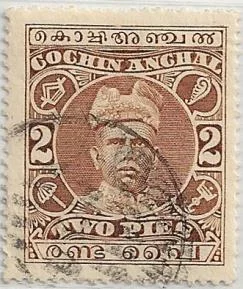
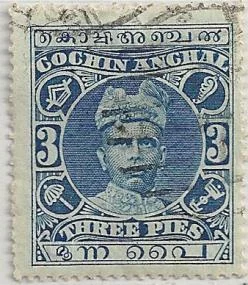
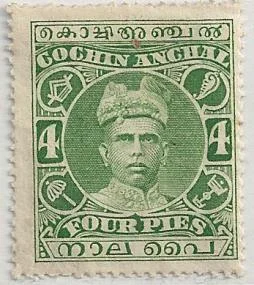
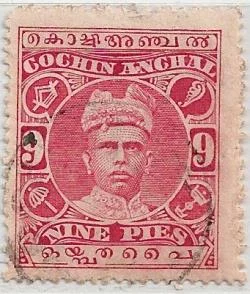
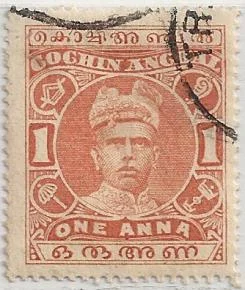
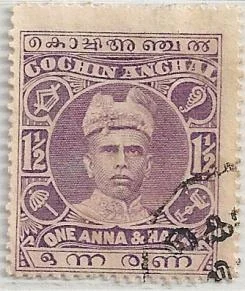
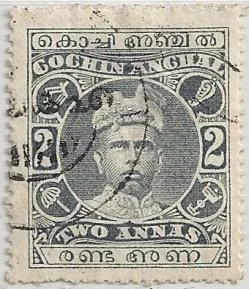
In 1911 The Postage Stamp reported receiving the line-engraved portrait issue from Whitfield King & Co., on white wove paper watermarked with an umbrella, and recognised the portrait from the earlier one-anna fiscal. A period annual names Perkins Bacon of London and records perforations 13½ and 14. Whitfield King supplied the journal’s copies; neither report names the artist or the engraver.[29][30]
A portrait before the finished stamp
A nine-pies progress proof described by Stanley Gibbons as of 1916 shows a stage before the Malayalam lettering was fully engraved. The photograph shows pencilled guides for the lettering around the design and a separate photograph of the ruler, which the catalogue calls the engraver’s model. It documents the design process, not an issued imperforate stamp.[21]
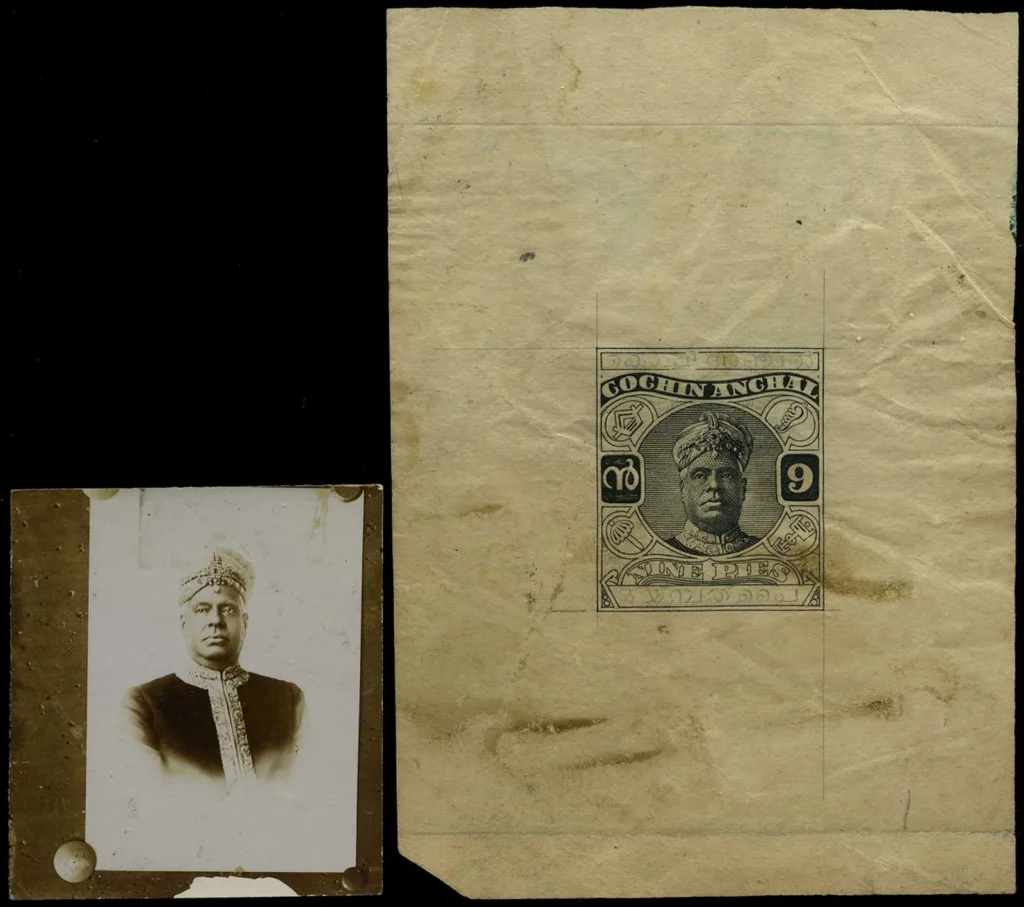
Grosvenor’s sale 120 lists an imperforate proof block mounted in a Perkins Bacon workbook, pairs of proofs in the issued colours, and a 2¼-anna die proof with a pencilled final date of 2 January 1933. These are different stages of production; the pencilled date belongs to that proof and leaves the date of issue open.[35]
Palmer’s survey of proofs includes stamp designs, a postcard die, a study of the head alone and a Foreign Bill revenue design: different objects, even when they share a portrait. A proof on unusual paper or in an unusual colour is not a missing regular issue.[51]
The second portrait
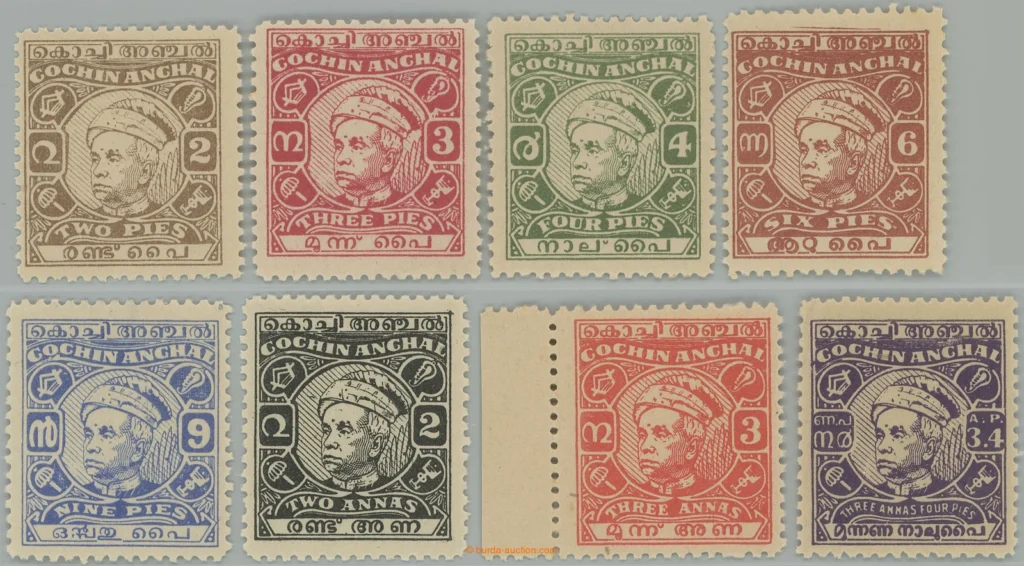
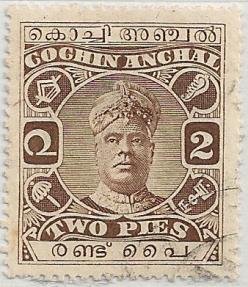
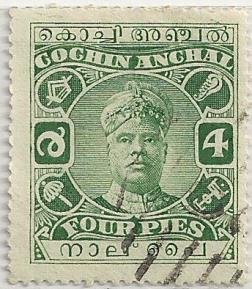
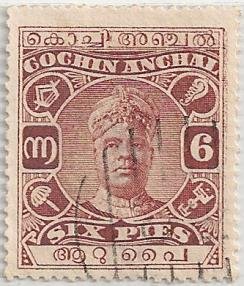
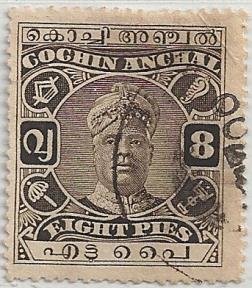
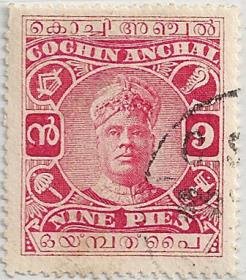
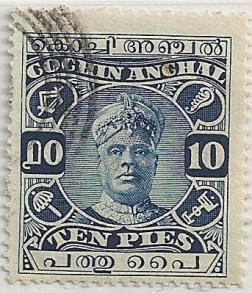
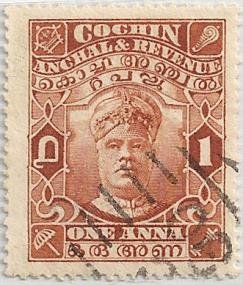
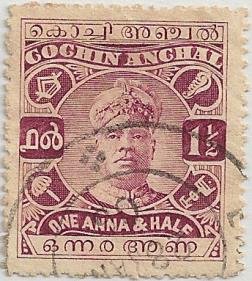
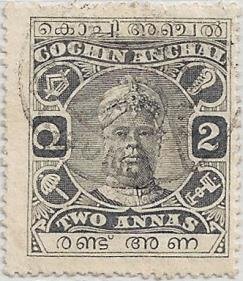
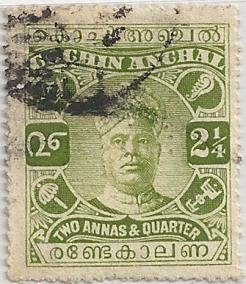
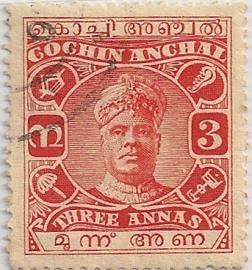
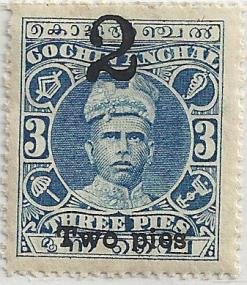
The eleven ordinary values of the second portrait family are shown together below. The two-pies surcharge on the same page uses the earlier portrait and belongs to its own family.[3]
From London to Madras
Gibbons Stamp Monthly names Associated Printers of Madras for the later issues. The State’s report for 1937–38 says that stamps and stamp papers came from England, except certain items made locally, and that orders for 1114–1117 M.E. had gone to an Indian firm it does not name. The Royal Philatelic Society London dates the liquidation of Perkins Bacon to 1935, while philatelic references continue the engraved issues to 1938; later studies place the change from Perkins Bacon to Associated Printers in 1938. Work orders are needed to match printing dates to the firm’s history and the later contract.[36][15][32][34]
Two other records name makers without settling the stamps. The 1911 Manual records an arrangement of 1908 with John Dickinson & Co. of London, after objections to making and selling stamps under one administration, but it speaks of the Darbar’s main stamp values in general and lists no Anchal stamps. The report of 1909–10, by contrast, says that Anchal cards and two-puthan Anchal stamps were among the items made locally that year, without naming the printer, method or plate.[50][56]
| Stage | Supported | Still open |
|---|---|---|
| Early state seal | Typographed, attributed to the Cochin Government; P. Orr & Sons credited with the dies in an exhibit | A signed die, the purchase order and the engraver |
| Portraits of 1911 | Line-engraved, on wove umbrella-watermarked paper, by Perkins Bacon | The artist; which gauge belongs to which stamp |
| Later portrait families | Engraved issues, then lithographs associated with Madras | Exact dates and the last British and first Madras jobs |
The late portraits, ordinary and official
Three set photographs raise two questions. A value can exist as an ordinary stamp and as an official with ON C G S without the two being one checklist entry, and the official series can include values the ordinary did not. Compare the later clean-shaven portrait with the earlier bearded revised portrait before trusting a catalogue’s ruler name: the auction calls the ordinary set’s sitter Ravi Varma, while the specialist sequence gives that design to Kerala Varma II, and the same auction calls the later official set Kerala Varma III. The disagreement is stated, and no royal numbering is inferred.[19][4]
The pictorials of 1949
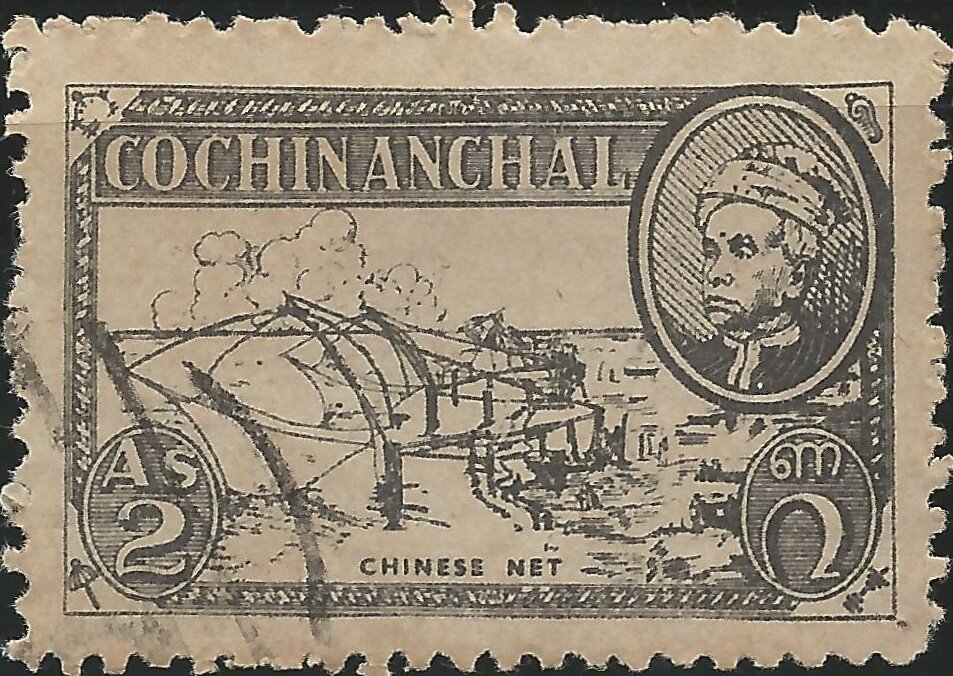
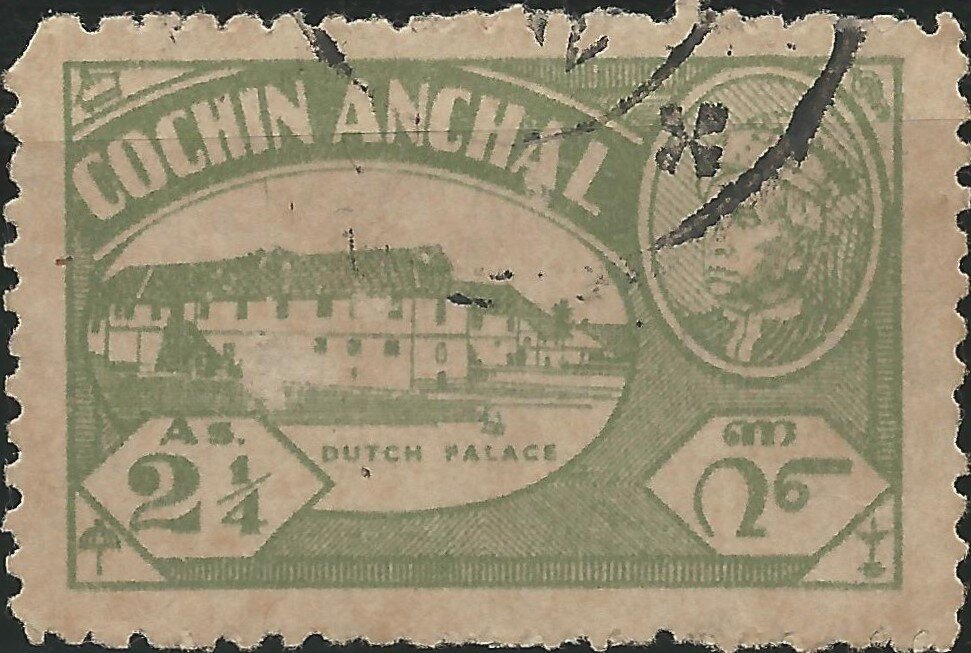
The last issue was a pictorial pair, a two-anna Chinese Fishing Net and a two-and-a-quarter-anna Dutch Palace. One album page appears to reverse their values; the stamps themselves and independent auction descriptions give the Chinese Net as two annas and the Dutch Palace as two and a quarter. Donald B. Griffin cites a programme planned in 1947, of which only these two were issued in 1949; the notice of 1947 has not been seen, and the history of the proof sheets is unresolved.[6][7][8][9][53]
The order of 1910
Proceedings of 1910 reproduced by Luiz link the new portrait stamps with a reorganisation of the Anchal. Following the Diwan’s instructions of 4 February 1910, the Superintendent of Anchal (not named on the page) made proposals on 15 February for reorganisation, new stamps and revised rates, and the order of 10 July 1910, under Diwan Sir A. R. Banerji, called for a central likeness of the ruler with the State’s insignia, replacing the half, one and two puthen values with four pies, nine pies and one and a half annas stamps and envelopes. It records an administrative decision, not an artist or engraver.[4]
Two papers and two dies
For the second portrait, Trowbridge separates a crisp, coarser, unevenly thick white wove paper A from a softer, evenly thick white wove paper B. Impressions measure generally 23½ mm on paper A and 24 mm on paper B, the one anna smaller, which he explains by shrinkage of paper dampened for recess printing; a difference of width alone is not a new die. He records comb perforations 14 and 13½, paper A at 14 and paper B at either gauge depending on the value. His two-pie Type I has two oval, right-sloping Malayalam characters in the bottom line, Type II broader upright forms with the lettering re-engraved; on the one anna a two-curved character in Type I becomes a semicircle in Type II.[54]
More about the proofs
Palmer records die proofs of the first portrait, unwatermarked, in se-tenant pairs of two and three pies, four and nine pies, and two and three annas, which are proofs, not issued pairs. For the second portrait he lists a four-pies plate proof on paper with a (S)PECIAL watermark, an unfinished four-pies carmine die on thin card for postcards, and a two-annas Foreign Bill revenue die proof in several colours. Third-portrait proofs include a green head-only die proof on thin card, described as used on postcards. Couvreur adds a blue medallion of 41 mm, a reduced red medallion of 18 mm and an unfinished brown proof with the values missing and a manuscript date 5.12.32.[51][52]
The pictorial programme of 1947
Griffin, citing Antony Tavsons in India’s Stamp Journal of May 1947, p. 105, reports a planned issue of thirteen values, three portraits and ten pictorials: Secretariat 6 pies, Harbour 9 pies, Backwaters 1¼ annas, Tramway 1¾ annas, Chinese Net 2 annas, Dutch Palace 2¼ annas, Ram Mohan Palace 3 annas, Coconut Palms 3 annas 4 pies, Synagogue 6 annas 8 pies and Hill Palace 10 annas. Only the Chinese Net and the Dutch Palace were issued. His illustration of a ten-design sheet came from a friend’s photocopy whose pedigree he declined to judge, and his attribution of the pair to Nasik is a later assertion.[53]
Sources
- [3] W. Michael Adkins, Cochin, Indian Princely State Album, revised to February 2018, pp. 1–11.
- [4] S. P. Luiz, Stamps of Cochin, Kalamassery, 23 February 1972.
- [6] David Feldman, 2013 auction lot 41015: Cochin 1949 2¼-anna Dutch Palace, identified as the issued monochrome stamp.
- [7] Stamp-auctions.de, 19 October 2021, lot 2326: Cochin 1949 Chinese Nets, 2-anna black issue.
- [8] Wikimedia Commons, “Stamp of Cochin – 1949 – Chinese Net” (public domain).
- [9] Wikimedia Commons, “Stamp of Cochin – 1949 – Dutch Palace” (public domain).
- [15] Government of Cochin, Report on the Administration of Cochin for the year 1113 M.E. (17 August 1937 – 16 August 1938), Cochin Government Press, 1939, section 9, Anchal, pp. 60–63, with the stamps, Government Press and personnel sections.
- [17] William E. Steiner, India—Feudatory States, Cochin album pages, PDF pp.32–49. Machine-readable denomination labels read.
- [19] Burda Auction, Public Auction 74, Cochin lots 247374, 251205 and 249382.
- [21] Stanley Gibbons sale 5930, 28 March 2022, I.F.S. Cochin, lots 457 and 463.
- [25] “History of Cochin Anchal”, exhibit, Virtuafil.
- [27] E. J. Nankivell, “Countries of the World: Cochin”, Gibbons Stamp Weekly, vol. 5, 1907, pp. 81 and 83.
- [29] The Postage Stamp, 20 May 1911, Cochin new-issue notice.
- [30] New Issues of 1911, printed p. 123, Cochin entry, Crawford Library scan.
- [32] Royal Philatelic Society London, Perkins Bacon Archive: the company’s liquidation in 1935.
- [34] David Feldman, Indian States auction catalogue, 8 December 2017, p. 46.
- [35] Grosvenor sale 120 (2018), Cochin lots 483–488. The January 1933 date is an attributed pencil annotation on a proof; it is not an issue date.
- [36] Gibbons Stamp Monthly, May 2008, Cochin portion of southern Indian states survey.
- [50] C. Achyuta Menon, The Cochin State Manual, Ernakulam: Cochin Government Press, 1911, pp. 347–349 and 362–364.
- [51] Derek Palmer, The Proofs of Cochin, Essay-Proof Journal no 94 (1967), pp 55–59 Supplementary reading: All five original pages.
- [52] The Proofs of Cochin, with notes by Pierre Couvreur.
- [53] Donald B. Griffin, “The 1949 Cochin Pictorial Issue: Genuine or Fantasy?”, pp. 220 and 246.
- [54] J. F. A. Trowbridge, “Cochin State: The 2nd Raja Postage Stamp Issues, 1918–43”, Gibbons Stamp Monthly, June 1964, pp. 173–176.
- [56] Government of Cochin, Report on the Administration of Cochin for 1085 M.E. (1909–10), printed pp.24–25, sections 93–99.
Notes 0
Add what you know: a cover or stamp in your collection, a date or source, a correction or a question.
No notes yet.
Sign in to add a note.
Notes show straight away. Keep them kind and about the article; anyone can report one that isn't. House rules
