
Cochin’s First Stamps, 1892–1909: the State Seal, Puttans and the Numeral Issue
The disputed first day of 1892, the seal design and its emblems, P. Orr & Sons and the Government Press, puttans and pies, Evans’s sheets of the numeral issue, and the two-pie surcharge of 1909.
Updated October 20, 2026
In this article
From state seal to portraits
Cochin’s stamps begin with the state-seal designs of 1892, followed by numeral designs and a succession of royal portraits, with surcharges and the two pictorials of 1949 at the end. A portrait identifies a design family, not a printing: the same stamp may reappear on another paper, with another perforation or a surcharge, so record the stamp underneath before the added value or the official inscription.[6][7][3]
The disputed first day
The editor of the Stanley Gibbons Monthly Journal wrote in February 1900 that the first stamps were said to have appeared on 1 April 1892, and that he himself saw them the following July. David Feldman’s later catalogue gives 13 April 1892, gauge 12. Neither is an inspected release order, and the editor’s quoted Malabar-era equivalent and later different wording also remain unreconciled; one date should not quietly replace the other.[47][34]
Puttans and pies
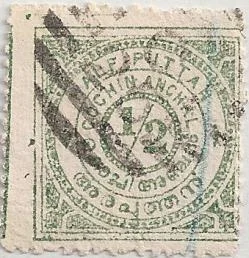
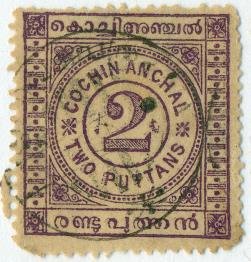
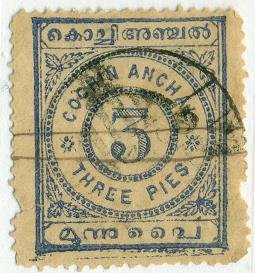
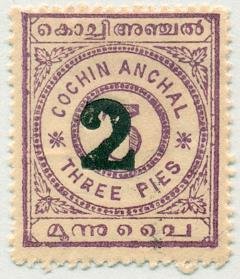
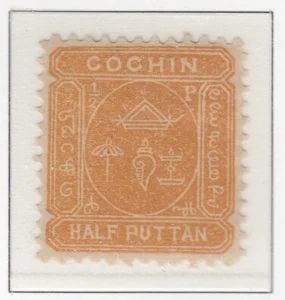
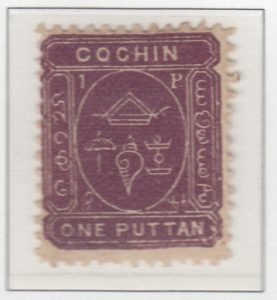
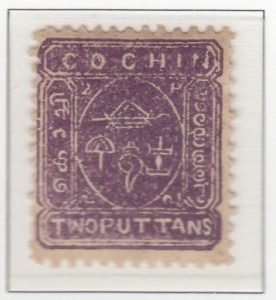
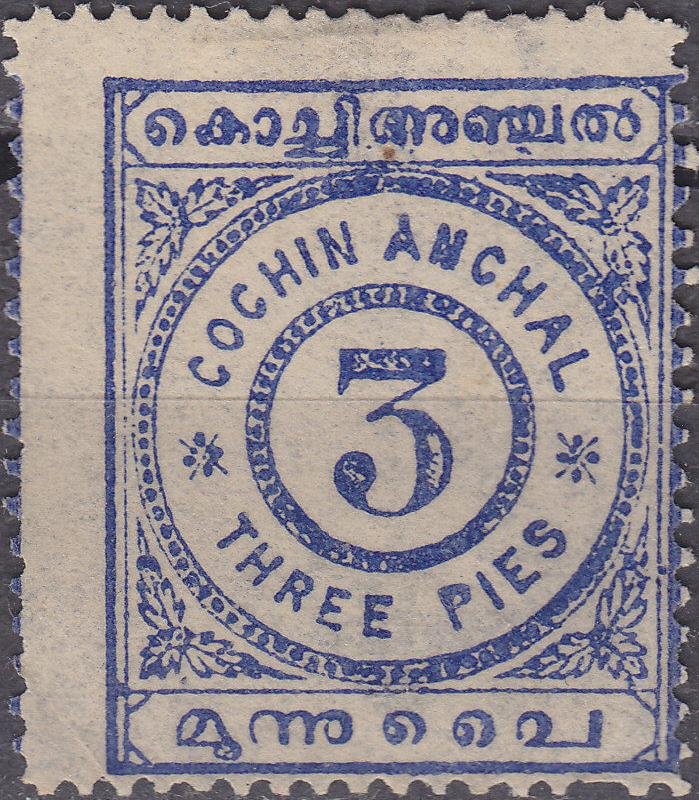
The early currency must be read in full. The puttan (also puthan) is a different unit from the pie; S. P. Luiz describes a puthan as ten pies. The numeral family includes a blue three pies beside the half, one and two puttans, and an album’s abbreviation P is not enough to tell the unit without the issue. The surcharge of 1909, two on three, changes the value to two pies.[4][17]
The emblems
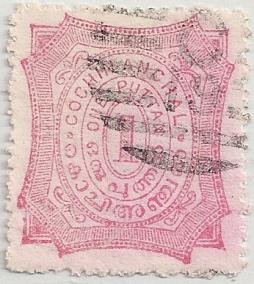
The seal places Cochin’s emblem in an oval, with the value in English and Malayalam. Luiz reads the palanquin, umbrella, conch and lamp as progress, protection, plenty and instruction, and Derek Palmer gives a similar reading of the portrait frame, in terms of abundance and education. These are later explanations, not the artist’s brief; the editor of 1900 was unsure of several of the shapes and did not explain them all.[4][51][47]
Who made the first stamps
A specialist exhibit attributes the early dies to P. Orr & Sons of Madras and the typographic printing to the Cochin Government at Ernakulam, and a Madras trade directory lists Orr as engraver and seal and die cutter. Luiz’s account of 1972 says the same: the dies by Orr, the printing by the Cochin Government Press at Ernakulam, two different jobs. Neither names the designer or the engraver, and the original order has not been found.[25][26][27][4][36]
The editor of 1900 was more cautious. He thought the first stamps were typographed, probably from plates of electrotypes or casts, and from differences between the values inferred that each was drawn separately, without naming the makers.[47][4]
The enlarged one puttan
An enlarged one puttan is dated “end 1896(?)” by inference; the editor first saw it in January 1897, and the question mark stays. Evans saw sheets of the half and two puttans with the small umbrella watermark in September 1897, and the one puttan in August 1898: dates when stamps were seen, not first uses.[47]
The numeral issue of 1898
A notice of August 1899 reports that sheets of the half and one puttan were printed from the earlier blocks with the currency in the margin revised to Puthen, and separately describes envelopes with an embossed government mark on the flap. The margin helps identify a printing where it survives. The editor of February 1900 dates the numeral issue “October (?) 1898”; Nankivell’s quotation of 1907 drops the question mark, and a later catalogue gives 1896 for the choice of the design.[28][27][34][47]
Evans’s study of February 1900 connects the numeral design with its production. He took the plates to be electrotypes or casts, with the frames built up from printer’s rule. The sheet size varied with the value, so that every sheet was worth 24 puttans. He saw extra rows of perforation in the margins and suggested, as no more than an explanation, that they were machine tests.[45]
| Value | Stamps to the sheet |
|---|---|
| 3 pies | 80 |
| ½ puttan | 48 |
| 1 puttan | 24 |
| 2 puttans | 12 |
The first two-puttan sheets described in 1900 had twelve stamps in two horizontal rows of six; the later numeral two puttans also came in twelves, but in two columns of six. The number alone does not give the layout.[45][47]
Paper and the umbrella watermark
An umbrella on Cochin paper did not always mean one neat umbrella behind each stamp. Evans described thin sheets that looked unwatermarked and thicker opaque paper with a large umbrella spread across the sheet: he measured it at 102 mm wide, the stick at least 110 mm long, with 32 mm between watermarks, so that his sheets showed only the top of one and part of another stick. A single stamp without a watermark is therefore not proof of unwatermarked paper. He later saw thinner paper with small umbrellas, but could not say when it came in.[44][45]
The first-series paper was comparatively thin, greyish-white wove, varying in thickness and tint, the half and two puttans usually more opaque than the one puttan. The first sheets held 48 half puttans in eight rows of six, 24 one puttans in four rows, and 12 two puttans in two rows of six.[47][44]
The larger numeral designs of 1898 did not fit the small-umbrella spacing: on one half-puttan sheet Evans counted ten rows of seven watermarks across eight rows of six stamps, sideways to the stamps. He also recorded a double horizontal perforation on the three pies and a two-puttan vertical pair imperforate between, and margins with English value inscriptions (Puthen, Puthens) where the stamps say puttan.[45]
The enlarged one puttan, known to Evans by January 1897, measured 25 × 30 mm against 19 × 23 mm, in sheets of 36, six rows of six. Its thicker white wove paper had a sheet watermark of the central emblems inside a circular band about 85 mm across lettered COCHIN GOVERNMENT, with J. D. & Co. Ld. — CROXLEY MILL below in two lines: a papermaker’s mark, not a printer’s. He thought it printed as before but allowed that it might be lithographed. The editor suggested it was an experimental issue printed only once before the earlier type returned. Luiz says the stamps of 1896 were first fiscal and later allowed for postage.[44][47][4]
Luiz gives thick white paper with a smaller umbrella and perforation 12 to 1903, and two types of the figure 2 overprinted on the three pies in 1909.[4]
Sources
- [3] W. Michael Adkins, Cochin, Indian Princely State Album, revised to February 2018, pp. 1–11.
- [4] S. P. Luiz, Stamps of Cochin, Kalamassery, 23 February 1972.
- [6] David Feldman, 2013 auction lot 41015: Cochin 1949 2¼-anna Dutch Palace, identified as the issued monochrome stamp.
- [7] Stamp-auctions.de, 19 October 2021, lot 2326: Cochin 1949 Chinese Nets, 2-anna black issue.
- [17] William E. Steiner, India—Feudatory States, Cochin album pages, PDF pp.32–49. Machine-readable denomination labels read.
- [25] “History of Cochin Anchal”, exhibit, Virtuafil.
- [26] Madras commercial directory, transcription by the Families in British India Society: P. Orr & Sons, engravers and seal and die cutters.
- [27] E. J. Nankivell, “Countries of the World: Cochin”, Gibbons Stamp Weekly, vol. 5, 1907, pp. 81 and 83.
- [28] The Philatelic Journal of Great Britain, 10 August 1899, p. 148, Cochin notice.
- [34] David Feldman, Indian States auction catalogue, 8 December 2017, p. 46.
- [36] Gibbons Stamp Monthly, May 2008, Cochin portion of southern Indian states survey.
- [44] E. B. Evans, Cochin, Stanley Gibbons Monthly Journal, 28 February 1900, p. 184.
- [45] E. B. Evans, Cochin, Stanley Gibbons Monthly Journal, 28 February 1900, p. 185.
- [47] The Editor (attributed to E. B. Evans), “The Stamps of Some of the Native States of India: Cochin”, Stanley Gibbons Monthly Journal, 28 February 1900, p. 183.
- [51] Derek Palmer, The Proofs of Cochin, Essay-Proof Journal no 94 (1967), pp 55–59 Supplementary reading: All five original pages.
Notes 0
Add what you know: a cover or stamp in your collection, a date or source, a correction or a question.
No notes yet.
Sign in to add a note.
Notes show straight away. Keep them kind and about the article; anyone can report one that isn't. House rules
