
Jaipur Before Its Stamps: Seals, Runners, a Coin-Weight Tariff and RAJ Service, 1861–1904
How Jaipur’s post worked before 1904: the seals of the 1861 rules, ziledars and runners, a tariff measured in coins, thikana agents, the Brahmani Dak, and the RAJ Service marks on British Indian stamps.
Updated May 14, 2026
In this article
Jaipur’s stamps begin in 1904, but its postal markings lead back into an older system run by district officials, runners and seals.
Paid, bearing and service seals
The rules of 1861 described by Adrian V. Kemmenoe separated four kinds of seal: square seals for service mail, red circular marks for postage paid, black circular marks for postage due, and octagonal marks for items needing a receipt. Shape, colour and function worked together, and an attractive seal on an old letter has to be read within that system.[6]
Kemmenoe warns that older marks sold as “chieftain seals” had no postal validity: a ruler’s or chief’s seal is not a postage-paid mark. His illustrated pre-stamp cover has a square red seal and a service inscription, identified as official correspondence; the red colour alone would not show its purpose.[6]
How a letter moved
The 1861 arrangements made district officials part of the post. A ziledar gathered official and private letters into bags for each destination, sealed them and sent them by harkaras, or runners; relay points called chaukies let runners hand over. A statement inside the bag listed its contents, the destination was written outside, and the bag was to come back through the system rather than be thrown away.[10]
District headquarters received the four classes of seal; officials elsewhere were told to write the same information on each letter. A handwritten paid, unpaid or service endorsement may therefore record an authorised stage of handling, not an improvised substitute.[10]
Mail needing a delivery receipt travelled with a separate paper slip. S. D. Singh compares this with an acknowledgement form, while making clear that the instruction concerned a blank slip, not a printed registration form.[10]
A tariff measured against coins
The 1861 schedule measured weight against coins, not in tolas. Up to the weight of one pice the charge was two pice; from one to three pice in weight, one anna; from three pice up to one seer, two annas. These are the historical terms as Singh transcribes them and should not be turned into grams without knowing which coins and standards were meant.[10]
A delivery receipt doubled the charge, to one, two and four annas. Payment by the addressee did not change the rate in this account, so an early bearing letter was not automatically charged double. The state disclaimed responsibility for valuables sent this way.[10]
| Weight | Ordinary charge | With a delivery receipt |
|---|---|---|
| Up to the weight of one pice | 2 pice | 1 anna |
| One to three pice in weight | 1 anna | 2 annas |
| Three pice in weight to one seer | 2 annas | 4 annas |
Thikana agents and the private post at the boundary
The network also reached places where the state had no officer of its own. Singh lists Kot Putli, Sikar, Nawalgarh, Fatehpur, Lachhmangarh, Khetri and Ramgarh as centres served by mutsaddis appointed to receive bags, send them on and add local letters, at five rupees a month, ten at Sikar. That was forwarding work; it does not make every local chief’s seal a State postage mark.[10]
The 1861 manual restricted the competing Mahajani posts. Singh describes State runners exchanging bags at the boundary with a contractor carrying mail towards Tonk, Bundi, Kota and Shahpura, the Brahmani Dak; records of arrears owed by the contractor Lun Karan and his family show the connection lasted beyond 1861. His suggestion that it ended about 1873 rests partly on its absence from the 1885 manual; there is no dated closure order.[10]
RAJ Service: a departmental mark on British Indian stamps
British Indian stamps marked RAJ Service have their own place in Jaipur’s history. In February 1892 Stanley Gibbons Monthly Journal illustrated two types and still questioned their attribution to Jeypore. In April 1892 it reproduced a Resident’s letter of 17 February 1892: the Engineering Department had overprinted British postal labels the year before to keep track of stamps used in the Durbar’s service, and had stopped after the postal authorities objected. The journal also noted a separately reported copy postmarked Ju. 7–88.[45]
A letter of 13 April 1893 from the Superintendent of Post Offices, Upper Rajputana Division (his signature illegible), reproduced in July 1893, said the Engineering Department had used Imperial stamps with Raj Service added by rubber stamp, like merchants’ marks, and that there were no special Raj Service stamps in the state. Neither document creates an earlier issue of Jaipur’s own stamps.[46]
The accounts were not uniform. In November 1896 an unnamed former Resident said the Public Works Department’s use had State sanction and had stopped because the Government of India objected to overprinting by anyone but its own officials; he compared the marks’ official standing with Gwalior’s or Patiala’s. The difference is between authorised departmental use of Indian stamps and a recognised State issue, not simply between genuine and forged. Later clippings of 1922–23 also describe the mark as a departmental anti-theft or accounting imprint.[47][49][50]
How it was applied is still uncertain. The 1893 letter says rubber stamp; David Padgham later separated a form with RAJ in capitals and Service in lower case from all-capital and lower-case forms, and proposed letterpress for one and possible handstamping for another, marking both as tentative. He left some lower-case copies in doubt and asked for unquestioned originals, preferably properly postmarked. Record capitals, lower case, punctuation and impression without inventing a printer, a setting or a test of genuineness.[48][46]
This security mark must also stay apart from the much later Jaipur SERVICE stamps and the Raj Service Stamp rules of 1928. Shared wording does not make them one issue.[16]
Where Jaipur was
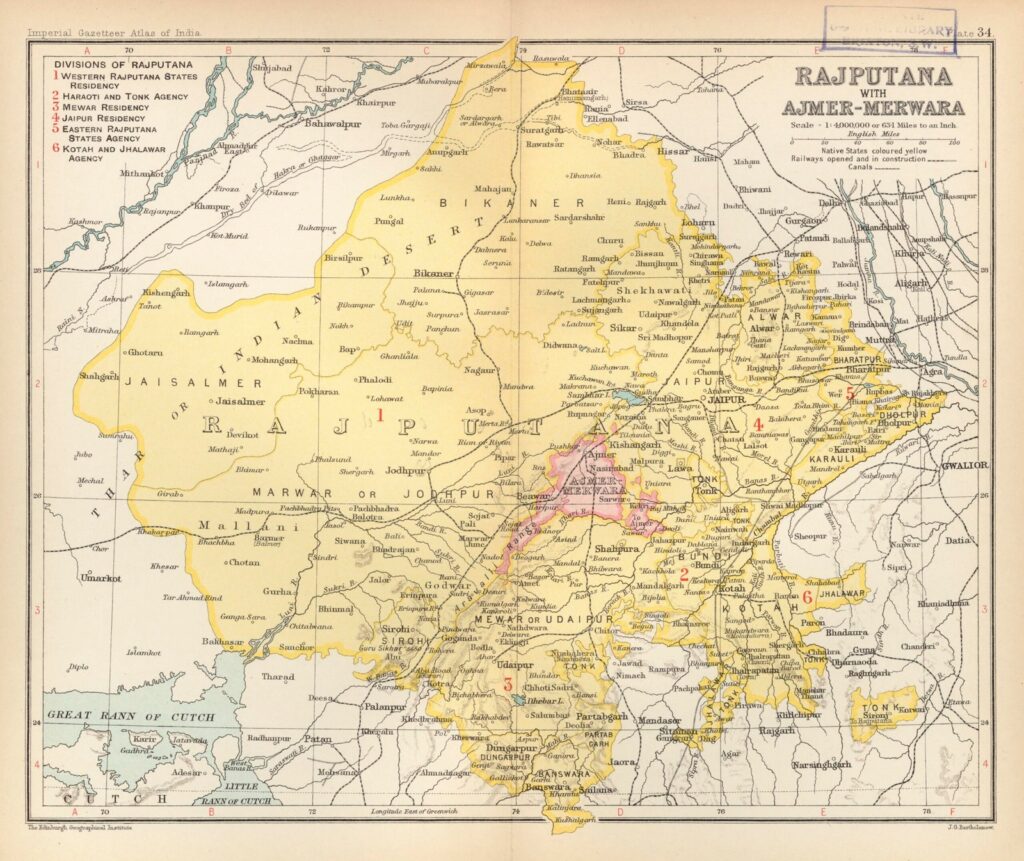
Jaipur lay in eastern Rajputana. Its planned capital succeeded Amber as the royal centre. The 1909 atlas places Jaipur and Amber among the Rajputana States, coloured yellow like all Native States; its railways do not show postal routes.[2][18]
Sources
- [2] Encyclopædia Britannica, 11th edition (1911), “Jaipur”.
- [6] Adrian V. Kemmenoe, “A brief introduction to the postal markings of Jaipur State”, Postal History, no. 285, pp. 16–18.
- [10] Justice S. D. Singh, “Early postal administration in Jaipur State”, pp. 33–37.
- [16] Report on the Administration of the Jaipur State for 1936–37, published under the orders of the Council of State, Allahabad: Allahabad Law Journal Press, 1939.
- [18] The Imperial Gazetteer of India, vol. XXVI: Atlas, new edition, Oxford: Clarendon Press, 1909, plate 34, “Rajputana with Ajmer-Merwara”, J. G. Bartholomew, 1:4,000,000.
- [45] Stanley Gibbons Monthly Journal, 29 February 1892, p. 211, and 30 April 1892, p. 325: Jeypore notices.
- [46] Stanley Gibbons Monthly Journal, 31 July 1893, p. 5: Jeypore notice, with a letter of 13 April 1893.
- [47] Stanley Gibbons Monthly Journal, 30 November 1896, p. 77: Indian Native States, Jeypore.
- [48] David Padgham, “RAJ SERVICE – Security Overprint on Indian Adhesives”, typescript, signed 11 April 1993.
- [49] Two RAJ Service clippings annotated as The Stamp Lover, vol. XV, p. 47 (1922) and March 1923, p. 202.
- [50] Undated Jeypore RAJ Service catalogue clipping, with six stamp illustrations.
Notes 0
Add what you know: a cover or stamp in your collection, a date or source, a correction or a question.
No notes yet.
Sign in to add a note.
Notes show straight away. Keep them kind and about the article; anyone can report one that isn't. House rules
