
Jaipur’s Raj Postal Department, 1905–1939: Offices, a Refused Convention, the Jail Press and the Rules
The Raj post beside the Imperial offices: office counts from 112 in 1906 to 131 in 1939, the convention Jaipur asked for and was refused, the newswriters, the Superintendent of 1936, the State Press in the Central Jail and the rules of 1937.
Updated November 10, 2026
In this article
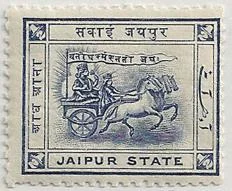
Jaipur ran its own Darbar or Raj post, and the Imperial post kept its own offices inside the state. The administration reports keep the two apart, and so should a collector.
The network after the first stamps
The report for 1 April 1905 to 31 August 1906 describes a thorough reorganisation of the State Postal Department, with eight postal lines, 112 post offices and 130 letterboxes, up from 99 offices in the Residency’s previous report. A later report counts eight mail lines and 119 Darbar post offices, against 114 in 1907, with 153 letterboxes in Jaipur city and the district; although it is the report for the year ending August 1909, printed in 1910, its postal figures are explicitly those for the year ending 31 August 1908. The counts give the scale, not the names of the lines or an office-by-office history.[14][15]
| Period reported | Post | Offices | Other |
|---|---|---|---|
| April 1905 – August 1906 | Darbar / State | 112 | 8 lines; 130 letterboxes |
| Year ending 31 August 1908 | Darbar / State | 119 | 8 lines; 153 letterboxes |
| Close of 1936–1937 | Raj / State | 115 | 2 head offices, 1 sub-office, 112 branches |
| 1936–1937 | Imperial offices in Jaipur | 82 | Separate from the Raj total |
A convention asked for, and refused
The 1905–06 report records the Darbar’s wish for a postal convention with the Government for exchanging correspondence between the Imperial and Darbar departments; the proposal was “under reference”. The report for the year ending August 1909 says negotiations were still in progress. That is evidence of an effort, not of a convention in force, and it does not make Jaipur a Convention State or widen its stamps’ validity.[14][15]
Geoffrey Clarke, in The Post Office of India and Its Story (1921), writes that Jaipur asked for a convention and was refused, under the Government’s policy of moving towards a unified postal system. He gives no date or reference, and the convention-state clauses printed near his account do not apply to Jaipur.[61]
Newswriters and a Superintendent
The 1928–29 report records 115 Raj offices, with the postal work in the districts entrusted to the Khabar Nawises, or newswriters, of the Khabar Department, and 65 Imperial offices, up from 63 in 1927–28. In 1930–31 Walghat and Bhandarej closed and Gudha-Chanderji and Bhabhru opened, leaving 115 Raj offices beside 68 Imperial ones. The 1934–35 report describes postal work as an addition to the newswriters’ other duties, and records Bai’s closure and Mehdipur’s opening, again leaving 115. These are yearly snapshots without exact days.[52][58][53]
During 1935–36 Jaipur separated its Raj Postal Department from the newswriters. The report names Rai Sahib Munshi Kishen Dayal Singh, a retired Superintendent of the Indian Posts and Telegraphs Department, as full-time Superintendent from 1 March 1936, the day the newswriters were relieved of postal duties. It records a Central Post Office and 113 branches, 114 Raj offices beside 82 Imperial ones, and 32 new letterboxes, taking the total from 149 to 181, with better clearing. It also says the State and Imperial posts had no interchange.[55]
Two postal systems in 1936–37
The 1936–37 report says it plainly: Jaipur had its own Postal Department and issued its own stamps, with 115 Raj post offices at the end of the year, and 82 Imperial post offices also worked in the state. The same place name on two covers does not mean both belonged to the Raj post.[16]
That year Phulera’s branch office became a head office and Dausa’s a sub-office, giving two head offices (Jaipur and Phulera), one sub-office (Dausa) and 112 branch offices at administrative headquarters and important villages in Khalsa and Jagir areas. More letterboxes were installed, the delivery staff strengthened, and stamps were sold through postmen and overseers to reach remote parts; the report calls them simply “stamps”, not Imperial stamps.[16]
In 1938–39 the branch offices at Bandikui, Gangapur, Khetri and Sikar were raised to sub-offices, and at the end of the year the Raj system had two head offices, eight sub-offices and 121 branches; fourteen letterboxes took the total from 259 to 273.[59]
Rules in force in 1937
An appendix to the 1936–37 report lists the laws and rules in force on 31 August 1937, among them rules on the introduction of Raj Service Stamps (1928), certificates of posting in Raj post offices (1929), the charging of Bata in Raj post offices (1934) and the recovery of postage due on all classes of article (1936). It gives titles only, not the rules, so it cannot supply a fee, the basis of Bata or a postage-due formula. The 1936 list gave the Bata rule as item 68 and the postage-due rule as item 81; the 1933–34 report’s postal page is hidden by a map in the surviving scan.[16][53][55][56]
A rule of 1932 required “Jaipur” or “Jaipur State” after the name of the thikana and before “Rajputana” in addresses on letters from the thikanas: context for addresses on surviving letters, not proof that everyone complied or of a cover’s route.[16]
A press inside the Central Jail
The 1936–37 report places the State Printing Press inside the Central Jail, its manager under the jail superintendent’s general control. Besides paid staff it used convict labour, for which it paid the jail Rs. 5,000 a year; a clerk was added that year. The staff were a press manager, foreman, proof reader, clerk, storekeeper, head compositor, two compositors, eight machine and press men, a lithographic copyist and a daftri. More type was bought for Rs. 994, and the year’s work was valued at Rs. 45,423, a figure for the whole press, not for stamps.[16]
The report names the State Press as printer of the Jaipur State Gazette, but in these passages not as the maker of any postage stamp; the report’s own imprint, the Allahabad Law Journal Press, is the printer of that volume only.[16]
The Gazette
The Jaipur State Gazette appeared on the 1st and 15th of each month in English, Urdu and Hindi, printed by the State Press and published by its manager. Copies went free to State departments and offices and were exchanged with the gazettes of some other states; a year’s subscription was Rs. 3 locally and Rs. 4 outside Jaipur, a subscription, not a postage rate. The report records 271 copies issued during the year, 158 of them free, against 281 in 1935–36.[16]
Fiscal stamps were another department
A section headed “Stamps” in the 1936–37 report concerns court-fee and revenue stamps: printed on the orders of the Finance Minister of the Council and kept and sold at the Sadar Treasury, Jaipur. The Raj Postal Department follows, under Kishen Dayal Singh. The finance officers named, Rai Bahadur Pandit Amarnath Atal (Finance Minister, on leave outside India), Dewan Bahadur Lala Vaishnava Das (Special Accounts Officer, officiating Finance Minister from 24 April to 23 September 1937), Mr. B. G. Bhattacharyya (Treasury Officer) and Mr. D. N. Sen (Accountant-General), had no recorded part in ordering postage stamps.[16]
A request to the School of Arts, 1925
A photographed letter of 3 December 1925 from the Finance Department to the principal of the School of Arts, sold by Gärtner as lot 1111, concerns contemplated one-anna stamps: it asks for a block to be made at the school and refers to a type sent as a model. It records a request, not a finished design, and does not say whether the stamps were postal or fiscal.[17]
An address for military mail
From 11 September 1936 the office of Chief Staff Officer, Jaipur State Forces, was abolished, and correspondence for the Chief Commandant or Chief Staff Officer was to be addressed to “Headquarters, Jaipur Army”. That is context for addresses, not evidence of a military post office or a route.[16]
Sources
- [14] Annual Administration Report of the Jaipur State for the period from 1st April 1905 to the 31st August 1906, Abu: R. A. Press, 1907.
- [15] H. L. Showers, Annual Administration Report of the Jaipur State, for the Year ending 31st August 1909, Mount Abu: Rajputana Agency Press, 1910, p. 8, §§75–76.
- [16] Report on the Administration of the Jaipur State for 1936–37, published under the orders of the Council of State, Allahabad: Allahabad Law Journal Press, 1939.
- [17] Christoph Gärtner, 17th auction, Indian States, 7 March 2011, Jaipur lots 1095–1117, plates pp. 49 and 51.
- [52] Report on the Administration of the Jaipur State for 1928–29, Allahabad: The Pioneer Press, 1930, p. 34, §§224–226.
- [53] Report on the Administration of the Jaipur State for 1934–35, Allahabad: Allahabad Law Journal Press, 1936, p. 36, §§213–215, and Appendix XIX.
- [55] Report on the Administration of the Jaipur State for 1935–36, Allahabad: Allahabad Law Journal Press, 1937, pp. 36–37 and 55.
- [56] Report on the Administration of the Jaipur State for 1933–34.
- [58] Report on the Administration of the Jaipur State for 1930–31, Allahabad: The Pioneer Press, 1932, p. 44, §§215–217.
- [59] Report on the Administration of the Jaipur State for 1938–39, Ajmer: Vedic Yantralaya, 1941, pp. 34–35, §§198–203.
- [61] Geoffrey Clarke, The Post Office of India and Its Story, London: John Lane, 1921, chapter XII, p. 116.
Notes 0
Add what you know: a cover or stamp in your collection, a date or source, a correction or a question.
No notes yet.
Sign in to add a note.
Notes show straight away. Keep them kind and about the article; anyone can report one that isn't. House rules
