
Jaipur Tariffs, Postmarks and Covers: the Sun Cancellations, Travelling Offices and the Rates of 1942–1947
Jaipur’s cancellations with and without the sun, sorting and delivery marks, R.S., T.P.O. and MOTOR route marks, cards that crossed both posts, Raj stamps on Imperial stationery, and the tariffs of 1942, 1944 and 1947.
Updated October 12, 2026
In this article
One sun emblem, several office systems
The early cancellers of outlying offices combined an office number and an abbreviated name in Devanagari; later designs added the sun and then dates. Jaipur City had its own sequence: Kemmenoe records dated city designs without a sun from 1904 into early 1937, though many other State marks carried it, so a missing sun does not rule out a Jaipur City mark.[6]
English-language designs came to the outlying offices in 1936 and to the city from 1937. Dated cancellations used the Gregorian calendar even when lettered in Devanagari, so do not read a Samvat year from the script.[6]
Sorting, delivery, registration and experimental offices
In Jaipur City, inscriptions such as SOR and DELY separated sorting and delivery and included the time as well as the date; other city marks were for despatch, registration or the dead-letter office. Registered letters first carried a “Raj Sadari” rectangle at Jaipur City, later a rectangle with R and the office name; Kemmenoe’s registered cover of 19 August 1915 keeps the earlier rectangle beside a city cancellation. At outlying offices a registration rectangle could go with the ordinary circular mark.[6]
Numbered Experimental P.O. cancellers served offices on trial, and a number could move between places, so an isolated number cannot be given a permanent location. Money-order and savings-bank devices also turn up on postal items without having been designed as cancellers.[6]
Railway station, railway route and motor route
H. Garratt-Adams’s study of travelling offices makes a useful distinction: Jaipur R.S. means railway station, and that mark is not a T.P.O. Route marks carry a route name or later a code, with the sun, the date and sometimes a set number. His concluding instalment links J-1 with Jaipur–Jhunjhunu and J-2 with Jaipur–Hindaun, and records MOTOR devices for road services such as Jaipur–Toda Rai Singh and Jaipur–Ghonsla. His dates are the copies he saw, not opening dates; he lacked the records to explain every route change, including a suggested reorganisation of 1946, and Kemmenoe later questioned whether some earlier marks were true travelling offices.[7][6]
Reading a journey from a whole card
Kemmenoe’s card of February 1907 from Chomu to Gangapur combines a numbered cancellation of origin, a dated destination mark with the sun and a Jaipur City transit mark. Another card, redirected from Naraina to Sawai Madhopur, carries English office marks, a Devanagari T.P.O. mark, a Postage Due device and a DEP mark, each from a different stage. Record the front and back, the address and redirections, every readable office and date, service marks and charges, and compare them with the tariff in force.[6]
Köhler’s 2021 catalogue, lot 10800, describes an Edward VII quarter-anna card of 1910 from Shahdara to Jaipur, missent to Jodhpur and then redirected through Jaipur City’s Imperial exchange office into the State post. The catalogue reads its black Bearing mark and red boxed Devanagari strike as the transfer and receipt after the day’s mail had left; the route, date and translation are the catalogue’s.[62]
Ashok Kumar Bayanwala illustrates a postcard he traces from Bandikui towards Dausa in March–April 1940, with postage-due and DLO marks at Sawai Jaipur before its return towards Bandikui. He attributes the charge to paper attached to the card and infers that the addressee refused it, citing the Indian Postal Guide of December 1882; his text gives 4 and 5 April for the DLO, his chart 4 April. Neither a half-anna penalty nor its collection is established.[63]
Sandeep Jaiswal illustrates a registered cover with two two-anna stamps and a half anna and a boxed registration mark, and explains the 4½ annas as half an anna postage, three annas registration and one anna acknowledgement, his interpretation of one cover.[57]
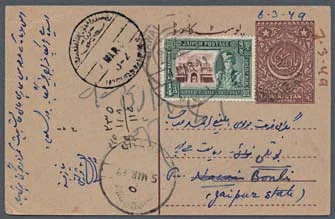
Raj stamps on Imperial stationery, 1938
The 1938–39 report describes an arrangement begun in June 1938 under which Imperial postcards and envelopes were sold with Raj stamps attached, made permanent during the year. It was a selling arrangement for combined postage, not a convention or a new stationery issue, and the report gives no offices or amounts.[59]
The tariff of 1 December 1942
From 1 December 1942 a postcard cost six pies and a reply card one anna. An envelope cost nine pies for the first two tolas and six pies for each further two tolas or part. The notice writes the amounts as 0-0-6, 0-1-0 and 0-0-9, rupees, annas and pies, which keeps six pies from being read as six annas. Insurance cost three annas for 100 rupees, five for 200 and seven for 300, and two annas for each further 100 or part, on top of postage.[4]
The increase of 1 October 1944
From 1 October 1944 the basic envelope rate rose from nine pies to one anna, and registration from two annas to two annas six pies, under Government Order 1142 S.C. of 5 September 1944, in a notice signed by the State postal superintendent, Bhagirath Singh.[4]
1 January 1947: cheaper postage and an exchange
From 1 January 1947 the postcard fell from half an anna to a quarter and the envelope from one anna to three-quarters. During January unspoiled stationery of the higher values could be exchanged for its value, but not if defaced, torn, cut, imperfect or written or drawn on. The same Gazette page raised the yearly limit for postal savings-bank deposits from 1,000 to 5,000 rupees: the department ran a savings bank as well.[5]
| From | Postcard | Envelope | Registration |
|---|---|---|---|
| 1 December 1942 | 6 pies (reply card 1 anna) | 9 pies for 2 tolas; 6 pies each further 2 tolas | — |
| 1 October 1944 | — | 1 anna | 2 annas 6 pies (from 2 annas) |
| 1 January 1947 | ¼ anna (from ½) | ¾ anna (from 1 anna) | — |
Sources
- [4] Jaipur State Postal Department, postal notice effective 1 December 1942, signed Bhagirath Singh, Superintendent; with the notice under Government Order 1142 S.C. of 5 September 1944, effective 1 October 1944.
- [5] The Jaipur Gazette, 1 January 1947, p. 33, State Postal Department notices, Government Order 1766 S.C., 24 December 1946.
- [6] Adrian V. Kemmenoe, “A brief introduction to the postal markings of Jaipur State”, Postal History, no. 285, pp. 16–18.
- [7] H. Garratt-Adams, “Indian States Travelling Post Offices (1) Jaipur State”, The Philatelic Guide, Spring 1961, pp. 10–13, concluded Winter 1961–2, pp. 40–43.
- [17] Christoph Gärtner, 17th auction, Indian States, 7 March 2011, Jaipur lots 1095–1117, plates pp. 49 and 51.
- [57] Sandeep Jaiswal, The First Issue of Jaipur, specialist exhibit, hosted by Richard Frajola.
- [59] Report on the Administration of the Jaipur State for 1938–39, Ajmer: Vedic Yantralaya, 1941, pp. 34–35, §§198–203.
- [62] Heinrich Köhler, auction 377, Gems of Indian States 1864–1950, 21 September 2021, lot 10800, pp. 150–151.
- [63] Ashok Kumar Bayanwala, “DLO of Jaipur”, Vadophil nos. 175–177, July 2023 – January 2024, p. 5.
Notes 0
Add what you know: a cover or stamp in your collection, a date or source, a correction or a question.
No notes yet.
Sign in to add a note.
Notes show straight away. Keep them kind and about the article; anyone can report one that isn't. House rules
