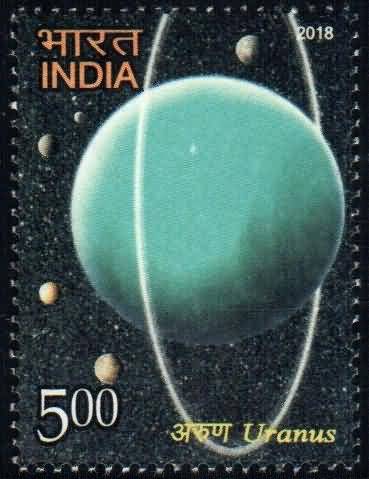
About this stamp
The Enigmatic Seventh Planet
Uranus, the seventh planet from the Sun, holds a special place in our Solar System for its unique characteristics and serene blue-green glow. Known as the “Tilted Planet”, Uranus rotates at an unusual angle of 98 degrees, making it appear to roll around the Sun on its side. This extraordinary tilt gives rise to extreme seasonal variations, with each pole experiencing 42 years of continuous sunlight followed by 42 years of darkness.
Composition and Structure
Uranus’s atmosphere is primarily composed of hydrogen and helium, similar to Jupiter and Saturn, but with a higher presence of “ices” such as water, ammonia, and methane. It is this methane content that scatters sunlight and gives the planet its signature pale blue color.
Beneath its calm exterior, Uranus hides a deep interior made up of ices and rocky materials, earning it the classification of an ice giant. Its average density of 1.27 g/cm³ makes it the second least dense planet after Saturn. Despite its seemingly tranquil appearance, Uranus is a world of intense cold — the coldest planetary atmosphere in the Solar System, with temperatures plunging to –224°C (49 K).
Orbit, Rotation, and Discovery
Uranus takes 84 Earth years to complete one revolution around the Sun, while its rotational period is approximately 17 hours and 14 minutes. It was discovered in 1781 by the astronomer William Herschel, marking the first time a planet was identified using a telescope. This discovery expanded the known boundaries of our Solar System and inspired generations of astronomical exploration.
Moons and Rings
Uranus is surrounded by a delicate system of rings and at least 27 known moons, many of which are named after characters from the works of Shakespeare and Alexander Pope — including Titania, Oberon, Miranda, Ariel, and Umbriel. These moons and rings form a graceful celestial ensemble that orbits the planet, adding to its mystique and beauty.
Philatelic Tribute to Uranus
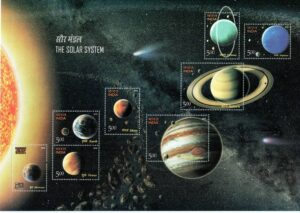
In celebration of the vast wonders of our Solar System, the Department of Posts issued a commemorative postage stamp on Uranus. The stamp artistically portrays the planet’s soft blue-green hue and unique axial tilt — a striking visual that captures its quiet majesty and scientific intrigue.
This philatelic issue stands as a tribute to human curiosity and discovery, honoring Uranus as a symbol of the unknown frontiers that continue to inspire exploration and wonder.