About this stamp
The Bright Jewel of the Sky
Venus, the second planet from the Sun, shines brilliantly in the sky and is often referred to as both the Morning Star and the Evening Star. Named after the Roman goddess of love and beauty, Venus is one of the most radiant celestial bodies visible to the naked eye. Similar in size and composition to Earth, it is often called Earth’s “sister planet”, though its environment is vastly different and far more extreme.
Physical and Atmospheric Features
Venus orbits the Sun once every 224.7 Earth days and has a slow retrograde rotation, taking 243 Earth days to complete one spin on its axis — the longest rotation period of any planet. This means a day on Venus is longer than its year. The planet’s diameter of 12,103.6 km is only slightly less than Earth’s, and its mass is 81.5% of Earth’s.
Venus has a dense atmosphere made up of more than 96% carbon dioxide, with clouds of sulphuric acid that trap heat through a runaway greenhouse effect. As a result, the planet’s surface temperature reaches an astonishing 735 K (462°C), making Venus the hottest planet in the Solar System — even hotter than Mercury, which is closer to the Sun. The atmospheric pressure on its surface is about 92 times greater than Earth’s, equivalent to being nearly a kilometer underwater.
A World of Extremes
Beneath its thick clouds lies a rocky terrain of mountains, vast plains, and thousands of volcanoes. Despite the harsh conditions, Venus continues to fascinate astronomers as a key to understanding planetary evolution and the delicate balance that sustains life on Earth. Its similarities to Earth have made it an important subject of scientific study, especially in understanding climate change and atmospheric dynamics.
Scientific and Historical Significance
Since ancient times, Venus has inspired poets, scientists, and sky-watchers alike. In modern times, it has been explored by numerous space missions, including NASA’s Magellan, Soviet Venera probes, and the European Space Agency’s Venus Express, all of which have deepened our understanding of its surface and atmosphere.
Venus remains a symbol of beauty shrouded in mystery — a dazzling planet whose brightness hides one of the most inhospitable environments in our Solar System.
Philatelic Tribute to Venus
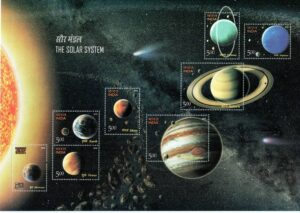
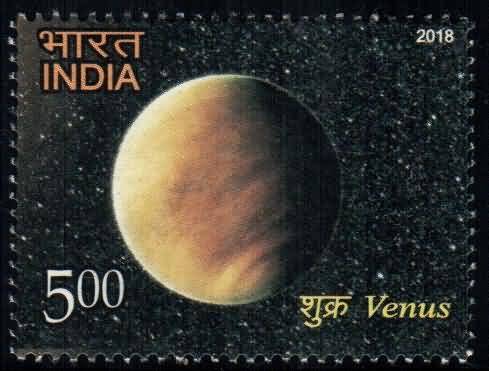
In honour of its celestial brilliance and enduring significance in astronomy, the Department of Posts issued a commemorative postage stamp on Venus as part of the Solar System series. The stamp beautifully captures the planet’s golden glow and cloud-covered surface, representing both its radiance and enigma.