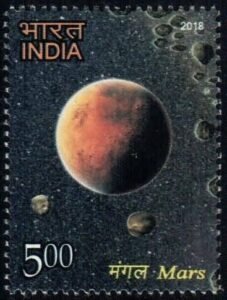

About this stamp
The King Among Planets
Jupiter, the fifth planet from the Sun, reigns supreme as the largest planet in our Solar System. Known as the King of Planets, it embodies immense power and grandeur. Its name, derived from the Roman god Jupiter (equivalent to the Greek god Zeus), reflects its commanding presence and majestic influence over the cosmic realm. Shining brilliantly in the night sky, Jupiter has fascinated astronomers since ancient times and continues to be a subject of deep scientific interest and wonder.
Structure and Composition
Jupiter is a gas giant primarily composed of hydrogen and helium, resembling a miniature star in its make-up. It lacks a solid surface and has an extensive atmosphere marked by swirling cloud bands and colorful storms. The most iconic of these is the Great Red Spot, a gigantic, centuries-old storm system large enough to engulf the Earth.
Beneath its vibrant atmosphere lies a dense core of rock and metal, surrounded by layers of liquid metallic hydrogen, which generates Jupiter’s powerful magnetic field—the strongest of any planet in the Solar System. This magnetic field, combined with its immense gravity, makes Jupiter a protective guardian, deflecting asteroids and comets that might otherwise threaten the inner planets.
Orbit and Rotation
Jupiter takes about 11.86 Earth years to complete one revolution around the Sun, while it rotates extremely fast—once every 9.9 hours—making it the fastest spinning planet in the Solar System. This rapid rotation causes Jupiter’s slightly flattened shape and contributes to its striking banded appearance.
Moons and Rings
Encircling this massive planet is a delicate ring system and an impressive family of over 90 moons, each unique in character. The four largest—Io, Europa, Ganymede, and Callisto—known as the Galilean moons, were first observed by Galileo Galilei in 1610. These moons are worlds in themselves: Io is volcanically active, Europa harbors a subsurface ocean that could sustain life, and Ganymede is the largest moon in the Solar System.
Philatelic Tribute to Jupiter
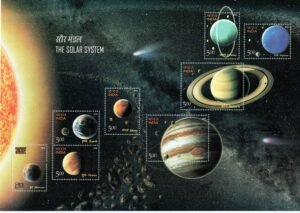
To honor this colossal planet, the Department of Posts issued a commemorative postage stamp on Jupiter as part of its Solar System series. The stamp beautifully depicts the planet’s distinctive bands and the Great Red Spot, symbolizing its turbulent yet majestic nature.
This philatelic issue serves as a tribute to humanity’s unending quest to explore and understand the vast cosmos. Jupiter, with its immense scale and cosmic influence, continues to remind us of the boundless power and mystery of the universe.