
Cochin Postmarks, Railway Mail, Stationery and Covers
Malayalam date seals, the barred C numbers, C. S. IN and OUT on the Shoranur–Ernakulam railway, POSTED IN WRONG TRAIN and TOO LATE, the Anchal envelopes and cards, service cards, receipts, privileged mail and covers between the Anchal and the Imperial post.
Updated November 5, 2026
In this article
Malayalam date seals before the adhesive
An early Cochin seal could carry the year across its top, the office name in the centre and the month and day below, all in Malayalam. The examples before the stamps described in Luiz’s survey of 1972 are circles of about 30–34 mm with a heavy outer line. Read such a seal in its own calendar and script before assigning a Gregorian date or a modern spelling.[4]
One Ernakulam folder he describes combines an Anchal seal with a separate British Indian mark cancelling an Indian stamp: two marks for two postal stages, not a duplicate cancellation. His count of early offices is an estimate and is not an official total.[4]
The barred C numbers
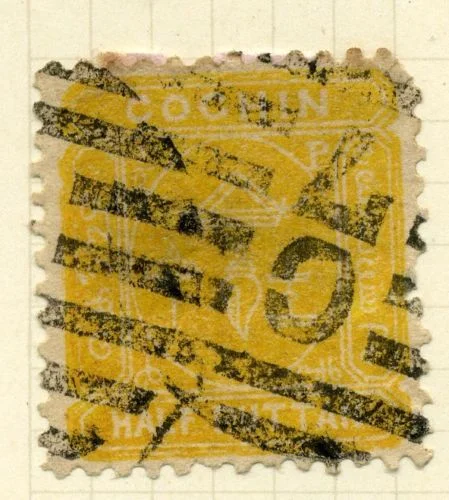
A barred mark with a C and a number is a different instrument from the office’s dated seal. Luiz describes a C above an Arabic numeral, surrounded by horizontal bars without a full circle, used on early puttan stamps and on material after the union with Travancore, so the mark alone cannot date a stamp.[4]
A number is not a fixed office address. Luiz reports C3 at both Ayyimpilly and the palace office, and identifies C1 with Kozinjampara from a registered cover rather than from the importance of the palace. His list records observations, with gaps; keep a named datestamp or the whole cover when assigning an office.[4]
Railway mail across three jurisdictions
Cochin’s railway post ran on a line that crossed political boundaries. G. B. Pai traces the Shoranur–Ernakulam route through Madras Presidency, Travancore and Cochin; goods traffic opened in June 1902 and passengers in July. The Imperial Gazetteer records the 65-mile line as owned by the State and worked at first by the Madras Railway Company. The opening of the railway is not the date of the first railway cancellation.[10]
Pai describes a green mail coach with the royal emblem and records a C. S. IN strike dated 30 KAR 1080, which he converts to 12 August 1905, the earliest he knew. Joseph Stephen’s later exhibit illustrates a letter from Oorakam to Tripunithura dated 1904 with a C.S. IN Set No. 1 mark. Grosvenor’s sale 58, lot 35, describes a card of 11 May 1944 with both IN and OUT marks.[10][24][22]
In Pai’s reading, C. S. IN and C. S. OUT give the direction relative to Ernakulam. Early single-ring devices measure about 23 mm; later ones put the wording, date and set number in separate compartments. Transcribe the set number before deciding whether it identified a clerk or a train: the article discusses both.[10]
The triangular POSTED IN WRONG TRAIN mark records handling, not a cancellation; Pai shows it on a letter sheet and on the back of a cover. It is not a stamp design or a surcharge.[10]
TOO LATE and POSTAGE DUE
Luiz describes a leaf-shaped TOO LATE mark in English and Malayalam. On one two-pie postcard he reads posting on 8 Dhanu and a second dated seal on 9 Dhanu: the mark explains a delay and does not change the card’s value. A rectangular POSTAGE DUE device in the same study has separate compartments for the wording and the amount, one example assessed two annas in Malayalam. Record the charge apart from the stamps and from any routing or late mark.[4]
The envelope as a postal object
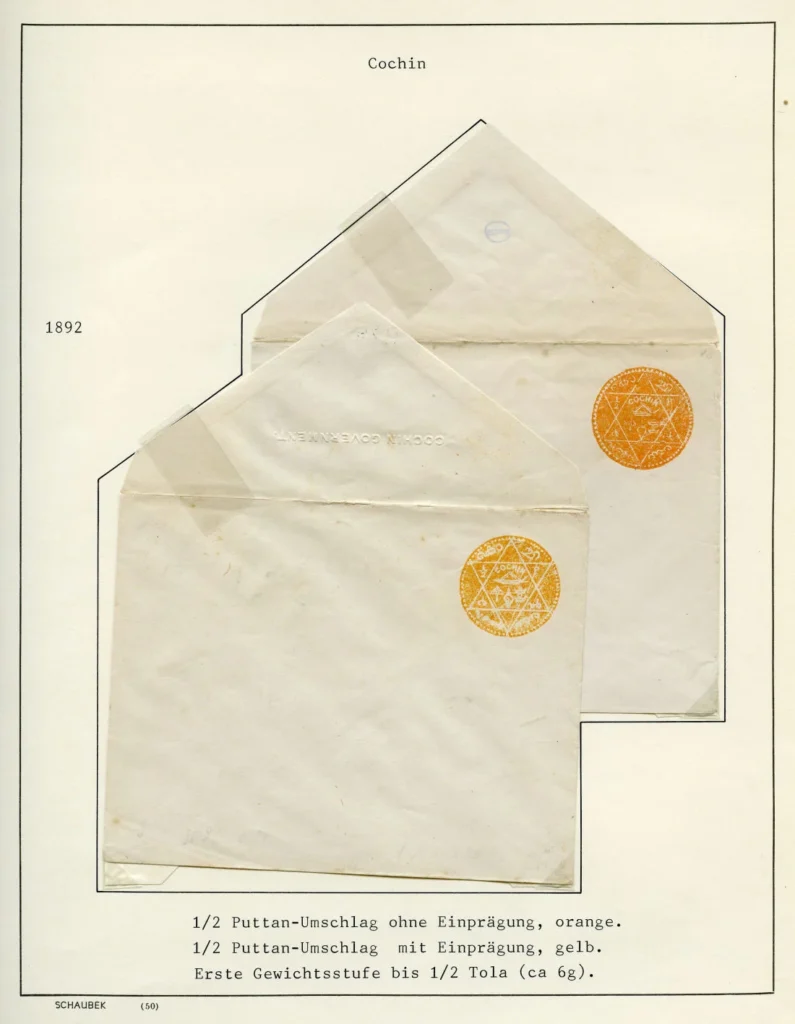
K. T. Varied records puttan envelopes and later royal portraits differing in paper, flap embossing, size and die; cutting out the impressed stamp throws much of that away. His half-puttan envelope cancelled in the Malayalam year 1062 led him to suggest use before the stamps of 1892; the study gives no exact day and no notice, so it stays a lead.[11]
The census of 1901 lists three values of Anchal envelopes then in use, half, one and two puttans, and single and reply postcards at two and four pies. The Superintendent of Stamps was in charge of making, keeping and issuing them, and Anchal masters received a discount of five per cent on sales. Designs and colours changed in 1073 M.E. (1897–98), when three-pie stamps and two-pie cards appeared.[20]
| Kind | Value | Note |
|---|---|---|
| Envelope | ½ puttan | No die, size or colour given |
| Envelope | 1 puttan | No die, size or colour given |
| Envelope | 2 puttans | No die, size or colour given |
| Single postcard | 2 pies | No die or day of issue given |
| Reply postcard | 4 pies | The total value stated |
The 1911 Manual groups three, five, ten and twenty-pie stamps, envelopes of similar values and two- and four-pie single and reply cards with its statement on 1892, then describes a reorganisation “last year”: stamps of 2, 3, 4, 9 and 18 pies, envelopes to match except for 2 and 3 pies, and cards of 2 and 4 pies.[50]
Stanley Gibbons’s sale 5930, lot 457, describes later stationery by Deschl catalogue numbers. These overlap the census list in part and are not five extra issues; the reply card is not automatically the census four-pie card.[21]
| Kind and value | Auction date | Deschl |
|---|---|---|
| Envelope, ½ puttan | 1899 | E4 |
| Envelope, 2 puttans | 1899 | E6 |
| Reply card, value not stated | 1900 | C3 |
| Envelope, 4 pies | 1912 | E7 |
| Official card, 2 pies | 1912 | OC1 |
A service card was not always used officially
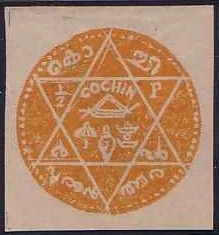
Varied describes the first-portrait two-pie postcard overprinted ON C G S and its later FOUR PIES surcharge, and reports a retired officer’s explanation that worries about secrecy ended official use of open cards; no order to that effect has been seen. Prakash O. K. shows both an officially used service card and a surcharged one described as privately used. Read the message, the sender’s authority and the marks together.[11][12]
Receipts, service-bearing letters and privileged mail
Prakash illustrates a certificate of posting of 1905 on plain paper and advice-of-delivery forms with one-puttan and nine-pie stamps, and dates the acknowledgement fee to one puttan up to the Malayalam year 1086 and nine pies from 1087. He separates SERVICE BEARING letters, charged to the recipient, from privileged unstamped mail, which needed the right authority and signature: a prince’s letter was charged postage because the signature was missing. He also illustrates a first-portrait official letter dated 12.02.89, which he identifies as 1913.[12]
The rates of 1910
The order of 1910 reproduced by Luiz gives the new letter rates: up to ¼ tola 3 pies; over ¼ to 1 tola 4 pies; over 1 to 10 tolas 9 pies; each further 10 tolas or part 9 pies; and newspapers, books and pattern packets 4 pies for each 10 tolas or part. It is a transcription of the order in a book of 1972, not the gazette itself.[4]
| Weight | Charge |
|---|---|
| Up to ¼ tola | 3 pies |
| Over ¼ to 1 tola | 4 pies |
| Over 1 to 10 tolas | 9 pies |
| Each further 10 tolas or part | 9 pies |
| Newspapers, books, pattern packets, per 10 tolas | 4 pies |
Covers between the Anchal and the Imperial post
Keep the whole address, the dispatch and arrival marks, backstamps and any accounting note. A Cochin–Travancore exchange cover may show acceptance under their reciprocal arrangement; a cover addressed farther afield needs evidence of the extra service. Loose stamps cannot show a route or a rate, and a cancelled portrait is not necessarily postally used.[2]
Grosvenor’s sale 58, lot 36, describes a half-puttan envelope of 23 January 1897 redirected to Cutch Mandvi, with an Anchal cancellation, a British Indian half-anna stamp cancelled at Ernacolum the same day, and later Bombay and Cutch Mandvi marks. Lot 37 describes a two-pie card sent to Bombay on 3 March 1902, with an Anchal Malayalam cancellation, an added British Indian half anna cancelled by the Imperial office and a Fort Bombay arrival of 7 March. Both show transfer between the networks; neither gives a general rate.[22]
A Feldman lot describes an Ernakulam-cancelled two-on-three-pies multiple with extra perforations in the right margin, and another lists unprinted umbrella-watermarked paper with Perkins Bacon proof cachets: a cancellation and a production clue, and evidence of the watermark.[33]
When a palace letter could not be delivered
An envelope in Grosvenor’s sale of 2018, lot 500, shows the dead-letter procedure. Both sides are pictured, with a printed D.L.O. Slip No. 2 on the front, a manuscript reference to the Maharaja’s Palace, and several Anchal office marks on the back, among them Tripunithura and Irinjalakuda. The catalogue calls it an official free envelope of 1937 from the palace to Pariyanam, a spelling that differs from the apparent Pariyaram mark; the description and photograph go together, without guessing why delivery failed.[55]
Sources
- [2] Frank M. Cowen and J. Devasya, “Travancore-Cochin: Its Postage Stamps and Postal History”, The Collectors Club Philatelist, vol. 32, no. 6, 1953, part I, pp. 287–302.
- [4] S. P. Luiz, Stamps of Cochin, Kalamassery, 23 February 1972.
- [10] G. B. Pai, “Railway Post Marks of the Cochin State”, printed pp.128–135, eight.
- [11] K. T. Varied, “Postal Stationery of Cochin”, printed pp.31, 33, 35 and 37, four.
- [12] Prakash O. K., “Some Scarce Postal History Items of Cochin State”, The Goa Philatelist (GPNS Quarterly), vol. II, issue 1, April–June 2021, pp. 29–33.
- [20] M. Sankara Menon, Census of India, 1901, vol. XX, Cochin, part I, Report, Ernakulam: Cochin Government Press, 1903, pp. xliii–xliv.
- [21] Stanley Gibbons sale 5930, 28 March 2022, I.F.S. Cochin, lots 457 and 463.
- [22] Grosvenor Philatelic Auctions, sale 58, sale-summary listing.
- [24] Joseph Stephen, Cochin railway-mail exhibit: a letter from Oorakam to Tripunithura, 1904, with C.S. IN Set No. 1.
- [33] David Feldman, June 2026 auction, Cochin lots 60264 and 60266–60269.
- [50] C. Achyuta Menon, The Cochin State Manual, Ernakulam: Cochin Government Press, 1911, pp. 347–349 and 362–364.
- [55] Grosvenor sale 120, 28 February 2018, lot 500. Published description and original linked two-sided photograph inspected.
- Grosvenor Sale 124, lot 1652, Clough collection of Cochin cancellations and covers.
Notes 0
Add what you know: a cover or stamp in your collection, a date or source, a correction or a question.
No notes yet.
Sign in to add a note.
Notes show straight away. Keep them kind and about the article; anyone can report one that isn't. House rules
