
Bamra’s Portrait Postal Cards and Flap-Stamped Envelopes
The quarter-anna card with the Raja’s portrait, envelopes with six pies on the sealing flap, the corner-stamped half anna in use by December 1890, and the Ipswich envelope of 1891.
Updated August 19, 2026
In this article
Bamra’s stationery keeps evidence of production and postal use that loose stamps cannot.
The quarter-anna portrait card
The postcard shows Basudeo Sudhal Deo with heading lines in English and Odia. Singhee keeps a question mark against the traditional date of 1894 and suggests it may be earlier. It is printed in yellow-green on blue or greenish card, in two main sizes: about 128 × 84 and 133 × 86 mm in his undated extract (p. 84), while his December 1982 account (p. 237) gives 127 × 84 mm for the smaller card and the same 133 × 86 mm for the larger. The one-millimetre difference is left as it stands.[2][M20]
Age and storage can change the colour of a card, and Singhee could not fix an order for every shade and size. His suggestion that the portrait die came from earlier Court Fee stamps is a suggestion, not proof that a revenue stamp paid postage. His two accounts also differ: p. 237 tentatively puts the smaller cards first and mentions several text settings not yet studied; p. 84 does not settle the order of sizes and suggests one setting, with small shifts perhaps caused by a loose forme.[2][M20]
Six pies on the sealing flap
The early envelope has a fancy frame on the address side and a three-line impression, BAMRA / POSTAGE / value in Odia, on the sealing flap. Six pies was half an anna. Loop and oblong border ornaments, the orientation of the envelope and the spacing of the value line separate the recorded forms.[2]
Some envelopes have no Odia value. Their purpose is unknown: a suggested official or personal use is not an established Service issue. Singhee also says he could not verify the reported frame of 23 ornaments, as against the normal 24.[2]
The second envelope was in use by December 1890
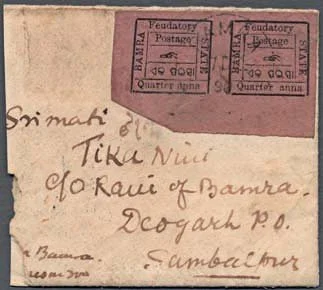
The later half-anna envelope has a framed stamp impression at upper right. Singhee records one sent to Calcutta on 27 December 1890, although catalogues have often put the issue in 1891. The addressee was a stamp firm, but that does not make a carried envelope cancelled to order.[2]
Five states of the impression are distinguished by changes in the central ornament, the letters of STATE and the Odia value. A shortened upper line of the ornament is the “broken trunk”. How the flap was made gives another clue, but not a date of issue.[2]
Three envelope designs
The earliest envelope has its value inscription on the flap and an ornamental border round the front; the Odia value is six pies, half an anna. Pointed and rounded flap tongues, missing value characters and changes in the border ornaments are recorded. Long bag-shaped envelopes and conflicting published measurements mean an envelope must be identified from the item, not from its size.[M6]
A second flap-stamped format has a loop border, and its inscription settings differ in the spacing between lines. The third design moves the stamp to the usual upper right corner: it looks like a framed adhesive but has no inner frame lines and puts the English value above the ornament. It is known on cream and white laid envelopes, and filled letters occur on both, so they do not show which was printed first.[M6]
Benns calls these E1, E2 and E3. E3’s device uses Odia numerals for the value, not the adhesive’s words, and comes in more than one setting. For the earlier envelopes, Singhee describes the flap inscription and the front frame as printed separately on made-up envelopes (December 1982, p. 237), but in the undated extract (p. 84) proposes a single operation, since the two are always in the same position relative to each other. Neither is a contemporary production record, so record the position and alignment of each part.[M6][M20][2]
Where the card’s portrait came from
Benns and Padgham describe the postcard’s stamp as taken from the centre of an earlier court-fee die, or more probably a woodblock. The portrait is presumed to be the Raja; no artist’s record identifies it. The early fiscal is likewise described as apparently from a woodblock, its date of about 1890 probably conjectural, and no original was available to those writers. The perforations drawn on it are part of the design, not holes.[M6][M20][2]
The Ipswich envelope
Sandeep Jaiswal’s display to the Royal Philatelic Society London on 26 February 2026 included an envelope that joins state and Imperial postage. The half-anna Bamra impression carries a dispatch date of 30 July 1891; British Indian stamps worth half an anna and two annas carry the Sambalpur exchange cancellation of 1 August, and the back has a Bombay transit mark and the Ipswich delivery mark of 24 August. The exhibitor reads the state payment as covering carriage to Sambalpur and the Indian stamps the journey to England, and calls it the only recorded Bamra stationery item to a foreign destination: his assessment.[8]
It is addressed to Mr. W. M. Bradbury, 15 High Street, Ipswich, England. An oval endorsement names the head postmaster’s office at Bamra, Sambalpur C.P.; it does not name the sender, and Abdul Rahim’s name on the next year’s envelope does not identify him.[8]
Clarke gives two annas six pies as the British Indian postage to the United Kingdom from 1 January 1891. The two Indian stamps add up to exactly that, six pies being half an anna, which supports the reading of the onward postage. The half-anna state impression belongs to the first stage. The weight, the sender and the inland and sea conveyances remain unknown, and the franking does not show registration or a full tariff.[8][9]
More stationery in the auction records
A David Feldman listing describes five unused Bamra envelopes of different types and two unused quarter-anna cards in two sizes. It confirms more than one envelope format and card size, but does not list every type.[M16]
Early reports, objects and dates
The disputed 23-ornament frame has an early source: the Monthly Journal of January 1891 reported envelopes with 23 as well as 24 ornaments. Singhee’s later statement that he could not verify one still stands. A report, a surviving object and its authentication are separate stages.[M18][M20]
Likewise, the notice of May 1891 of the corner-stamped half-anna envelope is the date of a report. It does not displace the use of December 1890 that Singhee recorded. The date news arrived, the date of issue and the date on a carried letter answer different questions.[M18][2]
Sources
- [2] A. R. Singhee, Bamra State Postal Stationery, pp. 83–90, illustrated extract with its own bibliography and catalogue.
- [8] Sandeep Jaiswal, India Postal Stationery, Royal Philatelic Society London display, 26 February 2026; Bamra envelope caption.
- [9] Geoffrey Clarke, The Post Office of India and Its Story, 1921, chapter XII, pp. 112–118 (p. 116).
- [M6] R. J. Benns, Bamra, Handbook of Indian Philately, India Study Circle, January 1982.
- [M16] David Feldman SA sale 1405A, p.41, Bamra lots 20563–20564; listing of unused envelopes and postal-stationery cards.
- [M18] Stanley Gibbons Monthly Journal, vol. 1 (1890–91): 20 September 1890 p. 51; 20 October 1890 pp. 81–82 (Chas. J. Phillips, Notes and News); 30 January 1891 p. 150; 30 April 1891 pp. 233–234; 30 May 1891 pp. 255–256.
- [M20] A. R. Singhee, “Bamra State Postal Stationery”, Ind Dak, December 1982, p. 237.
Notes 0
Add what you know: a cover or stamp in your collection, a date or source, a correction or a question.
No notes yet.
Sign in to add a note.
Notes show straight away. Keep them kind and about the article; anyone can report one that isn't. House rules
