
Bamra’s Framed Feudatory State Issue and Its Changing Settings, 1890–1894
The framed design of July 1890 in seven values: twenty-subject and sixteen-subject settings, the elephant’s-trunk ornament, capital and lower-case P, Stoney’s long strips and the papers.
Updated November 9, 2026
In this article
The central ornament and the arrangement of the lettering matter as much as the value.
What changed in July 1890
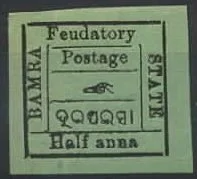
The second design has a frame of ten lines, English and Odia inscriptions and a central ornament usually described as an elephant’s trunk holding a stick. There are seven values, from a quarter anna to one rupee. Dawson dates the change to July 1890, with complete sets received in London the next month.[1]
The ornament comes in different lengths and directions. A capital P or lower-case p in Postage, the division of the Odia text and the movement of single pieces of type recur through several settings. One feature alone is not a classification.[1]
Twenty subjects, then sixteen
The first setting has twenty subjects in five rows of four, of which only part was used for the eight-anna and one-rupee sheets. Later settings normally have sixteen. Dawson discusses ten settings and groups them by the use of capitals and other physical features.[1]
Give a setting number together with its author or catalogue edition: old catalogue groups need not match the order of printing one for one. The checklist gives all the basic values; the finer relationships need multiples and a direct comparison with the study.[1]
A small forme could make a much larger sheet
The Monthly Journal of September 1890 separates a 20-subject setting from the paper it was impressed on, again and again. It describes a quarter-anna sheet with four such blocks side by side, and parts of half-anna and one-anna sheets with blocks one above another. The eighty stamps on that quarter-anna sheet did not need an eighty-subject forme.[M18]
In April 1891 the journal described later four-by-four settings with ten capital-P and six lower-case-p subjects. Both forms of Postage could therefore occur in one setting, and their separate catalogue entries do not mean all capital-P stamps came before all lower-case-p ones.[M18]
Errors of lettering, not new values
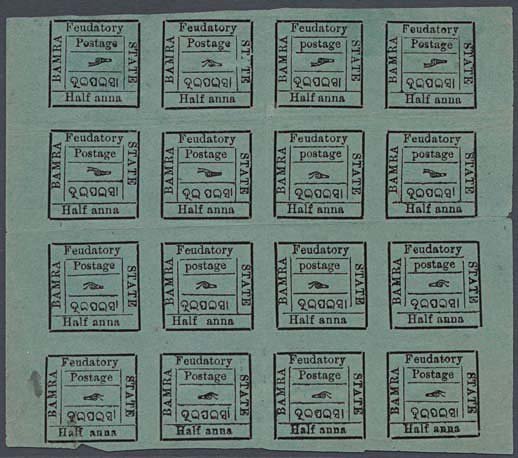
The framed design and its value inscriptions
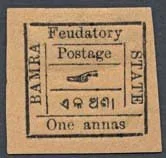
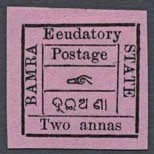
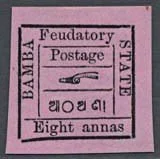
The framed design combines outer and inner rules, BAMRA and STATE down the sides, Feudatory above, postage or Postage inside, the ornament, an Odia value in words and an English value. Benns reads the seven Odia values as ek paisa, dui paisa, ek ana, dui ana, chari ana, ath ana and ek tanka, with spacing that varies with the composition; these are his transliterations. The sources do not establish what the ornament was meant to represent, or who designed it.[M6][M23]
Setting I has twenty subjects in five rows of four; later settings have sixteen in four rows of four, and the same small forme could be impressed repeatedly along a longer piece of paper. Setting I’s eight-anna and one-rupee combination puts ten eight-anna subjects at the left and ten one-rupee subjects at the right: two values in one forme, not two separate plates.[M6]
The central ornament occurs in four reported lengths, 4, 5, 6½ and 11 mm, and changes direction and orientation. Evans’s classification, refined by later specialists, combines these with the capital or lower-case P, the rules and individual defects; the 11 mm ornament belongs to Setting I. Neither the ornament nor the paper colour alone is enough to plate or authenticate a stamp.[M6][M23]
Stoney’s five-pane and four-pane strips
Stoney’s first-hand evidence is unusually precise. He owned a horizontal strip of five complete quarter-anna Setting VII panes on paper 4½ inches wide and 23 inches long, and a vertical strip of four complete half-anna Setting III panes on paper 5½ inches wide and 17½ inches long: at least two different arrangements. Benns’s later statement that the forme was impressed five times, horizontally or vertically, is too general to override Stoney’s four-pane example.[M23][M6]
From these Stoney inferred parent sheets of about 17½ by 23 inches, possibly cut into strips to feed the press. He wrote tentatively, and the figures are not from an invoice, a ledger or an uncut sheet. His measured strips and his proposed cutting are two different things.[M23][M22]
Panes could be printed so close together that the gap across a pane boundary looked like ordinary spacing, so a small multiple crossing it could be mistaken for part of one larger setting; complete long strips settled the question. Stoney linked Settings II–IV with vertical strips and V–X with horizontal strips, the second only for the material he had. Setting I was mixed: half and one anna vertical, the other values horizontal. These are observations, not a fixed rule for every printing.[M23][M6][M22]
Settings record changes, not a production diary
Benns shows values being changed within a retained framework, and ornaments or letters being moved. His Settings VII–IX interlock: arrangements recur, and changes need not follow a simple order. Setting III has sub-settings identified by changing Odia letters and small defects, and in his closing notes the order of some values was still unresolved. Ten settings are not ten dated print runs.[M6]
In quarter-anna Setting III, Benns separates a normal curved fourth Odia character from one with an internal loop, and suggests a compositor’s error or a temporary shortage of the usual type. The different character is a useful sign; the explanation is a suggestion. Take the same care with shifted words, bent characters and “missing letters”, since poor inking can look like a missing piece of type.[M6]
Paper and separation
Benns describes the first issue on thin coloured wove, or bazaar, paper: the quarter and four annas on yellow, half and eight annas on rose, one anna on blue and two annas on green, all printed in black. In the framed series the shade and thickness vary with value and setting; green and rose papers fade, and stocks range from thin to more opaque. These are collectors’ observations, not mill identifications or colour measurements.[M6][M23]
The ordinary stamps are imperforate. Benns records W. P. Molineux’s report of a roughly pin-perforated pane of the quarter anna, in the Setting VIIb discussion, with no gauge, date or evidence of official authority. It is a research note, not a perforated issue.[M6]
No reliable statement about a Bamra watermark has been found. Benns’s thin coloured wove or bazaar paper and Stoney’s thin wove papers describe the structure of the paper, not the absence of a watermark, so “unwatermarked” is unconfirmed.[M6][M23]
The press and the later researchers
| Person or institution | Role | Limits |
|---|---|---|
| Jagannath (Jagannata) Ballabh Press, Deogarh | Printer, according to later specialist studies | The spelling varies; no contemporary contract found |
| Unnamed Bamra or Deogarh press | The local press of the official reports | Not shown to be the same press or to have printed stamps |
| R. F. Stoney | Collector and researcher who owned the long strips | Not a maker; the parent-sheet size and cutting are his inference |
| Robert Bateman | Later specialist author | The lever hand press and his view of the errors are interpretations |
| R. J. Benns | Author of the handbook | His cliché and setting terms do not identify the foundry or staff |
| D. C. Padgham | Readings of the inscriptions; research on fiscals | Not a designer or block cutter |
| A. M. Benders; W. P. Molineux | Collectors who supplied observations and material | The pin-perforated pane is not an official issue |
Sources
- [1] L. E. Dawson, “The Stamps of Bamra”, The Philatelic Journal of India, 1938, serial study, with the first-issue plate and the final erratum.
- [M6] R. J. Benns, Bamra, Handbook of Indian Philately, India Study Circle, January 1982.
- [M8] Evert Klaseboer, online catalogue, “Bamra” in Indian States: framed quarter-anna and half-anna specimens, with reprint and forgery notes.
- [M9] Christoph Gärtner, Park Collection: Indian States, 7 March 2011, lots 559–582.
- [M18] Stanley Gibbons Monthly Journal, vol. 1 (1890–91): 20 September 1890 p. 51; 20 October 1890 pp. 81–82 (Chas. J. Phillips, Notes and News); 30 January 1891 p. 150; 30 April 1891 pp. 233–234; 30 May 1891 pp. 255–256.
- [M20] A. R. Singhee, “Bamra State Postal Stationery”, Ind Dak, December 1982, p. 237.
- [M22] R. F. Stoney, Bamra, manuscript notes and letter to L. E. Dawson, December 1940, India Study Circle accession 1418.
- [M23] R. F. Stoney, “Bamra: A Note on the Printing of the Stamps of Type 8”, The Philatelic Journal of India, February 1941, pp. 20–21.
- [M24] Robert Bateman, “Indian Native States: Notes on Printing and Production. Bamra: A History of Contradictions”, India Post, September 1968, pp. 105–106.
- [M27] A. Mackenzie, Chief Commissioner, Report on the Administration of the Central Provinces for the Year 1889–90, Nagpur, 1890, pp. 3 and 105.
- [M29] Sir A. P. MacDonnell, Chief Commissioner, Report on the Administration of the Central Provinces for the Year 1892–93, 1894, pp. 57 and 175.
- [M30] L. E. B. Cobden-Ramsay, Bengal Gazetteers: Feudatory States of Orissa, Calcutta, 1910, Bamra chapter pp. 119–125, and pp. 122 and 341.
Notes 0
Add what you know: a cover or stamp in your collection, a date or source, a correction or a question.
No notes yet.
Sign in to add a note.
Notes show straight away. Keep them kind and about the article; anyone can report one that isn't. House rules
