
Bamra’s Press, Its Post and a Returned Remittance
The 1890 letters to Stanley Gibbons, the Deogarh press, the eleven native post offices, British supervision, the railway route and what the government reports say about the press.
Updated June 10, 2026
In this article
The history of Bamra’s stamps is more nuanced than either “all speculative” or “all commercial”.
The exchange with Stanley Gibbons
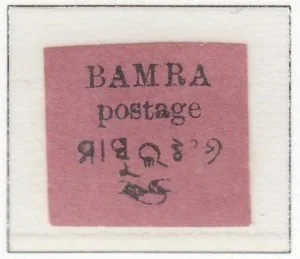
Dawson reproduces the correspondence of 1890. When Stanley Gibbons first asked for stamps and sent a remittance, the chief’s private secretary returned the money and sent samples free, describing the locally printed stamps as ordinary tickets for doing business. A later request was filled with stock of the old and new designs.[1]
Evans used this exchange to challenge the claim that the first stamps were invented only for collectors, though he still believed that much later stock went to the stamp trade. The useful conclusion is not that every cancelled copy travelled through the post, but that real postal need and collectors’ demand could exist side by side.[1]
The letters were already in print in 1890
The correspondence Dawson reproduced goes back directly to Chas. J. Phillips’s Notes and News of 20 October 1890. The private secretary’s reply of 21 April returned the remittance, described stamps prepared on the local printing press and sent samples free. The printed signature is expressly illegible: we know the office, not the man who held it.[M18][M19]
The reply of 5 August 1890 said the Rajah had changed the stamps into a new form and that the earlier samples were no longer in use. That is the secretary’s report of the change, not a design drawing or proof that the ruler himself composed the lettering. Who set and printed the stamps is a different question.[M18]
Phillips listed 59 stamps of the old design and about 800 of the current one in the consignment. These are shipment figures, not the number printed. His suggestion that the post office’s old stock was exhausted was a dealer’s belief, not an audited count.[M18][M19]
A local institution with an outside connection
Singhee attributes the stamps and stationery to the Jagannath Ballabh Press at Deogarh. The combination envelopes he records carry state postage beside British Indian stamps on mail leaving Bamra. The two payments explain why a local post needed its own stamps even with the Imperial network close by.[2]
The offices behind the stamps
The state post served more than the capital. Benns, drawing on Peter Röver’s research, lists eleven offices of the native system: Barkot, Deogarh, Gaurpali, Govindpur, Gugua, Jamankhera, Kuchinda, Naikul, Riamal, Saraipal and Bhujpur. Govindpur was later renamed Bamra, and Bhujpur later became Shirod. Garpush and Kesaibahal belong to the later Imperial expansion and should not be counted as offices of the native post.[M6]
The administration reports help show the service was real. Benns reports eleven schools in the return for 1889–90 and thirteen in 1890–91, and he links post offices with schools, though that does not prove two more offices opened. His extract from the report of 1892–93 describes negotiations to transfer the Raja’s system to the Imperial post office, with the same facilities and no contribution asked of him. These records show a working administrative service, even though much of the surviving cancelled material was made for collectors.[M6]
| Office | Later name |
|---|---|
| Barkot | |
| Deogarh | |
| Gaurpali | |
| Govindpur | Bamra |
| Gugua | |
| Jamankhera | |
| Kuchinda | |
| Naikul | |
| Riamal | |
| Saraipal | |
| Bhujpur | Shirod |
A named press, but unnamed stamp makers
Bateman in 1968 and Benns in 1982 both attribute the two adhesive issues to the Jagannata Ballabh Press at Deogarh (the spelling varies). This is a later specialist attribution; no stamp-printing order survives. No designer, compositor, pressman, punch-cutter or engraver of the stamps is named in the sources. The ruler, the private secretary, the press and the later philatelists are separate people with separate roles.[M24][M6]
Bateman and Benns describe heavy relief impressions that sometimes pierce thin paper. From the size of the forme and the depth of the impression Bateman proposed a lever-operated hand press, but no model, maker, purchase record, power source or surviving machine is known. His remark that building up the framed subjects must have been tedious is his own speculation, not a recorded decision of the printer.[M24][M6]
Bateman compared the stamps’ typography with Bamra State Press printing as late as 1946 and found the same shortcomings. Benns uses this to argue that not every stamp error was manufactured deliberately. It is an argument from comparison, not proof that every variety was an accident or that the same type and staff carried on.[M24][M6]
E. B. Evans, L. E. Dawson, R. F. Stoney, Robert Bateman and R. J. Benns were researchers; D. C. Padgham contributed readings of the inscriptions and notes on the fiscals; A. M. Benders and W. P. Molineux supplied material or observations. Moens’s illustrated sheets and the Ferrari, Hind and Dawson provenances belong to study, publication or ownership. None of these makes anyone the designer or printer of the stamps.[M24][M6][M23]
The state government and British supervision
Bamra’s stamps belong to a state still governed by its own ruler, not to a British district post. The Central Provinces report for 1889–90 places Bamra among the self-governing feudatories and names Raja Sudhal Deo, C.I.E. Near the end of that year, political charge of Bamra passed from the Deputy Commissioner of Sambalpur to the Political Agent for the Chhattisgarh Feudatories: a change of supervision, not the end of the Raja’s administration or his post. The report for 1892–93 adds that Bamra was one of seven states run by their own chiefs, and the only one of them without a government-appointed Diwan to assist.[M27][M29]
Offices after integration
By the Bengal Gazetteer of 1910 the Imperial post had sub-offices at Bamra and Deogarh and branch offices at Kuchinda and Barkut. Letter boxes stood in school houses in the main villages, and there was a telegraph office at Bamra. This describes the later Imperial network, not the original native offices; a school-house letter box is not a separately staffed post office. The Gazetteer’s four offices sit beside the native list above, not in place of it.[M30]
The railway and the Deogarh mail route
The Gazetteer of 1910 places the state in a road-and-rail network. The Bengal-Nagpur Railway crossed its north-eastern corner, with stations at Garpos and Bamra, and a road of about 58 miles linked Bamra station with Deogarh; the Imperial post ran between Deogarh and Bamra station. That is a later mail link and proves nothing about the route of a native-period cover. The earlier report of 1889–90 records Raja Sudhal Deo’s road towards the railway, 23 miles complete, but gives the distance to the railway as 48 miles. The two distances belong to different dates and are kept as they are.[M30][M27]
Local printing: what the government reports show
The official reports confirm printing in Bamra but do not name a stamp printer. The report for 1889–90 records a press in the state. The report for 1891–92 says the Bamra press no longer existed and that the newspaper Sambalpur Patriot, published in Bamra, had ceased. The report for 1892–93 says the press had come into existence again. These are reports about an unnamed press; they do not prove that stamp printing stopped and restarted, or that this was the Jagannath Ballabh Press. The Gazetteer of 1910 again records a printing press at Deogarh and a weekly newspaper circulating in Sambalpur and the Oriya States, without naming either.[M27][M29][M30]
Correspondents, administrators and observers
A named correspondent, ruler, publisher or collector is not automatically a stamp maker. The table separates authority, manufacture, supply and research.
| Person or institution | Role | Limits |
|---|---|---|
| Unnamed private secretary to the Chief of Bamra | Signed the published reply of 21 April 1890 | Signature printed as illegible; not a designer or printer |
| Rajah of Bamra | The reply of 5 August 1890 credits him with the new form of stamp | A decision of authority, not personal design or typesetting |
| Chas. J. Phillips | Wrote Notes and News of 20 October 1890 and published the letters | Dealer and publisher, not a stamp maker |
| S. A. E. Hutton | Presidency Postmaster, Calcutta, quoted in a letter of 9 May 1890 through the American Journal of Philately | Part of the authenticity controversy; no part in production |
| M. Moens | Sent the editor proofs of his forthcoming illustration sheets | Proofs of book illustrations, not stamp proofs |
| A. Cameron & Co., Jersey | Supplied the new-setting sheets described in April 1891 | Dealer, not a printer |
| Unnamed illustration engraver | Added the frame to the Philatelic Record illustration of March 1890 | Made a journal picture, not a Bamra stamp |
| A. R. Singhee | Later stationery researcher | Not part of production; his hypotheses and measurements are his own |
| Raja Sudhal Deo (Basudeo Sudhal Deo) | Ruler; the August 1890 reply credits him with the changed form | Not proof that he drew or set the design |
| A. Mackenzie; A. P. MacDonnell | Chief Commissioners responsible for the administration reports | Not stamp authors or commissioners of stamp printing |
| Secretariat Press, Nagpur; Bengal Secretariat Book Depot | Printed the reports and the Gazetteer | Not Bamra stamp printers |
| Sir Arthur Fanshawe | Director-General behind the general policy of postal unification | Not known to have signed Bamra’s transfer |
| Pandit Nilamani Vidyaratna | Named in later cultural history | No verified part in stamp production |
Sources
- [1] L. E. Dawson, “The Stamps of Bamra”, The Philatelic Journal of India, 1938, serial study, with the first-issue plate and the final erratum.
- [2] A. R. Singhee, Bamra State Postal Stationery, pp. 83–90, illustrated extract with its own bibliography and catalogue.
- [4] Government of Odisha, Deogarh district, History: Bamanda rulers, local press and the postal merger in 1895.
- [9] Geoffrey Clarke, The Post Office of India and Its Story, 1921, chapter XII, pp. 112–118 (p. 116).
- [M6] R. J. Benns, Bamra, Handbook of Indian Philately, India Study Circle, January 1982.
- [M17] The Philatelic Record, vol. 12 (1890): March p. 51, August p. 136, October pp. 170–171.
- [M18] Stanley Gibbons Monthly Journal, vol. 1 (1890–91): 20 September 1890 p. 51; 20 October 1890 pp. 81–82 (Chas. J. Phillips, Notes and News); 30 January 1891 p. 150; 30 April 1891 pp. 233–234; 30 May 1891 pp. 255–256.
- [M19] E. B. Evans, “The Stamps of Some of the Native States of India: Bamra”, Stanley Gibbons Monthly Journal, 31 December 1898, p. 92.
- [M20] A. R. Singhee, “Bamra State Postal Stationery”, Ind Dak, December 1982, p. 237.
- [M23] R. F. Stoney, “Bamra: A Note on the Printing of the Stamps of Type 8”, The Philatelic Journal of India, February 1941, pp. 20–21.
- [M24] Robert Bateman, “Indian Native States: Notes on Printing and Production. Bamra: A History of Contradictions”, India Post, September 1968, pp. 105–106.
- [M27] A. Mackenzie, Chief Commissioner, Report on the Administration of the Central Provinces for the Year 1889–90, Nagpur, 1890, pp. 3 and 105.
- [M29] Sir A. P. MacDonnell, Chief Commissioner, Report on the Administration of the Central Provinces for the Year 1892–93, 1894, pp. 57 and 175.
- [M30] L. E. B. Cobden-Ramsay, Bengal Gazetteers: Feudatory States of Orissa, Calcutta, 1910, Bamra chapter pp. 119–125, and pp. 122 and 341.
Notes 0
Add what you know: a cover or stamp in your collection, a date or source, a correction or a question.
No notes yet.
Sign in to add a note.
Notes show straight away. Keep them kind and about the article; anyone can report one that isn't. House rules
