
Jaipur: the Sun Chariot Stamps and the Raj Post
Jaipur, the Kachwaha state of eastern Rajputana, ran its own Raj post beside the Imperial offices and issued sun-chariot stamps from 1904: its rulers, chronology and stamps.
Updated August 17, 2026
In this article
The state behind the stamp
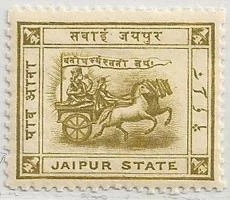
Jaipur lay in eastern Rajputana, ruled by the Kachwaha Rajput Maharajas from the planned city of Jaipur, which succeeded Amber as the royal centre. The sun-chariot emblem on its stamps links the post with the dynasty’s imagery.[2]
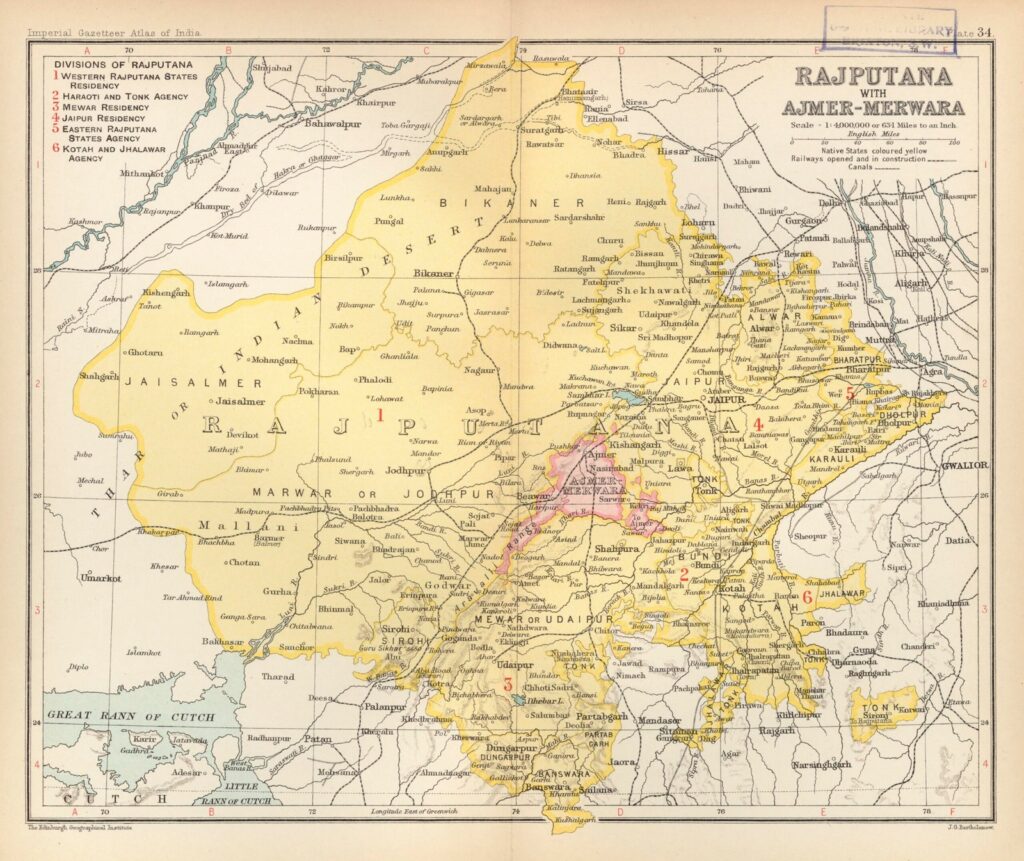
Jaipur’s own Darbar or Raj post worked beside the Imperial offices in its territory: in 1936–37 the report counts 115 Raj offices and 82 Imperial ones. Jaipur asked for a postal convention in 1905–1909, but none took effect.[16][14][61]
The rulers
A ruler’s accession and the start of his own government are separate dates. Ram Singh II succeeded as an infant in 1835 and, according to the census handbook, received full powers in 1851. Madho Singh II succeeded in 1880 and received full powers in 1882. Man Singh II succeeded on 7 September 1922 as a minor and assumed full ruling powers on 14 March 1931.[31][33][32]
| Reign | Ruler | Note |
|---|---|---|
| 1835–1880 | Ram Singh II | Succeeded as an infant; full powers 1851 |
| 1880–1922 | Madho Singh II | Full governing powers 1882; died 7 September 1922; the sun-chariot stamps were issued in his reign |
| 1922–1949 | Man Singh II | Succeeded as a minor; full powers 14 March 1931, marked by the investiture stamps; 1949 is the state’s integration, not a stamp date |
The stamps in brief
The first stamps, in 1904, were lithographed at the Raj Press, every subject drawn on the stone; Perkins Bacon of London engraved the next series; local provisionals filled a shortage in 1911; and from 1913 the Jail Press printed the chariot from surface plates. From 15 November 1928 official mail paid postage, with SERVICE stamps. On 14 March 1931 the bicoloured investiture set, printed at Nasik, marked Man Singh II’s full powers, followed by his portraits and, in 1947–48, the Silver Jubilee.[1][52][58]
The chapters that follow take the post before stamps, the sun-chariot stamps, the investiture, portrait and Jubilee issues, the Service stamps, the Raj Postal Department, tariffs, postmarks and covers, and identification and the makers of the stamps.
Chronology
| Date | Event |
|---|---|
| 1835 / 1851 | Ram Singh II succeeds as an infant; full powers |
| 1861 | Postal rules and a coin-weight tariff (S. D. Singh, from the manual) |
| 1880 / 1882 | Madho Singh II succeeds; full governing powers |
| 17 February 1892 | Resident’s letter on the Engineering Department’s RAJ Service marks |
| 13 April 1893 | The postal superintendent describes the rubber-stamped Raj Service mark |
| 30 November 1896 | A former Resident’s account of State sanction |
| 1904 | First stamps, lithographed at the Raj Press: 14 July or 1 August (6 June claimed for one cover) |
| 16 January 1905 | Corfield has the engraved half anna in hand |
| 1905–1906 | Reorganisation: eight lines, 112 State offices, 130 letterboxes; a convention proposed |
| 1908 / 1909 | 119 State offices and 153 boxes (year ending August 1908); convention negotiations continue |
| 1911–1912 | Local chariot provisionals |
| From 1913 | Jail Press surface printings on Dorling paper |
| 7 September 1922 | Man Singh II succeeds |
| 1926–1927 | Three annas surcharged on eight annas and one rupee |
| 15 November 1928 | Official mail begins to pay postage; Raj Service stamps |
| 14 March 1931 | Man Singh II’s full powers; the Nasik investiture set |
| 1932 | Portrait definitives, Nasik |
| 1 March 1936 | Kishen Dayal Singh full-time Superintendent of the Raj Postal Department |
| 1936–1937 | 115 Raj offices beside 82 Imperial; Phulera a head office, Dausa a sub-office |
| June 1938 | Imperial stationery sold with Raj stamps attached |
| 1 December 1942 | Postcard, envelope and insurance tariff |
| 1 October 1944 | Envelope and registration rates raised |
| 1 January 1947 | Postcard and envelope rates lowered; stationery exchange; Pav Anna surcharges follow |
| 20 December 1947 | Mullen shows Silver Jubilee colour proofs |
| 1947–1948 | Silver Jubilee issue |
| 1949 | Jaipur’s integration into Rajasthan |
The stamps
The issues and their values, from the research checklist. Service stamps, shades, papers, settings and separations are not listed; one anna was twelve pies.
| Period | Issue | Values |
|---|---|---|
| 1904; July/August dates differ | Locally lithographed sun chariot | ½ anna, 1 anna, 2 annas |
| 1904–1908 | Perkins Bacon engraved sun chariot | ¼ anna, ½ anna, 1 anna, 2 annas, 4 annas, 8 annas, 1 rupee |
| 1911–1912 | Local sun-chariot imitation (postage provisional) | ¼ anna, ½ anna, 1 anna, 2 annas |
| 1913–1918 | Jail Press surface-printed chariot | ¼ anna, ½ anna, 1 anna, 2 annas, 4 annas |
| 1926–1927 (reference dates differ) | Three annas in red native script on eight-anna chariot (postage surcharge) | 3 annas on 8 annas |
| 1926–1927 (reference dates differ) | Three annas in red native script on one-rupee chariot (postage surcharge) | 3 annas on 1 rupee |
| 1928 | Sun chariot; Overland Bank sheet watermark | ½ anna, 1 anna, 2 annas, 4 annas, 8 annas, 1 rupee |
| 1931 | Durbar / investiture commemorative designs | ¼ anna, ½ anna, 1 anna, 2 annas, 2½ annas, 3 annas, 4 annas, 6 annas, 8 annas, 1 rupee, 2 rupees, 5 rupees |
| 1932–46 | Man Singh II portrait; POSTAGE & REVENUE and POSTAGE forms | ¼ anna, ¾ anna, 1 anna, 2 annas, 2½ annas, 3 annas, 4 annas, 6 annas, 8 annas, 1 rupee, 2 rupees |
| 1936 | One Rupee surcharges on earlier high values (surcharge) | 1 rupee on 2 rupees, 1 rupee on 5 rupees |
| 1938 | Native quarter-anna surcharge on Durbar half-anna (surcharge) | ¼ anna on ½ anna |
| 1947–48 catalogue group | Silver Jubilee / 25th accession anniversary | ¼ anna, ½ anna, ¾ anna, 1 anna, 2 annas, 3 annas, 4 annas, 8 annas, 1 rupee |
| 1947 | Three Pies on Durbar half-anna (surcharge) | 3 pies on ½ anna |
Sources
- [1] J. R. M. Albrecht, Notes on the Postage Stamps of Jaipur, Stanley Gibbons Monthly Journal, 1924 (22-page collected extract).
- [2] Encyclopædia Britannica, 11th edition (1911), “Jaipur”.
- [13] W. Michael Adkins, Jaipur, Princely State of India, illustrated collection album, 7 February 2018.
- [14] Annual Administration Report of the Jaipur State for the period from 1st April 1905 to the 31st August 1906, Abu: R. A. Press, 1907.
- [16] Report on the Administration of the Jaipur State for 1936–37, published under the orders of the Council of State, Allahabad: Allahabad Law Journal Press, 1939.
- [18] The Imperial Gazetteer of India, vol. XXVI: Atlas, new edition, Oxford: Clarendon Press, 1909, plate 34, “Rajputana with Ajmer-Merwara”, J. G. Bartholomew, 1:4,000,000.
- [31] C. U. Aitchison, A Collection of Treaties, Engagements and Sanads relating to India and Neighbouring Countries, vol. III: States in Rajputana, revised to 1930, Calcutta, 1932, Jaipur, pp. 55–59.
- [32] Government of Jaipur, Constitutional Reform in Jaipur: Report of the Committee on Constitutional Reform, 1943, pp. 4–5, §§8–9.
- [33] Pt. Yamuna Lal Dashora, Census 1951: Rajasthan and Ajmer, District Census Handbook, Jaipur, Part I, Bikaner: Government Press, 1954, introduction, pp. iii–iv.
- [52] Report on the Administration of the Jaipur State for 1928–29, Allahabad: The Pioneer Press, 1930, p. 34, §§224–226.
- [58] Report on the Administration of the Jaipur State for 1930–31, Allahabad: The Pioneer Press, 1932, p. 44, §§215–217.
- [61] Geoffrey Clarke, The Post Office of India and Its Story, London: John Lane, 1921, chapter XII, p. 116.
Notes 0
Add what you know: a cover or stamp in your collection, a date or source, a correction or a question.
No notes yet.
Sign in to add a note.
Notes show straight away. Keep them kind and about the article; anyone can report one that isn't. House rules
