
Cochin: the Royal House, the Anchal and Its Stamps
Cochin on the Kerala coast ran its own Anchal post from about 1791 and issued stamps from 1892 to 1949: the state, its rulers, a chronology and the stamps from the seal design to the pictorials.
Updated May 20, 2026
In this article
The state behind the stamp
Cochin lay on India’s south-western coast, in what is now Kerala. Ernakulam was the headquarters of its Anchal; Thrippunithura was the royal seat. The census of 1901 names the Anchal Act as Act I of 1067 M.E. (1892) and records 32 Anchal offices and 245 miles of line beside the British post offices; the Imperial Gazetteer records 39 offices and 56 letter boxes and the State-owned Shoranur–Ernakulam railway. By 1945 there were 99 offices.[20][2]
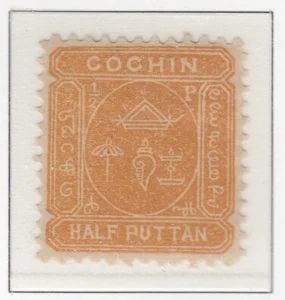
The Anchal carried official mail long before it carried the public’s. Private letters were admitted for cash in 1865 or 1866 (the sources differ), stamps and embossed envelopes came in 1067 M.E., and the service went on to hundis, value-payable articles and railway mail. Its stamps run from the state-seal design of 1892 through numerals and six portrait families to two pictorials of 1949, with ON C G S officials and many surcharges. Cochin joined Travancore on 1 July 1949; the Anchal was absorbed into the Indian post on 1 April 1951.[50][20][15][2]
The rulers
The list below follows the sources the research used, which do not always agree. Kerala Tourism dates Rama Varma Sakthan Thampuran’s accession to 1790 and the family index to 1791. The first stamps of 1892 fall in the reign of Veera Kerala Varma, 1888–1895. Sir Rama Varma abdicated in 1914; the government memorandum records his successor’s accession on 7 December 1914, and the report for 1937–38 that successor’s death on 25 March 1932, when his cousin succeeded. Three Rama Varmas reigned in turn; the philatelists’ “first Raja” and so on are not their numbers.[14][13][15]
After the death of Rama Varma on 13 April 1941, Kerala Varma was installed on 23 May 1941; the family account dates his death to 13 October 1943, and a British Library file (IOR/R/1/1/3702) concerns the succession of 1941. Ravi Varma was installed at the Durbar Hall, Ernakulam, on 14 November 1943 and died on 31 January 1946 according to the family history (Rulers.org gives 21 December 1943 and 1 February 1946). Kerala Varma was installed and proclaimed on 18 March 1946, recognised in file IOR/R/1/1/4385, and died on 8 July 1948. Rama Varma Pareekshit Thampuran signed the covenant that formed Travancore-Cochin, effective 1 July 1949.[40][41]
| Reign | Ruler | Note |
|---|---|---|
| 1790 (or 1791)–1805 | Rama Varma Sakthan Thampuran | The Anchal is placed around 1791 |
| 1805–1809 | Rama Varma | |
| 1809–1828 | Veera Kerala Varma | |
| 1828–1838 | Rama Varma | |
| 1838–1844 | Rama Varma | |
| 1844–1851 | Rama Varma | |
| 1851–1853 | Veera Kerala Varma | Kashiyil Theeppetta Thampuran |
| 1853–1864 | Ravi Varma | Before the review of the Anchal in 1864 |
| 1864–1888 | Rama Varma | Paid private mail introduced in his reign |
| 1888–1895 | Veera Kerala Varma | The first stamps of 1892 |
| 1895–1914 | Sir Rama Varma | Abdicated 1914 |
| 7 December 1914 – 25 March 1932 | Sir Sri Rama Varma | A different Rama Varma from his predecessor |
| 25 March 1932 – 13 April 1941 | Sir Sri Rama Varma | His cousin |
| 1941 – 13 October 1943 | Kerala Varma | Installed 23 May 1941 |
| 1943 – 31 January 1946 | Ravi Varma | Installed 14 November 1943 |
| 1946 – 8 July 1948 | Kerala Varma | Installed and proclaimed 18 March 1946 |
| 8 July 1948 – 1 July 1949 | Rama Varma Pareekshit Thampuran | Signed the Travancore-Cochin covenant |
On 20 February 1947 Jawaharlal Nehru wrote to the Maharaja of Cochin, one of the documents of the state’s last years.[16]
Chronology
| Date | Event |
|---|---|
| About 1791 | The Anchal created, according to the 1911 Manual |
| 1864; 1865 or 1866 | Review of the Anchal; paid private carriage begins (the sources differ) |
| 1067 M.E. (1892) | Anchal Act; stamps and embossed envelopes; registration |
| 1 April 1892 (or 13 April) | First stamps, as reported; not an inspected order |
| End of 1896(?) / January 1897 | The enlarged one puttan |
| 23 January 1897 | An Anchal envelope handed to the Imperial post at Ernacolum |
| 1073 M.E. (1897–98) | Three-pie stamps and two-pie cards; new designs and colours |
| October (?) 1898 | The numeral issue |
| 1902 | Shoranur–Ernakulam railway opens: goods in June, passengers in July |
| 1904–1905 | Earliest railway marks reported: 1904 (Stephen), 12 August 1905 (Pai) |
| 1908 | Arrangement with John Dickinson & Co. for fiscal stamps |
| 1909 | Two pies on three pies surcharge |
| 4 February – 10 July 1910 | Reorganisation and new portrait stamps ordered |
| 1911 | Engraved portraits by Perkins Bacon; the Manual records 43 offices |
| 1088 M.E.; 1089 M.E. | Anchal hundis begin; service stamps replace free official carriage |
| 1924 | Boyd studies the surcharge settings |
| 1937–38 | 79 offices, 158 letter boxes; boats, runners and buses |
| 1938 | Printing moves from Perkins Bacon to the Associated Printers, Madras (as later studies place it) |
| 1939 | One-anna ANCHAL overprint separates postage from revenue |
| 1949 | Bilingual surcharges and the two pictorials |
| 1 July 1949 | Travancore-Cochin formed |
| 1 April 1950; 1 April 1951 | The Anchal becomes an agency of the Indian post; absorbed |
The stamps
The issues and their values, from the research checklist; official stamps, and the shades, papers, perforations and settings of each issue, are not listed.
| Period | Issue | Values |
|---|---|---|
| 1892–1897 | State-seal puttan issues | ½ puttan, 1 puttan, 2 puttans |
| 1898–1903 | Numeral issues on thin and thick paper | 3 pies, ½ puttan, 1 puttan, 2 puttans |
| 1909 | Numeral two-pies surcharge (postage surcharge) | 2 pies on 3 pies |
| 1911–1914 | Rama Varma I, first portrait family | 2 pies, 3 pies, 4 pies, 9 pies, 1 anna, 1½ annas, 2 annas, 3 annas |
| 1918–1923 | Rama Varma II, second portrait family | 2 pies, 4 pies, 6 pies, 8 pies, 9 pies, 10 pies, 1 anna, 1½ annas, 2 annas, 2¼ annas, 3 annas |
| 1922–1929 | Rama Varma I, two-pies portrait surcharges (postage surcharge) | 2 pies on 3 pies |
| 1928–1934 | Rama Varma II, ordinary surcharges (postage surcharge) | 1 anna on 2¼ annas, 3 pies on 4 pies, 3 pies on 8 pies, 9 pies on 10 pies, 6 pies on 8 pies, 6 pies on 10 pies |
| 1933–1938 | Rama Varma III, engraved portrait family | 2 pies, 4 pies, 6 pies, 1 anna, 1 anna 8 pies, 2 annas, 2¼ annas, 3 annas, 3 annas 4 pies, 6 annas 8 pies, 10 annas |
| 1938–1941 | Rama Varma III, lithographed portrait family | 2 pies, 4 pies, 6 pies, 1 anna, 2¼ annas |
| 1939; catalogue group extends to 1944 | Rama Varma III, one-anna ANCHAL postal overprints (postage overprint) | 1 anna |
| 1939–1948 | Rama Varma III, engraved ordinary surcharges (postage surcharge) | 3 pies on 1 anna 8 pies, 1 anna 3 pies on 1 anna 8 pies, 6 pies on 1 anna 8 pies |
| 1941–1944 | Rama Varma III, lithographed ordinary surcharges (postage surcharge) | 3 pies on 4 pies, 6 pies on 1 anna, 9 pies on 1 anna |
| 1943 catalogue group | Kerala Varma I, fourth portrait family | 2 pies, 4 pies, 6 pies, 9 pies, 1 anna, 2¼ annas |
| 1943–1948 | Kerala Varma I, ordinary surcharges (postage surcharge) | 3 pies on 4 pies, 1 anna 3 pies on 1 anna, 9 pies on 1 anna, 2 pies on 6 pies, 3 pies on 6 pies, 4 pies on 6 pies |
| 1944–1946 | Ravi Varma early portrait | 9 pies, 1 anna 3 pies, 1 anna 9 pies |
| From 1946 | Ravi Varma revised portrait | 2 pies, 3 pies, 4 pies, 6 pies, 9 pies, 1 anna, 2 annas, 3 annas |
| 1948–1949 | Kerala Varma II portrait | 2 pies, 3 pies, 4 pies, 6 pies, 9 pies, 2 annas, 3 annas, 3 annas 4 pies |
| 1949 | Late ordinary surcharges | 3 pies on 9 pies, 6 pies on 1 anna 3 pies, 6 pies on 9 pies, 9 pies on 1 anna, 1 anna on 1 anna 9 pies |
| 1949 | Scenic designs: Dutch Palace and Chinese fishing net | 2 annas: Chinese fishing net, 2¼ annas: Dutch Palace |
Sources
- [2] Frank M. Cowen and J. Devasya, “Travancore-Cochin: Its Postage Stamps and Postal History”, The Collectors Club Philatelist, vol. 32, no. 6, 1953, part I, pp. 287–302.
- [13] Kerala State Archives Department, Archives Manual, pp. 48–49, “Records of the Abdicated Maharaja of Cochin (1895–1914)”.
- [14] Government of India, Memoranda on the Indian States 1932, Calcutta: Central Publication Branch, 1933, Cochin, pp. 86 and 88.
- [15] Government of Cochin, Report on the Administration of Cochin for the year 1113 M.E. (17 August 1937 – 16 August 1938), Cochin Government Press, 1939, section 9, Anchal, pp. 60–63, with the stamps, Government Press and personnel sections.
- [16] Jawaharlal Nehru, “To the Maharaja of Cochin”, 20 February 1947, Selected Works, Second Series, vol.2, p.225.
- [20] M. Sankara Menon, Census of India, 1901, vol. XX, Cochin, part I, Report, Ernakulam: Cochin Government Press, 1903, pp. xliii–xliv.
- [40] British Library, IOR/R/1/1/3702, Cochin succession, 1941.
- [41] British Library, IOR/R/1/1/4385, recognition of the Cochin succession, 1946.
- [50] C. Achyuta Menon, The Cochin State Manual, Ernakulam: Cochin Government Press, 1911, pp. 347–349 and 362–364.
- J. and C. Walker, map of Travancore and Cochin, Atlas of Southern India, 1854, via Wikimedia Commons.
- Madras Presidency, Cochin, Part I. Historical succession from 1888 to 1895.
- Cochin Royal Family history. Kerala Varma’s 1946 installation and proclamation.
- Cochin Royal Family History, Kerala Varma (1941–1943), installation and death.
- Cochin Royal Family History, Ravi Varma (1943–1946), installation and death.
- Rulers.org, Indian states before 1947, Cochin. Comparative dates.
- Kerala Tourism, Rulers of Kochi, Rama Varma Sakthan Thampuran.
Notes 0
Add what you know: a cover or stamp in your collection, a date or source, a correction or a question.
No notes yet.
Sign in to add a note.
Notes show straight away. Keep them kind and about the article; anyone can report one that isn't. House rules
