
1929: The Air Mail Stamps
Six aircraft stamps, three changing postal notices, and the difference between an air mail stamp, an air mail label and proof that a letter flew.
Updated September 15, 2026
In this article
An issue for a new service
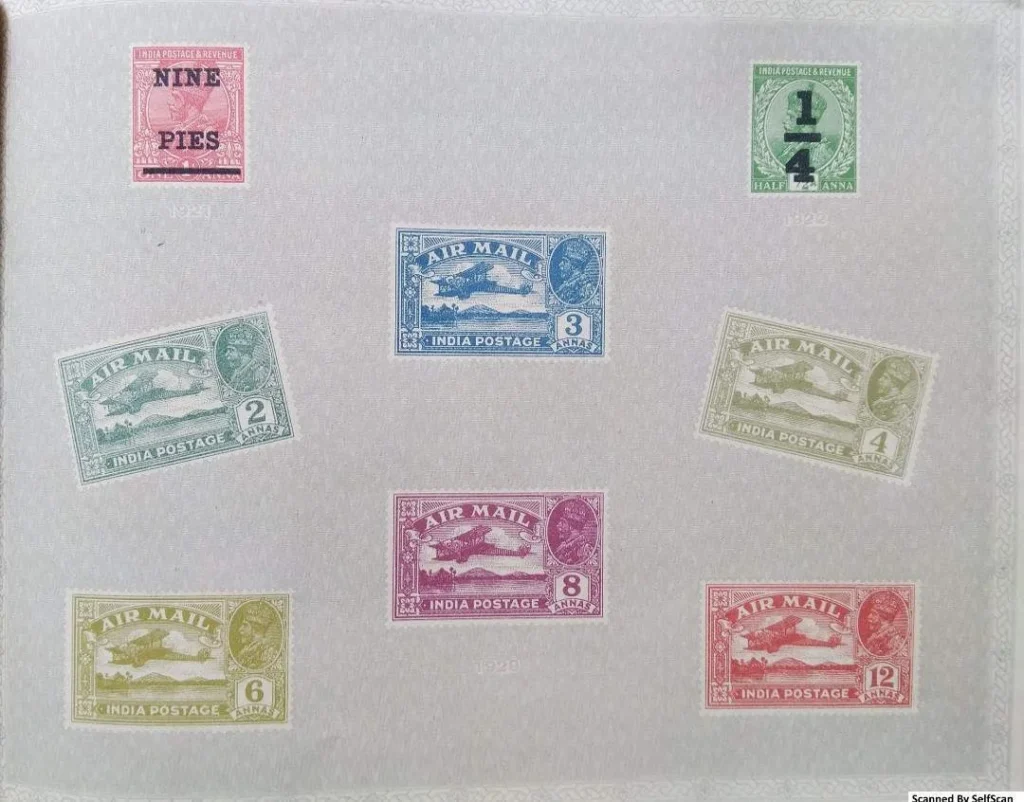
India’s Air Mail set of 1929 put a new means of transport on to a stamp family of its own. The large horizontal design shows a mail aircraft over a landscape, with the crowned George V portrait at the right and AIR MAIL across the top. The six values are 2, 3, 4, 6, 8 and 12 annas. Unlike the New Delhi stamps that followed, their subject is the carriage of mail itself, not a civic ceremony.[1][2]
Keppel identifies the aircraft as a de Havilland Hercules, the type used on the Egypt–Karachi section of the London–India route. The official album of 1954 shows the whole group but makes a tentative claim of a world first that is not repeated here; the issue’s importance does not depend on it.[1][2]
Three notices and the real opening
Three original notices, reproduced by Dipak and Markand Dave, clear up a common dating trap. P. G. Rogers’s notice of 5 September 1929 announced that the 3, 4, 6, 8 and 12 annas would be on sale from 1 October. A second notice, of 20 September, put the opening back to 1 November, and the final notice, of 1 October, moved it to Monday 4 November.[3][4][2]
These are announcements and revisions, not three issues of the same stamps. The Daves’ introduction and exhibit synopsis give 4 November 1929 for the five higher values and 20 December for the 2 annas, meant for inland air mail. Keppel’s earlier survey gives 22 October; the departmental notices are stronger evidence for November and show why an October date without qualification is unsafe.[3][4][2]
| Document or event | Date | What it did |
|---|---|---|
| First Rogers notice | 5 September 1929 | Announced an opening on 1 October for five values |
| Second Rogers notice | 20 September 1929 | Moved the opening to 1 November |
| Final Rogers notice | 1 October 1929 | Moved the opening to 4 November |
| Five values issued | 4 November 1929 | 3, 4, 6, 8 and 12 annas |
| Sixth value added | 20 December 1929 | 2 annas, for inland use |
Six values, one design
The same picture is used in contrasting colours: the 2 annas greenish or grey-green, 3 annas blue, 4 annas olive, 6 annas yellowish olive, 8 annas purple and 12 annas red. These are broad colour families, not a shade list. The value tablet at the lower right is the reliable guide when a cancellation hides the picture or an old reproduction has changed the colours.[1][3]
The 2 annas belongs with the set to look at but has its own history. Because it came later, a supposed first-day envelope with all six values needs close scrutiny: a November first-day label cannot be accepted just because five of the stamps were on sale then. The date of the cover and the dates of its stamps must agree.[1][3]
Printing and paper
The stamps were lithographed at Nasik in sheets of 144, twelve by twelve, according to Dave’s synopsis, on paper with a sideways multiple-star watermark, perforated 14. The synopsis gives the normal position as stars pointing right, seen from the back; Keppel also records stars pointing left. Always say from which side the watermark is viewed.[5][4][2]
Lawrence and Northam note several printings and shades, and discuss a reported grey 2 annas missing parts of the usual shading, which they said they had not seen themselves. It remains a report from their time, not a confirmed error. A faded grey-green stamp should not be promoted to a special printing without checking the paper, the actual lines and good comparison copies.[5][4][2]
What the air stamps could pay
The first notice said that using the special stamps was optional for mail sent by air, unlike the blue Air Mail label. The second notice added a restriction: the Air Mail stamps were valid for air mail and would not be accepted for charges on articles sent by other routes. Ordinary stamps could pay air mail fees, but at the start the reverse was not freely allowed.[3][5]
This prevents two common mistakes. A George V definitive on a flown cover is not short for lacking an aircraft stamp. And an aircraft stamp on an ordinary-looking letter does not show that the letter flew, or that its use kept to the rule of the day. The endorsement, the label, the dispatch date, the route and the arrival marks are still part of the explanation.[3][5]
Varieties and covers
Keppel records two well-known plate flaws on the 8 annas: an extra serif on the second I of INDIA and a missing treetop. Local faults like these are different from general under-inking or poor colour. Their positions on the sheet have not been published with certified examples, so the names are leads for research rather than an authentication checklist.[2]
On covers, keep commercial carriage, first-flight souvenirs and first-day use apart. An envelope can be more than one of these, but a collector’s cachet does not prove the route. The Allahabad flight covers of 1911 are earlier than this issue and belong to the Edward VII period. Later inland and imperial services produced many more combinations without making every aircraft-stamp cover a first flight.[2]
Still to be studied
The opening sequence is unusually well documented because the original notices survive in reproduction; the 2 annas date and the printing details rest on the Daves’ specialised research and the public synopsis. Dave’s full exhibit of 79 pages, the competition entries for the design, the printing records and the rate tables remain to be studied, as do commercial covers explained one by one and a comparison of plate flaws on authenticated stamps.[3][4][1]
Sources
- [1] Indian Posts and Telegraphs Department, India Postage Stamp Centenary 1854–1954: Souvenir Album (1 October 1954), plates 7–17 and printed commentary pp.2–4.
- [2] Adrian Keppel, “Emperor of India: India 1910–36”, Stamp Magazine, June 2010, pp.42–47.
- [3] Dipak Dave and Markand Dave, “The 1929 Airmail Stamps of India—Drawing Competition”, reprinted in AMSIPEX-25 Souvenir Book, PDF pp.133–134: introduction and three original postal notices signed P. G. Rogers (5 September, 20 September and 1 October 1929).
- [4] Markand Dave, The 1929 Air Mail Stamps of India, Museum of Philately/Philatelic Archives, collection 136, public exhibit synopsis.
- [5] Ian Lawrence and W. H. Northam, “India: A Study of the Nasik Printings”, The Stamp Magazine, July 1942, pp.206–207.
Notes 0
Add what you know: a cover or stamp in your collection, a date or source, a correction or a question.
No notes yet.
Sign in to add a note.
Notes show straight away. Keep them kind and about the article; anyone can report one that isn't. House rules
