
1931: The Inauguration of New Delhi
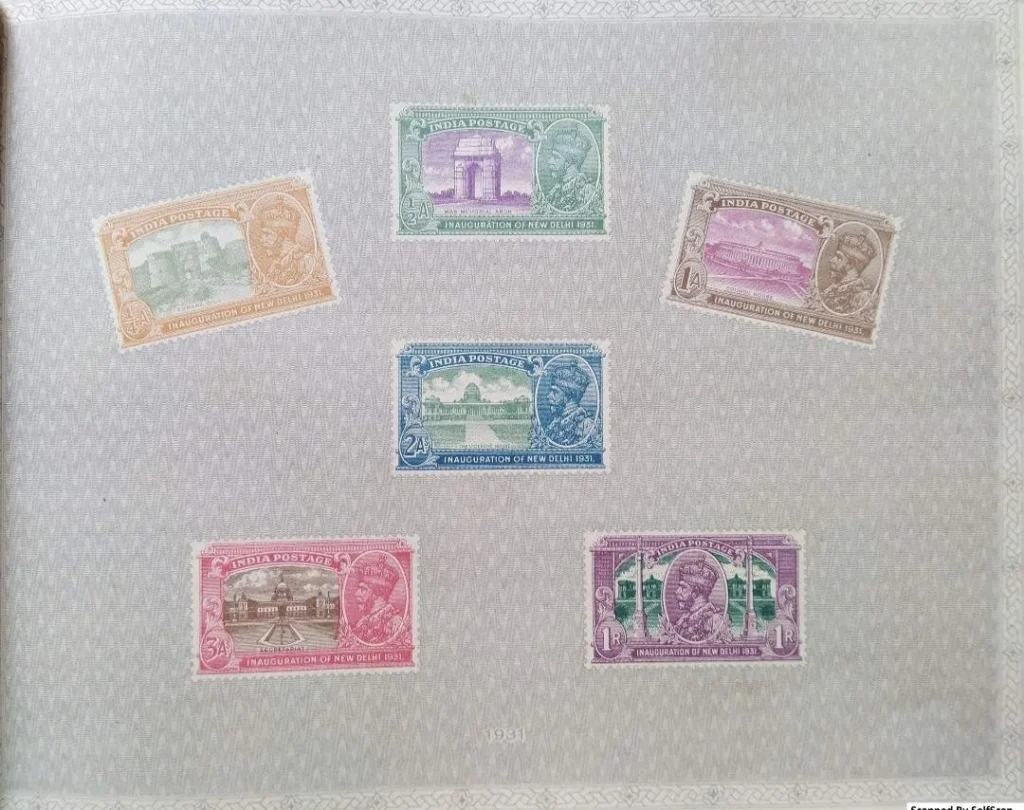
India’s first pictorial commemorative series: the Old Fort, the new government buildings and a portrait framed by the Dominion Columns.
Updated June 25, 2026
In this article
A capital in six pictures
The New Delhi issue celebrated the inauguration in 1931 of the new, purpose-built seat of government. The move of the capital had been announced at the Durbar of 1911; the stamps mark its completion and inauguration, not the announcement. Their six subjects set the Old Fort beside the main buildings and ceremonial features of the new administrative city.[1][2][3]
The set was issued on 9 February 1931. The city was inaugurated by Lord Irwin on 13 February, a reminder that the release of the stamps and the main ceremony were separate events. The official album of 1954 calls this India’s first pictorial commemorative series; the aircraft stamps of 1929 were pictorial too, but served the air mail rather than commemorating anything.[1][2][3]
The values and their subjects
The six values are ¼ anna, ½ anna, 1 anna, 2 annas, 3 annas and 1 rupee; the quarter anna equals 3 pies. Most designs put the King at the right, balancing the building. The rupee changes the emphasis: the portrait is in the centre, with the Dominion Columns and the Secretariat around it, so it is more than the same picture with a bigger figure.[1][4]
The printed names of the subjects keep the language of the time. The War Memorial Arch is now usually called India Gate; the Council House became the home of Parliament; the Viceroy’s House is now Rashtrapati Bhavan. Modern names help to find the places, while the original captions show the constitutional setting in which the stamps were made.[1][4]
| Value | Subject, as named then | Colours |
|---|---|---|
| ¼ anna | Purana Qila (Old Fort) | Olive-green and orange-brown |
| ½ anna | War Memorial Arch | Green and violet |
| 1 anna | Council House | Chocolate and mauve |
| 2 annas | Viceroy’s House | Blue and green |
| 3 annas | Government Secretariat | Carmine and chocolate |
| 1 rupee | Dominion Columns and Secretariat | Green and violet |
Printed in two colours
The set was printed by offset lithography at the Security Printing Press, Nasik, in two colours, one for the portrait and frame and one for the scene. H. W. Barr is credited with the design, in the collection consulted and in the Jhingans’ quotation from the Security Printing annual report; the credit is for the stamp design and studio work, not the buildings.[5][6][3]
Two printings make it easy for the colours to shift against each other. A scene sitting a little low in its frame may simply reflect that; it should not be called a double impression. Nor can the colours alone separate a proof from an issued stamp: a claimed trial or major error needs its own documents or an expert’s opinion.[5][6][3]
Paper, and a perforation that is quoted two ways
The paper has sideways multiple stars, which Keppel records pointing left or right, so say which way you are looking. “Multiple stars” alone is too vague for a collection of watermark positions, though it is fine as a broad identification. Do not damage a cover to settle a watermark that cannot safely be seen.[4][3][2]
The web summaries consulted call the perforation 14. Philately Life’s entries for each value, however, give 13½ × 14, while its own summary also says 14. The more precise measurement is kept here, with the disagreement noted; measuring with a gauge is better than repeating the rounded figure, especially when judging a trimmed edge or an odd-looking multiple.[4][3][2]
Poor impressions, use and demand
Lawrence and Northam describe the New Delhi stamps as produced in a hurry and often poorly printed. Their explanation, and their estimate of the total face value printed, are an opinion of their time, not a printing record. A weak impression is not a rarity in itself; tell ordinary poor printing from a proven constant fault or a missing colour.[5][2]
A first-day cover of 9 February and an envelope from later in the ceremonial week show different sides of the same event, and neither should be relabelled to make an album look tidy. On commercial mail, compare the stamps’ total with the service paid; a full set on one envelope may have been put on for its souvenir appeal and pay more than was needed.[5][2]
The stamps as a picture of the city
The set presents an imperial administrative landscape: an old fort, a war memorial, the buildings of the legislature and the executive, and ceremonial columns. It is good historical evidence even in an album rather than on a letter, and the original names and the prominent royal portrait show the intended political setting.[1][4]
A full plate reconstruction, a census of watermark positions and an authenticated list of errors in the two colours are still to be made, and genuine covers with clear rates, registration and arrival marks would add the next layer of postal history.[1][4]
Sources
- [1] Indian Posts and Telegraphs Department, India Postage Stamp Centenary 1854–1954: Souvenir Album (1 October 1954), plates 7–17 and printed commentary pp.2–4.
- [2] M. J. Shah, Indian Postage Stamps, “India—Inauguration of New Delhi”
- [3] Philately Life, “King George V: Inauguration of New Delhi 1931”
- [4] Adrian Keppel, “Emperor of India: India 1910–36”, Stamp Magazine, June 2010, pp.42–47.
- [5] Ian Lawrence and W. H. Northam, “India: A Study of the Nasik Printings”, The Stamp Magazine, July 1942, pp.206–207.
- [6] Madhukar and Savita Jhingan, “King George V Silver Jubilee Issues of India 1935”, Stamps of India, January 2012, version 1.1 (9 February 2012).
Notes 0
Add what you know: a cover or stamp in your collection, a date or source, a correction or a question.
No notes yet.
Sign in to add a note.
Notes show straight away. Keep them kind and about the article; anyone can report one that isn't. House rules
