
The Four Annas Bicoloured, 1854: Head, Frame and the Inverted Head
India’s first two-colour stamp: a blue head printed into a red frame, its head and frame dies, its settings of twelve and twenty-four, and the errors that separate printing made possible.
Updated June 30, 2026
In this article
A blue head inside a red frame
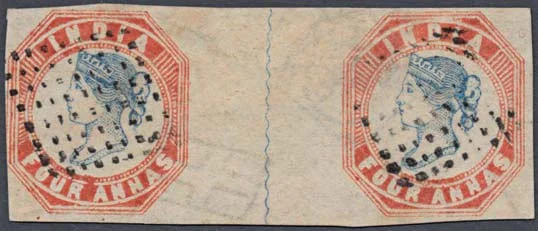
The four annas asks the collector to look at two impressions that belong together: a blue portrait inside a red octagonal frame. The colours had to be printed separately and brought together on the sheet. That is the starting point for understanding shifted heads, doubled impressions and the famous inverted head, though it does not mean that every odd alignment is a major error.[1][3]
The official centenary account identifies the four annas as a Calcutta lithograph, one of the general issues made in India. But the combination of head, frame and setting makes identifying it a different problem from the single-colour half anna and one anna.[1][3]
Name both parts
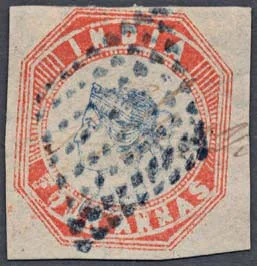
A specialised attribution should name both the head die and the frame die, not just a year and a colour. The Park catalogue uses combinations such as Head I / Frame I, Head II / Frame I and Head III / Frame II, together with descriptions of the printing and the setting. These labels describe different parts of the production.[3]
A change of shade does not prove a change of die. And a retouched portrait can keep its recognised head type while changing one local detail. The best identification records the feature you can see, the comparison it rests on and how sure the attribution is; older writers and later catalogues sometimes arrange this difficult material differently.[3]
Twelve stamps, then larger settings
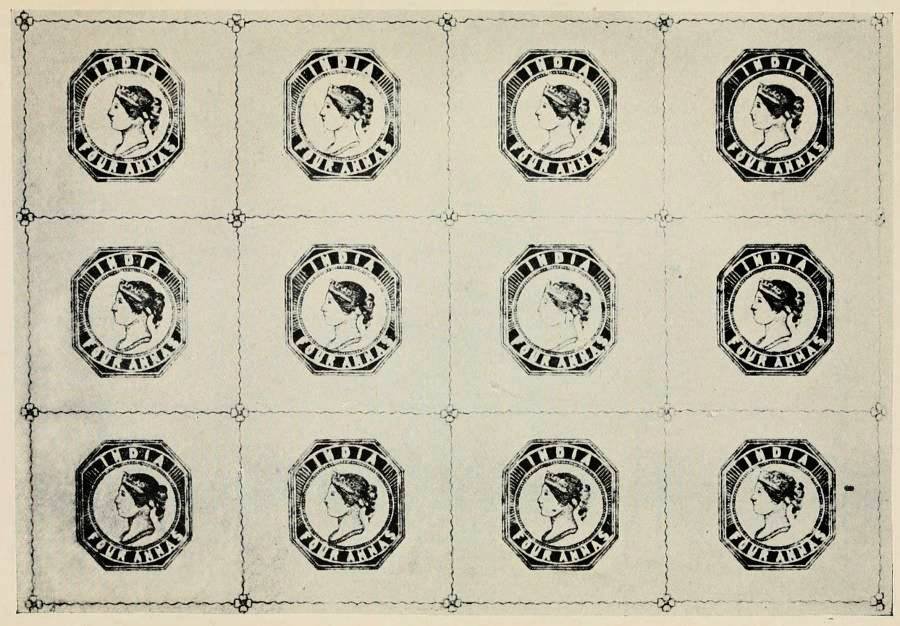
Clarke describes an early setting of twelve stamps followed in 1855 by an arrangement of twenty-four with different spacing. His summary is a good way into the subject, but not a full modern classification of all the printings: the auction catalogue identifies further printings and separates close and wide settings.[2][3]
Margins keep the evidence of those settings. A wavy line between stamps, a rosette or a generous piece of the surrounding paper can all help to place a stamp. A neatly cut octagon may have lost exactly the feature needed to test a setting. Keep the shape of the design apart from the shape in which a collector or a post office cut the stamp out.[2][3]
Registration in printing is not registered post
Talking about the two colours, “registration” means how one printed part sits against the other. A head can be shifted inside a normal frame without being inverted or doubled, and what physically happened has to be described before any rarity label is attached.[3][2]
Registered post is a different thing, a service recorded on a letter. A registered cover with a four annas would raise questions both of production and of tariff, but the same word would mean something different in each. Clear terms stop a technical observation about printing being mistaken for evidence of a postal fee.[3][2]
Inverted, doubled and missing parts
The Park catalogue illustrates stamps described as an inverted head, a double head, a double frame and a missing head. Each makes a different physical claim, and each needs the impression, the paper, the relation between the colours and the possibility of alteration examined; a handsome photograph of the face cannot settle all of that.[3]
Statements of rarity have to keep their date. A catalogue that calls a stamp the finest or the only recorded example is speaking for that sale, not giving a current count, and a certificate reported in a sale is not the same as a certificate seen. Thinning, repaired tears and staining matter alongside the error itself.[3]
| Description | Question being tested |
|---|---|
| Head shifted | Is the blue impression moved against its normal frame? |
| Head inverted | Is the blue part upside down inside the frame? |
| Head doubled | Are there really two blue impressions? |
| Frame doubled | Are there really two red frame impressions? |
| Head missing | Is the blue absent because of the printing, rather than alteration or damage? |
A letter to London
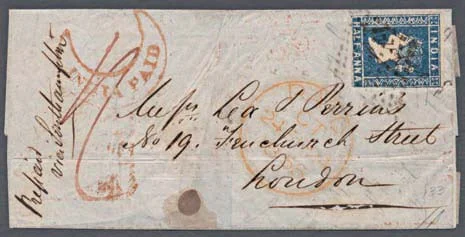
The catalogue describes a letter of 1855 carrying one half-anna blue and two four annas. The front shown here has the half anna; the four annas are not on this side. The catalogue gives its origin as Ootacamund, its address in London and its route by Southampton, and reads the half anna as the inland postage and the eight annas as the charge for the onward journey.[3]
The picture cannot prove marks on the back that are not shown, or a rate for all letters. A full study of the rate would check the weight, the date and the route against the regulations. The example is valuable because its source identifies a particular letter, which is stronger than a general claim that every four annas paid the same overseas service.[3]
Paper and condition
Look at the arms watermark of the sheet together with the head, the frame and the setting. A partial or missing central motif on a single stamp does not decide the paper. Repaired paper, thinning or a crease can also change how a watermark or a printed part looks.[1][3]
This article sets out how to identify the stamp and shows a few original objects. A full plating atlas, the attribution of every third printing and an up-to-date count of the inverted heads belong to the specialist literature and to well-documented examples.[1][3]
Sources
- [1] Indian Posts and Telegraphs Department, India Postage Stamp Centenary 1854–1954: Souvenir Album, 1 October 1954, plate 1 and its commentary, p. 1.
- [2] Geoffrey Clarke, The Post Office of India and Its Story, John Lane/The Bodley Head, London, 1921, chapters II–III and XIX.
- [3] Auktionshaus Christoph Gärtner, India: Park Collection, auction catalogue, 7 March 2011.
Notes 0
Add what you know: a cover or stamp in your collection, a date or source, a correction or a question.
No notes yet.
Sign in to add a note.
Notes show straight away. Keep them kind and about the article; anyone can report one that isn't. House rules
