
The Half Anna Blue, 1854: From a Copper Die to Printing Stones
How the everyday half-anna letter stamp of 1854 was lithographed in Calcutta, from a copper die through transfers to stones of ninety-six, and what its dies, margins and covers tell a collector.
Updated November 5, 2026
In this article
A blue stamp for a new postal system
The half-anna blue is one of the first Indian stamps of 1854 for general use. Its small rectangular design shows Queen Victoria’s profile and the value in words. That simple look hides a production chain in which the design passed through several stages before any ink reached the sheet. Differences that come from the die, from an intermediate transfer, from a parent stone or from a later repair each leave a different kind of evidence.[1][2]
The official centenary album of 1954 records that the half anna, one anna and four annas were lithographed at the Surveyor-General’s Office in Calcutta, while the two annas green was printed by typography at the Stamp Office. The half anna has to be studied as a lithograph, not as a small version of the later De La Rue typographed stamps.[1][2]

Printing, delivery and sale are separate dates
The familiar heading “1854” covers several stages of production. Richard Morel’s study of the archives describes early attempts in vermilion before the colour of the half anna was changed to blue, and places a very large printing of the blue in May–July 1854. A stamp may have been printed, or delivered to a Stamp Office, well before it went on general sale, and none of those dates should stand in for another without evidence.[3][4]
The printing went on into 1855, and a later use does not mean a later printing. A dated cover shows what a post office accepted on that day; it does not give the first day of issue, the exact stone, or the day that particular stamp was made.[3][4]
Start with the die, then the stone
Three main dies are the usual first division of the half anna. Identify the die before trying to place a stamp on a printing stone or in a position on the sheet. The hair, the chignon, the face and the frame have to be compared together, because a poor impression or a heavy cancellation can hide a useful detail.[2][4]
The stamp shown above, described as Die I with a retouched chignon, shows why these two levels must stay apart. A retouch can change how a stamp looks without making it a new principal die. A full identification should say whether it rests on the die, on the stone, on a particular flaw in one position, or on a documented retouch.[2][4]
How twenty-four impressions became ninety-six
Varun Raj describes the method for Die I step by step. Twenty-four impressions from the copper die were laid down on an intermediate or matrix stone, in three rows of eight. Four transfers of that matrix made a pane of ninety-six on a parent stone. Transfers from the parent could then make sub-stones for printing. Each step could carry existing faults forward and add new ones.[2]
This explains the central idea of plating. A mark inherited from one of the twenty-four subjects of the matrix may appear four times in a pane of ninety-six. A mark added later may identify only one position on a parent stone or sub-stone. A repeated feature and a feature found in one position only are not rival explanations; they can come from different stages of the same chain.[2]
| Stage | Arrangement or role | What it can leave behind |
|---|---|---|
| Copper die | The starting design | Features shared by everything transferred from it |
| Intermediate matrix | 24 impressions: 3 rows of 8 | Group features repeated in later transfers |
| Parent pane | Four transfers of the matrix: 96 subjects | Pane positions, marginal inscriptions and ornaments |
| Sub-stones | Further transfers for printing | Inherited features and new ones |
The printing office matters
Raj rebuilds the capacity of the presses from the records of the Survey. Before the office was expanded for stamp printing it had presses of different sizes, including a larger machine improvised for the work. He links the uneven quality of large and small printings to the practical conditions in which the sheets were produced, a more useful explanation of variation than assuming that every difference was intended.[2]
His comparison of a black proof with blue panes also separates the corner ornaments, the marginal inscriptions and the touching up of the portrait. A date written by hand on a proof and an inscription printed in the margin are different kinds of evidence, and neither should quietly become a public date of issue.[2]
Margins and the watermark
The official account describes paper with the East India Company’s arms as a watermark across the sheet, and stamps without perforations. A single stamp may show only part of that large device, or none of its central emblem; that does not prove the sheet was unwatermarked.[1][2]
Keep outer margins and corner ornaments wherever they survive. They can show which way up a multiple was and link the stamps with a particular arrangement of the pane. Cut margins, staining and thinned paper remove or distort the evidence, and the blue face of a stamp tells us nothing about its back.[1][2]
What a half-anna cover can teach
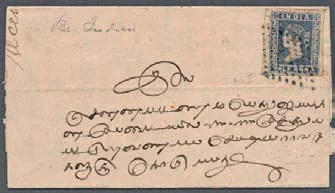
The folded letter shown above is described in the Park catalogue as dated 27 October 1854, with a blue dotted cancellation. It is not offered as the earliest use; its value is as a real, identified example of the stamp doing its job. Other letters may carry several stamps together or show charges paid separately.[4][2]
For a specialised collection, record the opinion on the die, any retouch you can see, the complete franking, every dated mark and the authority for how the rate is explained. This article covers the transfer method and a few objects; it does not settle every named stone, shade, earliest use or reconstruction of positions, for which Raj’s full paper is the reference.[4][2]
Sources
- [1] Indian Posts and Telegraphs Department, India Postage Stamp Centenary 1854–1954: Souvenir Album, 1 October 1954, plate 1 and its commentary, p. 1.
- [2] Varun Raj, “Stones of the Half Anna Die I Stamps of India May–July 1854”, The London Philatelist, vol. 113, September 2004, pp. 234–237 and following.
- [3] Richard Scott Morel, “India: Discovery of the Earliest Essay for the 1854 Stamp Issue”, The London Philatelist, vol. 131, October 2022, pp. 424–430.
- [4] Auktionshaus Christoph Gärtner, India: Park Collection, auction catalogue, 7 March 2011.
Notes 0
Add what you know: a cover or stamp in your collection, a date or source, a correction or a question.
No notes yet.
Sign in to add a note.
Notes show straight away. Keep them kind and about the article; anyone can report one that isn't. House rules
