
The Two Annas Green, 1854: The Typographed Stamp of the First Issue
The two annas green was the one stamp of 1854 printed by typography, not lithography: its dies, frame lines, paper and a pair on a letter to London.
Updated July 25, 2026
In this article
The exception in the first general issue
Putting the four values of 1854 under the handy heading “the lithographs” hides a basic fact: the two annas green was typographed. The centenary commentary of the Indian Posts and Telegraphs Department, published in 1954, assigns it to the Stamp Office, and the lithographed half, one and four annas to the Surveyor-General’s Office. A full account of the issue has to keep that difference.[1][2]
Because the stamp was printed from a raised surface, its features mean different things. Ideas worked out for a lithographic transfer stone cannot simply be applied to a typographic printing surface; frame lines, repeated features, the quality of impression and the way the plate was assembled have to be studied in terms of the process actually used.[1][2]
The issued stamp and a misleading green trial
The issued stamp has Queen Victoria’s profile in a rectangular frame and the value TWO ANNAS. Green impressions of other designs also survive among the essays and later impressions, so a green two-anna inscription is not enough on its own to identify the issued stamp.[3]
The Park catalogue lists separately a green proof of a design that was never issued, reported to carry Jal Cooper’s initial on the back. It belongs with the essays and proofs, not in the shades of the issued stamp, so that a striking trial is not used to fill a gap in a different design.[3]
From a die to a typographic surface
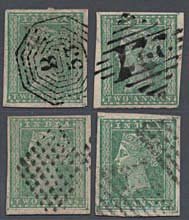
Y. R. Shah’s study of 1997 stresses the preparation of the die, the punch and the clichés on the way to the printing surface. He suggests that the die was still being refined while printing had already begun, an argument drawn from differences he sees in the portrait rather than from any surviving production ledger.[2]
He points to small blobs around the eyes, how clearly the throat and facial lines show, and changes to the hair and the chignon, and reads them as successive stages of preparation. That is his interpretation: no securely dated sequence of every proposed stage exists, and his proposed stages are not established catalogue dies.[2]
Frame lines and repeated features
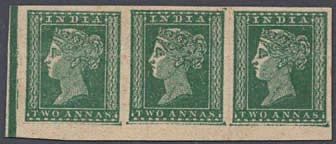
A line around the stamp can tell more than a broad shade name. Shah mentions examples with four extra frame lines and others with lines on two or three sides. The marginal strip above keeps the lines below the stamps, and its value lies precisely in showing how the stamps relate to the margin.[2][3]
Note which side a line is on, whether it runs on between neighbouring stamps, and whether it appears again on other material identified independently. A line can be genuine evidence without proving a whole new die. Cropping a photograph tight to the portrait would throw away what makes such a group useful.[2][3]
| Feature | Record | Do not assume |
|---|---|---|
| Clarity of the portrait | Eyes, throat, hair and chignon as they appear | An exact date of printing |
| Extra frame lines | Which sides, whether continuous, how they meet the margins | A new principal die from one line |
| Repeated marks | Where they are and matching examples | That a mark is constant from one stamp |
| Colour | A description under controlled light | A catalogue shade from a screen image |
| Paper | The part of the watermark seen and its direction | Unwatermarked paper because the centre is missing |
The arms watermark and the sheet
The official album records the large East India Company arms watermarked across the sheet, and stamps issued without perforations. A piece the size of one stamp may not include the central arms. Margins and multiples keep more of the watermark and show which way up it runs, which makes them especially valuable for studying the paper.[1][3]
A complete sheet shows the arrangement as separate stamps cannot. The Park catalogue describes the sheet of the issued two annas as eighty stamps; the strip shown here is only three, and does not show the whole sheet or prove the direction of the watermark from the front.[1][3]
A pair on a letter
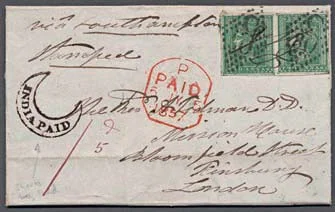
The letter below carries a pair of two annas green. The catalogue identifies it as a letter of 1857 from Vizagapatam to London and draws attention to the extra frame lines; those details are the catalogue’s description of this one cover.[3]
The pair shows why covers and multiples belong in a study of identification: they link the evidence of the plate with real postal handling. Even so, a franking of four annas has to be explained by its route and the tariff of the day; its total face value should not be turned into a general overseas rate.[3]
Unfinished questions
The two annas green deserves the same care as its better-known lithographed companions. How it was made, the evidence of its plate and its paper can support a specialised collection, even though published work has concentrated on the other values. Shah’s article is useful for drawing attention to these neglected features.[2]
A fuller account needs Shah’s complete study, more multiples, and a dated, documented sequence of how the plate was prepared and printed.[2]
Sources
- [1] Indian Posts and Telegraphs Department, India Postage Stamp Centenary 1854–1954: Souvenir Album, 1 October 1954, plate 1 and its commentary, p. 1.
- [2] Y. R. Shah, “Two Annas Green Stamps of 1854”, Ind Dak, December 1997, p. 147.
- [3] Auktionshaus Christoph Gärtner, India: Park Collection, auction catalogue, 7 March 2011.
Notes 0
Add what you know: a cover or stamp in your collection, a date or source, a correction or a question.
No notes yet.
Sign in to add a note.
Notes show straight away. Keep them kind and about the article; anyone can report one that isn't. House rules
