British India Before Stamps: Letters, Charges and Postal Marks
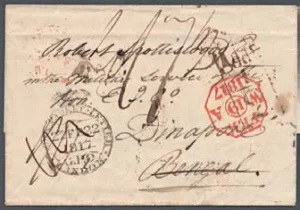
How letters travelled and postage was accounted for in India before 1854, and how to read the marks and sums on a letter without a stamp.
The post before stamps, the Scinde Dawk of 1852, the lithographed and typographed stamps of 1854, essays and proofs, the first De La Rue stamps and the change from Company to Crown.
How letters travelled and postage was accounted for in India before 1854, and how to read the marks and sums on a letter without a stamp.
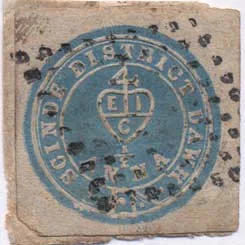
A half-anna provincial experiment in Sindh: three fragile forms, red, white and blue, the argument over who made them, their postmarks, forgeries and the recall that was not carried out.
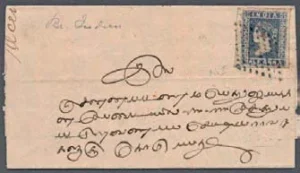
How the everyday half-anna letter stamp of 1854 was lithographed in Calcutta, from a copper die through transfers to stones of ninety-six, and what its dies, margins and covers tell a collector.
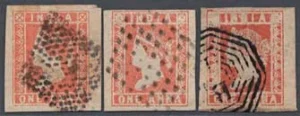
The lithographed one-anna red of 1854: its three dies, the substituted transfers on its stones, and how Sir Eric Studd rebuilt a block of four from two pairs cut from a cover.
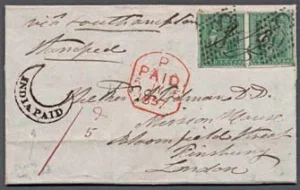
The two annas green was the one stamp of 1854 printed by typography, not lithography: its dies, frame lines, paper and a pair on a letter to London.
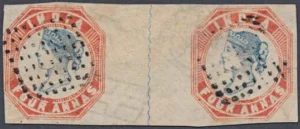
India’s first two-colour stamp: a blue head printed into a red frame, its head and frame dies, its settings of twelve and twenty-four, and the errors that separate printing made possible.
How repeated flaws, multiples and sheet margins link a single stamp of 1854 to the stone it was printed from, and how to build a reconstruction others can check.
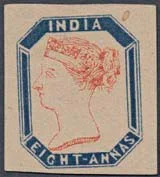
The designs that came before India’s first stamps, from a pencil sketch of 1852 and the lion and palm tree to an eight-anna stamp never issued, and the later impressions that can be mistaken for them.
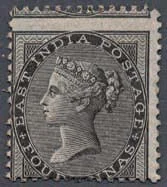
London typography replaced the Calcutta stamps: the contract of 1854, the papers, the green two annas that may never have been issued, and how to build a study of the first De La Rue stamps.
The end of East India Company rule in 1858 did not change the stamps at once: EAST INDIA POSTAGE stayed in use until 1882, while the post’s laws, accounts, official mail and rates changed on their own timetable.