
The First De La Rue Stamps, 1855–1864: Unwatermarked Paper
London typography replaced the Calcutta stamps: the contract of 1854, the papers, the green two annas that may never have been issued, and how to build a study of the first De La Rue stamps.
Updated October 27, 2026
In this article
From Calcutta to London
The first supply from De La Rue brought factory consistency to a post whose stamps of 1854 had been made in India. Clarke records that the half, one, two, four and eight annas arrived in November 1855. Arrival in India and the date heading in a catalogue are different kinds of date: the Bombay catalogue of 1947 puts most of the stamps on white paper under 1856–64, and the four and eight annas on glazed paper under 1855.[1][2][3]
These stamps were typographed, as the official centenary album says plainly. Clarke mentions that a master design was engraved on steel, but that does not make the issued stamps recess-printed: their raised printing surfaces put ink on the paper. That is what separates them from the lithographed half, one and four annas of 1854.[1][2][3]
Two papers
White wove paper with no watermark in the stamp is the main group. The four annas black and eight annas carmine are also found on thick, highly glazed bluish paper. The eight pies, added in 1860, has its own purple colour and an unusual value: eight pies is two thirds of an anna, not eight annas.[1][2][3]
“Unwatermarked” describes the stamp itself. Pieces from the margin can show the watermarked letters of the sheet inscription; Gärtner lot 120, for example, is described with part of the word POSTAGE in the margin. A fragment of lettering does not make such a stamp an Elephant’s Head issue.[1][2][3]
| Feature | Evidence and how to read it |
|---|---|
| Perforation | 14, in the official album; look for clipped or replaced perforations |
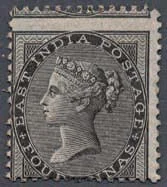
| Four annas | Black or grey-black, later green; identify the paper before assigning a colour to an issue |
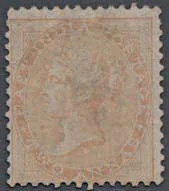
| Two annas | Pink, buff, yellow and orange are all named in the catalogue of 1947; compare with physical references |
The decision of 1854 behind the stamps of 1855
Printing in London was already being discussed while Captain Thuillier was still preparing the first general stamps in Calcutta. H. R. Holmes transcribes Inland Revenue letters of July 1854: the first enquiry was whether Bacon & Petch could print the stamps by recess, but the reply pointed instead to De La Rue’s receipt and draft stamps. The typographed stamps were therefore the result of a choice about administration and manufacture, not a continuation of the Calcutta method.[5][6]
John Easton reproduces the offer accepted on 14 October 1854: thirty-five million labels a year for five years at one shilling and sixpence a thousand, with a lower price for any excess. The price included the paper, dies and plates, and the dies and plates were to become the Company’s property when the contract ended.[5][6]
Security and supervision
The Inland Revenue supervised the printing. Holmes’s letters of October 1854 discuss how much time the supervising officer would need, the checking of the stamps, and sharing rooms with the printing of receipt and Foreign Bill stamps. De La Rue wrote on 16 November that the original matrix had been hardened at the Mint, the subsidiary dies were in hand, and printing could not begin before February. These are steps in production, not proof that stamps were on sale at an Indian post office.[5][6]
Easton’s early invoices do not divide the quantities by value. His entries for August 1855 total 17,904,000 stamps, followed by further invoices for totals only. Those figures should not be split among the values by guesswork, or treated as counts of how many stamps survive.[5][6]
The puzzle of the green two annas
The Bombay catalogue of 1947 lists the two annas yellow-green separately, as “printed but not officially issued”. J. A. Tilleard, writing in 1896 from the registered sheets and from letters with the printers, argued that green was the first colour supplied and that it was never printed again. His table of plates records green in June 1855, pink in September 1858 and yellow in May 1862.[7][3][4]
This is a real historical puzzle. A record of production proves that the stamp was made, and perhaps sent, but not that it was issued to the public in the ordinary way. The green copy in Gärtner lot 141, with a trial cancellation, should not be treated as an ordinary used stamp just because the trial mark carries a date. The green two annas is best kept on a separate, clearly labelled page until its status is settled.[7][3][4]
Which values really exist on glazed paper?
Tilleard found registered evidence on glazed paper for the four and eight annas, and reported that the printers denied supplying other values on blue paper in the ordinary way. He tentatively put the first plate of the four annas on white paper and the first of the eight annas on blue. That reservation matters: the two papers do not automatically form two complete sets.[7][4]
Gärtner lot 113 is described as an experimental one anna on bluish paper. An exceptional trial printing does not show that the one anna was regularly issued on the same glazed paper as the four and eight annas. Catalogue status, the surface of the paper and the history of the object all have to go with the name of a colour.[7][4]
Building a study
Begin with one example of each value, then add papers and shades. A sound stamp that has been hinged can be a better reference than a repaired one with attractive gum. Plate proofs and issued imperforate varieties each need their own evidence, and a single trimmed stamp can prove neither.[1][3][4]
Covers with both the 1854 stamps and De La Rue stamps belong to the change-over, since old stock was not withdrawn at once; Clarke puts the final recall and destruction of the Indian-made stamps in 1858. Bisected stamps need complete postal evidence, especially from Singapore, where a contemporary account records such use. The production families are set out here; matching every shade to an invoice or plate is a task for further study.[1][3][4]
Sources
- [1] Geoffrey Clarke, The Post Office of India and Its Story, London: John Lane, 1921, chapter XIX, pp. 181–184, with passages from chapters III–IV on franking and postal legislation.
- [2] Indian Posts and Telegraphs Department, India Postage Stamp Centenary 1854–1954: Souvenir Album, 1 October 1954, plates 2–6 and commentary pp. 1–2.
- [3] Bombay Philatelic Company, Catalogue of Postage Stamps 1947, Bombay, 1947, India, pp. 47–52.
- [4] Auktionshaus Christoph Gärtner, India: Park Collection, auction catalogue, 7 March 2011, plates pp. 23, 25, 27 and descriptions pp. 70–72, 82–83.
- [5] H. R. Holmes, “India. The Typographed Stamps on Unwatermarked Paper, 1855–1862”, The Philatelic Journal, April 1941, pp. 41–43.
- [6] John Easton, The De La Rue History of British and Foreign Postage Stamps 1855 to 1901, India chapter, pp. 177–179.
- [7] J. A. Tilleard, Notes on the De La Rue Series of the Adhesive Postage and Telegraph Stamps of India, London: Philatelic Society, 1896.
Notes 0
Add what you know: a cover or stamp in your collection, a date or source, a correction or a question.
No notes yet.
Sign in to add a note.
Notes show straight away. Keep them kind and about the article; anyone can report one that isn't. House rules
