
Company and Crown: How the Post Changed after 1858
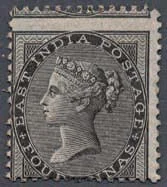
The end of East India Company rule in 1858 did not change the stamps at once: EAST INDIA POSTAGE stayed in use until 1882, while the post’s laws, accounts, official mail and rates changed on their own timetable.
Updated September 22, 2026
In this article
Three timetables, not one
A British India collection brings together the history of the government, of the post and of how the stamps were made, and they do not keep the same time. The postal reorganisation of 1854 came before the end of East India Company rule. The De La Rue portrait stamps arrived while the Company still governed, yet their inscription EAST INDIA POSTAGE stayed in use for years after the Crown took over in 1858.[1][2][3]
An EAST INDIA stamp on a letter of the 1860s or 1870s is therefore nothing strange: the designs and the printing arrangements simply carried on. The inscription cannot date a loose used stamp to Company rule; the postmark, and better still a complete dated letter, supply the evidence.[1][2][3]
Postal reform beyond the portrait
Clarke treats the Act of 1854 as the foundation of the single imperial Post Office. Later laws and working rules went on changing how it ran: the Act of 1866 revised the rates and the arrangements between departments, and the amendments of 1882 and 1895 dealt with later needs. These are events in administration, not dates of new stamps.[1]
Official mail changed too. Service stamps began in 1866, and Clarke records that the remaining franking privileges were abolished in 1873. A change like that can explain an official cover better than the sovereign’s portrait can. Free markings, departmental endorsements and SERVICE stamps have to be read against the rule in force at the time, not arranged as a simple succession of political regimes.[1]
The new department and its accounts
Clarke records 201 head offices and 451 minor offices at the start of the new administration of 1854. At first each office kept its own accounts and reported directly to the Audit Office; in 1861 the postal accounts were moved from the civil auditors to a Compiler of Post Office Accounts, and in 1866–67 the distinction between head and branch offices in accounting was made. This is the setting in which stamps became stock that had to be accounted for.[1]
In a postal history collection, an office’s class and its responsibility for accounts can matter as much as the sovereign on the stamp. A datestamp of an office in the imperial network should not be equated with the borders of a modern Indian state.[1]
Why official stamps became necessary
Under the earlier arrangement, departments were charged for official letters sent under frank. Clarke describes how hard it was to police a very long list of officials entitled to frank, and to account for official packets that were too large or too many. In 1866 service stamps became compulsory for official letters going beyond the limits of a Presidency town or district; in 1873 the remaining franking privileges were abolished.[1]
That step-by-step restriction is more exact than saying “official mail was stamped from 1866”. Some privileged or local correspondence could still be treated differently during the change, so a dated cover and its department of origin are needed before a missing stamp is read as underpayment.[1]
Changes of rate and registration seen on covers
The Act of 1866 cut the lowest inland letter rate to six pies for a quarter tola and kept one anna for the next step, up to half a tola. Clarke’s table for 1869 extends the six-pie step to half a tola. The same half-anna stamp could thus pay for different weights at different dates, and its face value alone cannot show that the weight stayed the same.[1]
Registration fees are another visible change. Clarke says that under the law of 1866 the registration fee of four annas was to be prepaid in stamps; earlier letters can show a stamp paying the postage while the registration was paid in cash. A franking has to be tested against the practice on the day the letter was sent.[1]
Government changed faster than the supply of stamps
The London contract of 1854, discussed by Easton, included supervision by the Inland Revenue and provisions on who owned the dies and plates. These arrangements began as Company purchasing, but they supported printing that went on after 1858: a change of government did not require usable printing plates to be destroyed.[4][1][2]
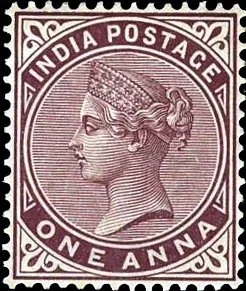
The redesign of 1882, with INDIA POSTAGE, is therefore best seen as a later reform of design and manufacture. The larger stamp and the star watermark give practical tests; the words EAST INDIA cannot stand in for a political date. The first De La Rue stamps, the Elephant’s Head issues and the INDIA POSTAGE issues each have an article of their own; this one follows the changing administration around them.[4][1][2]
The visible change of 1882
The new, larger Victorian series introduced from 1882 replaced EAST INDIA POSTAGE with INDIA POSTAGE, and the Elephant’s Head watermark with a single star. The official album dates its introduction 1882–88, a reminder that a series was brought in over several years.[1][2][3]
Later changes again followed practical policy. POSTAGE & REVENUE on Edward VII’s half anna and one anna came from the decision of 1906 to combine the two uses; it did not announce a new government. Record the issuer, portrait, inscription, watermark and purpose as separate facts, so that a long-lived design is not mistaken for one short period of administration.[1][2][3]
| Date | What changed |
|---|---|
| 1854 | A single imperial post and the first stamps for general use |
| 1858 | Company rule ends; the existing inscriptions carry on |
| 1866 onward | Official stamps, and changing charges for departments |
| 1873 | Remaining franking privileges abolished |
| 1882–88 | INDIA POSTAGE designs on single-star paper |
Sources
- [1] Geoffrey Clarke, The Post Office of India and Its Story, London: John Lane, 1921, chapter XIX, pp. 181–184, with passages from chapters III–IV on franking and postal legislation.
- [2] Indian Posts and Telegraphs Department, India Postage Stamp Centenary 1854–1954: Souvenir Album, 1 October 1954, plates 2–6 and commentary pp. 1–2.
- [3] Bombay Philatelic Company, Catalogue of Postage Stamps 1947, Bombay, 1947, India, pp. 47–52.
- [4] John Easton, The De La Rue History of British and Foreign Postage Stamps 1855 to 1901, India chapter, pp. 177–179.
Notes 0
Add what you know: a cover or stamp in your collection, a date or source, a correction or a question.
No notes yet.
Sign in to add a note.
Notes show straight away. Keep them kind and about the article; anyone can report one that isn't. House rules
