
King Edward VII: The High Values, One to Twenty-Five Rupees
The Edwardian rupee stamps, and the ten, fifteen and twenty-five rupees added in 1909 when telegrams came to be paid with postage stamps.
Updated July 14, 2026
In this article
One to five rupees
The first Edwardian rupee stamps followed the late Victorian pattern: a smaller one rupee and larger two, three and five rupees in two colours. Clarke lists one rupee green and carmine, two rupees carmine and yellow-brown, three rupees brown and green, and five rupees ultramarine and violet.[1][2][3]
A handsome bicolour is easily misdescribed if the frame and portrait colours are swapped. Record which part is which as well as the catalogue’s colour name. The 1947 catalogue recognises more than one shade for some values; its names are the classification of its day, not a modern colour standard.[1][2][3]
Ten, fifteen and twenty-five rupees in 1909
The special double-headed telegraph stamps were abolished in 1909 and postage stamps were used to pay for telegrams. The telegraph stamps had gone up to fifty rupees, but three new postage values, ten, fifteen and twenty-five rupees, were thought enough for the higher charges.[1][2][3][4]
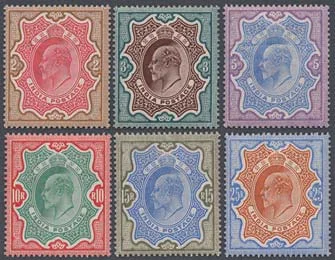
The new values used the large format of the two, three and five rupees. Clarke describes ten rupees pink and green, fifteen rupees olive-brown and blue, and twenty-five rupees orange and blue. The Gärtner photograph of six stamps lets the earlier and the added large values be compared as they were arranged.[1][2][3][4]
Six large values and a smaller rupee
The six large Edwardian stamps are two, three, five, ten, fifteen and twenty-five rupees. One rupee is in the smaller format, so a full rupee page has seven values in two formats. Three rupees should not be left out just because later reigns chose a different set of high values.[3][2][4]
The lot 177 photograph keeps the six large values together, which is useful for comparing corner figures, portraits and colour pairings. It is not evidence that all six came out together, or that they share one dated shade.[3][2][4]
The two colours of the high values
The colours of 1909 were chosen to tell very large sums apart. The catalogue of the period gives ten rupees green and scarlet, fifteen rupees blue and olive-brown, and twenty-five rupees brownish-orange and blue. Clarke sometimes puts the colours in a different order, so the safest description names the frame and portrait colours you can see as well as the catalogue’s words.[3][1][4]
Do not read a two-colour description mechanically as “first colour = head”: look at the stamp. A photograph also shows why a scanner cannot settle a premium shade, since paper, gum and light all affect both inks.[3][1][4]
| Value | Colours |
|---|---|
| 2 rupees | Carmine or rose-red with yellow-brown |
| 3 rupees | Brown or red-brown with green |
| 5 rupees | Ultramarine with violet or lilac |
| 10 rupees | Green and scarlet or pink |
| 15 rupees | Blue and olive-brown |
| 25 rupees | Orange-brown and blue |
High values used in Burma
The Park catalogue records an Edward twenty-five rupees cancelled at Rangoon on 25 November 1909 and another with a Sandoway TEL mark of 12 October 1914. The first places a high value in Burma early in the issue’s life; the second points to telegraph use, after Edward’s reign.[4]
These are two different statements. A Burma cancellation does not make the stamp a separate Burma issue, while the TEL wording matters for what the stamp paid. A caption can keep the place and the service without claiming a postal rarity, or assuming that a town datestamp always means a letter.[4]
Officials and later use of the stock
The 1909 official group in the 1947 catalogue has five large values with On H.M.S.: two, five, ten, fifteen and twenty-five rupees. The ordinary three rupees is not among them. Compare ordinary and official stamps by both inks and the base design before looking at the overprint; a genuine ordinary high value with a false official overprint added is still a dangerous fake.[3]
Later provisionals made on old Edwardian stock are a separate subject: the portrait can be many years older than the surcharge or overprint. Keep the date of the stamp, the date of the change made to it and the date of its use apart. The article on the Edwardian officials follows this through.[3]
A postmark is not the whole story
Large values invite claims of postal rarity that cannot be supported. A stamp with a town datestamp shows that it was cancelled; the original form or envelope is needed to show what was paid. A telegraph office mark matters especially after the change of 1909.[1][3][4]
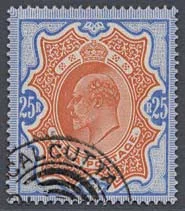
Gärtner’s lot 178 is described as a used twenty-five rupees from Calcutta. The catalogue also records copies with later dates, which shows that the end of the reign did not end the stamps’ use.[1][3][4]
Sources
- [1] Geoffrey Clarke, The Post Office of India and Its Story (London: John Lane, 1921), chapter XIX, printed pp.181–184.
- [2] Indian Posts and Telegraphs Department, India Postage Stamp Centenary 1854–1954: Souvenir Album (1 October 1954), plates 2–6 and printed commentary pp.1–2.
- [3] Bombay Philatelic Company, Catalogue of Postage Stamps 1947 (Bombay, 1947), cover, introduction and India printed pp.47–52.
- [4] Auktionshaus Christoph Gärtner, India: Park Collection, 7 March 2011.
Notes 0
Add what you know: a cover or stamp in your collection, a date or source, a correction or a question.
No notes yet.
Sign in to add a note.
Notes show straight away. Keep them kind and about the article; anyone can report one that isn't. House rules
