
King Edward VII: Official Stamps, On H.M.S.
On H.M.S. carried on under the new King, on the redesigned low values and the large rupee stamps, and old Edwardian stock was later revalued for official use.
Updated October 22, 2026
In this article
The official overprint outlived the old reign
The Edwardian official stamps kept the On H.M.S. overprint begun under Victoria. In the new reign the initials stood for On His Majesty’s Service: the sovereign changed, but the abbreviation could stay the same.[1][2][3]
The 1947 catalogue lists an Edwardian official group beginning in 1902, then the 1906 dual-purpose half and one anna, then a high-value group of 1909. A sound identification starts with Edward’s portrait and the right ordinary stamp underneath; the overprint alone does not tell the issue.[1][2][3]
An official programme of its own
The catalogue’s 1902 group covers three pies, half, one, two, four, six and eight annas and one rupee. It lists three pies grey or slate-grey, half anna pale green, one anna carmine, two annas pale violet, four annas olive or pale olive, six annas olive-bistre or mauve, eight annas magenta and one rupee green and carmine, in its own colour names.[1][2][3]
Two annas six pies, three annas and twelve annas are in the ordinary range but not in that 1902 official group. It is a mistake to assume that every ordinary value was overprinted at the same time, and a collector should not fill an apparent gap on that assumption. The structure of the issue is a matter of record, not of symmetry.[3]
The redesigned official low values
The official half anna and one anna of 1906 keep their green and carmine but carry POSTAGE & REVENUE in the design, with On H.M.S. printed over it. If the lower inscription is hidden, the colour alone cannot separate them from the official values before them.[3][1]
The values did not change; the policy behind the redesign concerned dual-purpose use. On an official page the distinction that matters is the base design together with the overprint. It does not mean the official stamps suddenly became interchangeable with every fiscal stamp bearing Edward’s head.[3][1]
The high values of 1909
The high-value official group of 1909 covers two, five, ten, fifteen and twenty-five rupees: large bicolours, best studied beside the matching ordinary stamps. Record the portrait ink, the frame ink, the paper, the perforation and the overprint separately.[3][1]
A large face value makes an added overprint or cancellation all the more tempting to a faker. A neat postmark does not prove a government use, or that an official stamp was properly available at a given office. An intact form or cover is the best evidence of the charge and the department involved.[3][1]
An Edwardian six annas revalued in 1926
The 1947 catalogue gives a heading of its own to a provisional official issue of 1926: one anna on the Edward VII six annas olive-bistre. This is old stock revalued long after Edward’s lifetime, and it should not be dated 1902 because the portrait looks like the original series. The new value of one anna is essential to identifying it.[3]
In an album it makes a bridge to the later official supply: old printed stock became a resource for a new need. The same stamp has an Edwardian design and a 1926 provisional issue, which makes it a good test of the difference between the date of a design and the date of an administrative act.[3]
SERVICE from 1911, and the rupee provisionals of 1921–26
Clarke records the return to the word SERVICE in 1911, as the George V stamps appeared. Later official revaluations also used old Edwardian high values. The Bombay catalogue groups them under 1921–26: one rupee on the Edward fifteen rupees (blue and olive) and on the twenty-five rupees (chestnut and blue), and two rupees on the ten rupees (green and scarlet, with green and carmine also listed). The King on the stamp cannot give the date of the revaluation.[1][3][4]
The same section of the catalogue also has provisionals on George V high values. Keep the two kings apart, and keep these rupee revaluations apart from the one anna on six annas of 1926. An old portrait, an official purpose and a new value are three different layers to identify.[1][3][4]
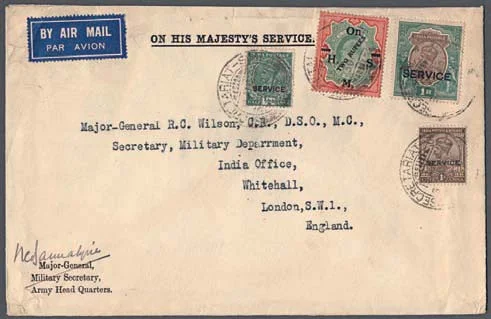
The airmail cover shown here is a real example of the older portrait in a later official franking. Its Edwardian two rupees on ten rupees travels with George V SERVICE stamps, which is why an album arranged by reign should keep the date of the revaluation and the date of use. The front of the cover alone does not give a first day or a full weight-and-rate calculation.[1][3][4]
Sources
- [1] Geoffrey Clarke, The Post Office of India and Its Story (London: John Lane, 1921), chapter XIX, printed pp.181–184.
- [2] Indian Posts and Telegraphs Department, India Postage Stamp Centenary 1854–1954: Souvenir Album (1 October 1954), plates 2–6 and printed commentary pp.1–2.
- [3] Bombay Philatelic Company, Catalogue of Postage Stamps 1947 (Bombay, 1947), cover, introduction and India printed pp.47–52.
- [4] Auktionshaus Christoph Gärtner, India: Park Collection, 7 March 2011, lot 313.
Notes 0
Add what you know: a cover or stamp in your collection, a date or source, a correction or a question.
No notes yet.
Sign in to add a note.
Notes show straight away. Keep them kind and about the article; anyone can report one that isn't. House rules
