
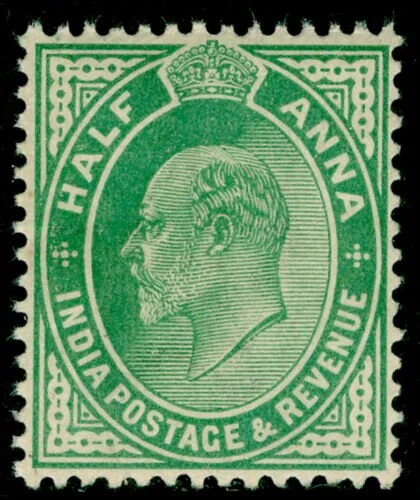
King Edward VII: POSTAGE & REVENUE, 1906
In 1906 the half-anna and one-anna stamps were redesigned with INDIA POSTAGE & REVENUE, so that one stamp could pay postage or a receipt.
Updated June 19, 2026
In this article
Why the wording changed
In 1906 the Government decided to abolish the special receipt stamp and let the half-anna and one-anna postage stamps serve for both postage and revenue. Clarke gives this explanation; the official centenary album dates the new wording to 1906 on its own account.[1][2][3]
The issued designs read INDIA POSTAGE & REVENUE. The half anna stayed green and the one anna carmine, keeping their familiar place in the colour scheme. The changed inscription is therefore the surest way to tell them from the postage-only stamps before them.[1][2][3]
Identify the whole stamp
Read the lower curved inscription rather than relying on the portrait or the colour. A heavy cancellation can hide REVENUE and leave INDIA POSTAGE visible. Where the key letters cannot be seen, compare the frame with a clear example instead of assuming the commoner type.[1][2][3]
Both values are De La Rue productions on single-star paper, perforated 14. Their later official forms must be catalogued under the right base design: the Bombay catalogue lists the official half and one anna POSTAGE & REVENUE under a separate 1906 heading, after the 1902 official group.[1][2][3]
| Stamp | What to look for |
|---|---|
| Ordinary ½ anna | Green, dual-purpose inscription, from 1906 |
| Ordinary 1 anna | Carmine, dual-purpose inscription, from 1906 |
| Earlier Receipt stamp | A separate fiscal stamp; do not assume it was valid for postage |
The earlier Receipt stamp was a different thing
The one-anna Receipt stamp in use before 1906 was a fiscal stamp. Gärtner’s lot 183 is a postcard to Great Britain of 1904 on which such a stamp was not accepted for postage: the card was treated as unpaid and charged two pence in Britain. It is a plain example of why a stamp with the King’s head need not be a postage stamp.[4][1]
The dual-purpose wording that followed cannot make that earlier franking valid after the event. Keep the rejected card’s postage-due marks, route and date: they show how it was handled, which a loose Receipt stamp with a cancellation cannot.[4][1]
The two low values side by side
The earlier half anna and one anna have INDIA POSTAGE around the portrait frame. In the 1906 designs the lower inscription grows to INDIA POSTAGE & REVENUE, with the value above. The added words change the balance of the design around the lower oval; they are part of the printed stamp, not a handstamp added later.[2][3]
On a damaged or heavily cancelled copy the portrait may be clear while the lower band is not. Such a stamp should be classified only as far as its surviving features allow. “Half anna, inscription not readable” is better than guessing the dual-purpose type from a late postmark.[2][3]
Official stamps add another printed layer
The 1906 official half and one anna take the same dual-purpose design and add On H.M.S. The Bombay catalogue gives them their own section rather than folding them into the 1902 postage-only officials. Identifying one needs two correct readings: the inscription of the stamp and the official overprint.[3]
The revenue wording does not cancel the official purpose of an overprinted stamp. Equally, an ordinary dual-purpose stamp with a pen mark is not an official stamp just because a government receipt might have used it. What was printed into the stamp, a later official overprint and the mark of actual use are three separate things to record.[3]
Keep 1905 and 1906 apart
The quarter-anna surcharge of 1905 was a stopgap for a shortage of three-pies stamps; the 1906 redesign was a decision about what a stamp could pay. Both involve green half-anna stamps, but they answer different questions and belong in different places in a display.[2][1][3]
The later George V series also had dual-purpose inscriptions, and in the end dropped them. Those changes belong to another reign and should not be read back into Edward’s 1906 issue.[2][1][3]
Postal and fiscal cancellations
From 1906 the same stamp could rightly turn up on a receipt or on a letter. Both uses are part of its history, but a fiscal pen mark or receipt cancellation should not be called postal without supporting evidence. Keep the document it was used on where you can.[1][2][3][4]
The rejected postcard of 1904 and the dual-purpose stamps after it together show where fiscal and postal authority met. Record the date, the exact inscription, any official overprint, what the cancellation was for and the document that survives. That tells far more than deciding postal validity from the King’s portrait alone.[1][2][3][4]
Sources
- [1] Geoffrey Clarke, The Post Office of India and Its Story (London: John Lane, 1921), chapter XIX, printed pp.181–184.
- [2] Indian Posts and Telegraphs Department, India Postage Stamp Centenary 1854–1954: Souvenir Album (1 October 1954), plates 2–6 and printed commentary pp.1–2.
- [3] Bombay Philatelic Company, Catalogue of Postage Stamps 1947 (Bombay, 1947), cover, introduction and India printed pp.47–52.
- [4] Auktionshaus Christoph Gärtner, India: Park Collection, 7 March 2011.
- [5] Wikimedia Commons, Post of India stamp scan: Edward VII half anna, INDIA POSTAGE & REVENUE.
Notes 0
Add what you know: a cover or stamp in your collection, a date or source, a correction or a question.
No notes yet.
Sign in to add a note.
Notes show straight away. Keep them kind and about the article; anyone can report one that isn't. House rules
