
King Edward VII: The Main Definitive Series, 1902–1911
Edward VII’s portrait went into a familiar system of values and colours, followed by a surcharge, dual-purpose low values and new high values.
Updated September 19, 2026
In this article
A new head in a working postal system
The Edward VII definitives began in 1902–03. They kept much of the late Victorian scheme of values and colours, with De La Rue’s typography, paper watermarked with a single star and perforation 14. The 1954 centenary album groups the reign’s ordinary stamps under 1902–11; that is a range for the whole family, not a claim that every value appeared in 1902.[1][2][3]
Edward faces left, his head close-cropped and bearded, in place of Victoria’s diadem and hair. The value still decides much of the frame around him. A basic set is therefore identified by portrait, full inscription, value, frame and colour together, not by a likeness to one single Edwardian design.[1][2][3]
The first working range
Clarke lists fourteen values, from three pies to five rupees: three pies, half anna, one, two, two annas six pies, three, four, six, eight and twelve annas, then one, two, three and five rupees. Note the six annas in the Edwardian range; it is a different stamp from the Victorian four annas six pies.[1][2][3]
Those fourteen values are a practical basic run, not the full count of a specialised catalogue. The catalogue of the period lists shades separately, as well as the 1905 quarter-anna surcharge, the 1906 POSTAGE & REVENUE low values and the later high values.[1][2][3]
| Value | Colour |
|---|---|
| 3 pies / ½ anna / 1 anna | Grey / yellow-green / carmine |
| 2 annas / 2 annas 6 pies | Mauve / ultramarine |
| 3 / 4 / 6 annas | Orange-brown / olive-green / bistre |
| 8 / 12 annas | Purple / purple on red paper |
| 1 rupee | Green and carmine: two printed colours, not a coloured paper |
Fourteen values, several ways of counting
The large rupee stamps are printed in two inks, while the twelve annas is known partly by its red paper. These are different physical features, even when a catalogue sums up both with two colour words.[1][3]
The Bombay catalogue of 1947 lists more than one shade for some values, so fourteen values do not make fourteen catalogue entries. A second shade, on the other hand, is not a new value or a change of postal policy. A reference page is clearest when it gives both counts: the number of face values and the number of classified stamps it shows.[1][3]
| Group | Stamps |
|---|---|
| First ordinary values | 3 p, ½ a, 1 a, 2 a, 2 a 6 p, 3 a, 4 a, 6 a, 8 a, 12 a, 1 r, 2 r, 3 r, 5 r |
| Later low values | 1905 ¼ a surcharge; 1906 ½ a and 1 a POSTAGE & REVENUE |
| Later high values | 1909 ten, fifteen and twenty-five rupees |
| Separate groups | On H.M.S. officials, the printer’s CANCELLED stamps, booklets |
Kept frames made the change easy to follow
Edward’s head replaced Victoria’s while many of the value frames stayed close to the earlier series. The half anna has a rounded portrait and an oval inscription; the two annas is more rectangular; the two annas six pies has a markedly ornamental frame. The large rupees carry value panels in the corners around a portrait printed in a second colour.[2][3]
This continuity helps tell a genuine Edward stamp from a misread late Victorian one, especially under a heavy cancellation. Look at the portrait itself, bearded and uncrowned in these designs, before taking a familiar green or mauve frame as enough.[2][3]
Booklets: another kind of evidence
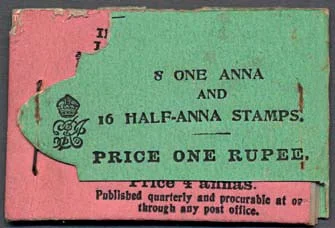
Gärtner’s lot 185 is a one-rupee booklet of 1907, described as two one-anna stamps short and with part of the cover flap cut away. The booklet held half-anna and one-anna stamps together. Its price is the booklet’s selling price, not the value of any one stamp in it.[4]
Booklet covers and panes keep evidence of how stamps were made up and sold, which loose singles lose. An incomplete booklet should be described exactly as it survives; putting stamps back to make it look complete would destroy what it shows. A booklet’s catalogue number and a stamp’s catalogue number name different objects.[4]
Four values on one registered cover
Lot 188 of the same sale is a registered cover from Delhi to Switzerland of August 1910, franked with half anna, one anna, two annas and one rupee: nineteen and a half annas in all. The sum is a safe first observation. How it divides between weight, postage and registration needs the tariff of the day and the whole cover.[4]
The Delhi R.M.S. registration marking adds the working context. A railway mail cancellation does not change which issue the stamps belong to, but it can turn an ordinary franking into a good postal history piece. The high values and the printing varieties have their own articles.[4]
Later additions and later use
The quarter-anna surcharge of 1905 met a shortage of three-pies stamps. The half and one anna were redesigned in 1906 with revenue wording added. Ten, fifteen and twenty-five rupees came in 1909, when telegrams began to be paid with postage stamps. These changes are why a page for the reign needs more than one row of values.[1][2][3]
Edwardian stamps stayed in use after the King died in 1910, so a later cancellation is not wrong in itself. Where you can, find from the original document whether a used high value paid postage, a telegram or another charge.[1][2][3]
Sources
- [1] Geoffrey Clarke, The Post Office of India and Its Story (London: John Lane, 1921), chapter XIX, printed pp.181–184.
- [2] Indian Posts and Telegraphs Department, India Postage Stamp Centenary 1854–1954: Souvenir Album (1 October 1954), plates 2–6 and printed commentary pp.1–2.
- [3] Bombay Philatelic Company, Catalogue of Postage Stamps 1947 (Bombay, 1947), cover, introduction and India printed pp.47–52.
- [4] Auktionshaus Christoph Gärtner, India: Park Collection, 7 March 2011.
Notes 0
Add what you know: a cover or stamp in your collection, a date or source, a correction or a question.
No notes yet.
Sign in to add a note.
Notes show straight away. Keep them kind and about the article; anyone can report one that isn't. House rules
