
Dhar’s Arms Stamps, 1898–1900: Sheets, Watermark and Printing
Dhar’s arms stamps of 1898–1900 in half anna, one anna and two annas: lithographed or typographed, sheets of 120, 60 and 30, the OFFICIAL—100 A1 watermark and perforations.
Updated July 1, 2026
In this article
The design
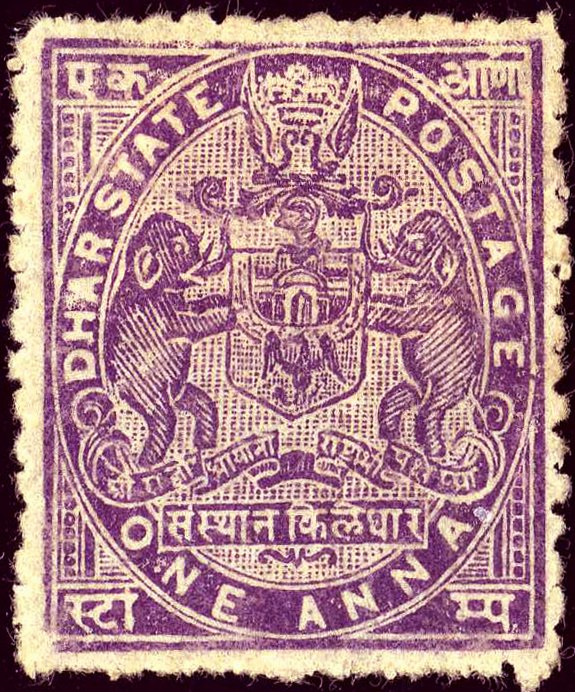
Nankivell describes the arms design with an English legend round the oval and the value in Devanagari in the upper corners. His summary lists the half anna carmine, one anna purple and two annas green; it is not a full chronology of shades or sheets. StampWorld numbers the half anna 6 and 6A, the one anna 7 and 7A, and the two annas 8.[9][24]
Lithographed or typographed?
The first notice, in The Philatelic Journal of India of September 1898, called the arms stamp lithographed. By February 1899 the Monthly Journal was describing an actual one-anna sheet of 120, ten rows of twelve, and inferring casts or electrotypes from flaws repeated in the third and tenth stamps of every row; Evans repeated this in 1900. Nankivell called the design engraved; Dawson and Feldman’s survey identify typography as the printing method. An engraved design can be used to make relief printing material, and Dawson’s repeated flaws and reconstructed strip of stereos support relief printing. No signed die, engraver or printer’s ledger has been found.[30][28][26][9][17][7]
Sheets of 120, 60 and 30
The Monthly Journal of November 1900 describes smaller sheets supplied by Whitfield King and Co.: sixty half annas in five rows of twelve, and thirty each of the one anna and two annas in five rows of six, the one anna apparently from a fresh plate. A dealer’s supply to a journal does not make the dealer the printer. Dawson later questioned the reported early half-anna sheet of 120, which he had not seen, while accepting his own sheet of sixty.[29][7]
| Value and colour | Reported sheet | Note |
|---|---|---|
| ½ anna, earlier carmine | 120? | From earlier accounts; not seen by Dawson |
| ½ anna, deep rose | 60: 5 rows × 12 | Report of November 1900 and Dawson’s own sheet |
| 1 anna, purple (1899 report); claret (Dawson) | 120: 10 rows × 12 | Sheet reported in February 1899; repeated flaws at positions 3 and 10 |
| 1 anna, bright mauve (1900 report); reddish violet (Dawson) | 30: 5 rows × 6 | Report of November 1900; apparently a fresh plate |
| 2 annas, deep green | 30: 5 rows × 6 | Report of November 1900 |
A sheet watermark
The Monthly Journal of December 1898 and Evans’s study of 1900 describe an outline sheet watermark reading OFFICIAL—100 A1 on the thin white wove paper of the arms stamps; Evans sets the words in two lines. A sheet watermark covers only part of a sheet, so it will not be on every stamp, and it is not known for every printing or for the coloured papers of the typeset stamps. No paper mill is identified.[28][26]
Perforation
The early arms stamps are described as pin-perforated 11½, and the sheets received in November 1900 as 12. Later studies give a wider range and record imperforate material, including Dawson’s block of the half anna in deep rose. No gauge goes with a particular shade. The early paper is thin white wove; Douie’s yellowish paper is his own observation.[30][26][29][31][7]
No quarter-anna arms stamp
A quarter-anna arms stamp was planned but, as far as the evidence goes, never released: the October 1900 report says the quarter anna and two annas in the new design were delayed and that temporary stamps in the old design were made instead.[16]
Sources
- [7] L. E. Dawson, “The Indian Feudatory States—X: Dhar”, The Philatelist, vol. 32, August 1966, pp. 328–331.
- [9] Edward J. Nankivell, “Countries of the World: Dhar”, Gibbons Stamp Weekly V, no. 18 (whole no. 122), 4 May 1907, pp. 277 and 279.
- [16] Philatelic Journal of Great Britain, 20 October 1900.
- [17] David Feldman, Indian Princely States, 8 December 2017.
- [24] StampWorld, Dhar postage stamps. Types A–H, including direct F and H thumbnails.
- [26] E. B. Evans, “The Stamps of some of the Native States of India”, Dhar, Stanley Gibbons Monthly Journal X, 28 February 1900, pp. 186–187.
- [28] Stanley Gibbons Monthly Journal IX, “New Issues and Discoveries”, Dhar: 31 October 1898, p. 56; 31 December 1898, p. 88; 28 February 1899, p. 126.
- [29] Stanley Gibbons Monthly Journal XI, “New Issues and Discoveries”, Dhar: 30 November 1900, p. 98; 31 January 1901, p. 144; 30 March 1901, p. 192.
- [30] “Dhar”, The Philatelic Journal of India II(9), September 1898, p. 244.
- [31] Lt.-Col. F. M. Douie, R.E., “The Stamps of Dhar”, in “The Stamps of the Indian Feudatory States”, The Philatelic Journal of India XXXVIII, no. 5, May 1934, pp. 53–59.
Notes 0
Add what you know: a cover or stamp in your collection, a date or source, a correction or a question.
No notes yet.
Sign in to add a note.
Notes show straight away. Keep them kind and about the article; anyone can report one that isn't. House rules
