
Dhar’s Oval Seal, Its Postmarks and Postal Stationery
The oval impression on Dhar’s stamps: a control applied before issue or a private signet added later? The 1897 evidence, the circular DHAR STATE datestamp, envelopes and reply cards.
Updated September 11, 2026
In this article
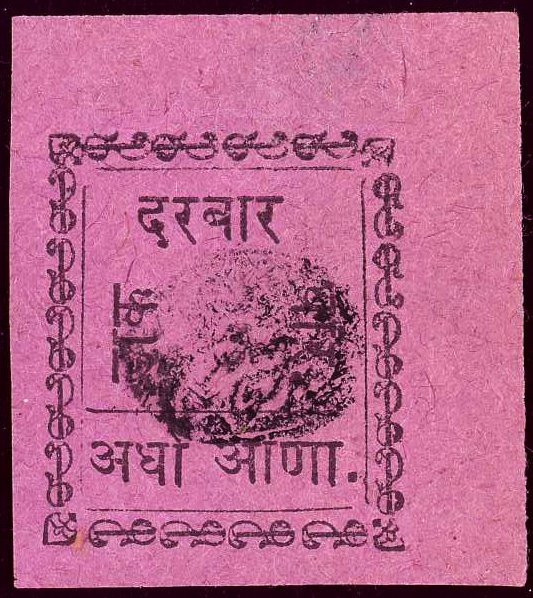
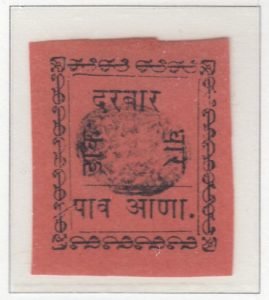
Most Dhar typeset stamps carry an oval impression beside the printed design. Its purpose was argued over in the 1960s, and the earliest reports settle part of the argument.
A personal name in the seal
Hurmuz Kaus read the inscription in the seal, on sheets illustrated by Dawson, as the personal name RANGHNATH/PURSOTAM, in the Nastaliq script used for Urdu and Persian. On the one-anna stamps it was upright; on the illustrated half-pice sheet it was upside down.[5][6]
Kaus argued in 1966 that this personal signet was put on only after the stamps had stopped being used. His reading of the name and his timing are separate claims.[5]
The 1897 evidence
The timing is the easier question. Groves illustrated the oval in September 1897 and said the stamps needed the State seal before they could be used. The Monthly Journal of November 1897 described the handstamp on newly received stamps and stationery as applied before issue, and Evans recorded it again in 1900. Those reports cannot be squared with the idea that every oval was added after the closure of 1901.[25][27][26]
They do not tell us whose seal it was, or prove every surviving impression genuine. In February 1967 D. C. Padgham cited early stationery and used covers carrying both the oval and a separate cancellation, but said he had failed to find the seal’s owner among the State’s officials. Nayeem’s reading, Pursotam son of Ranghnath, is the interpretation of a name, not a record of an appointment.[34][6]
Nayeem’s reply of March 1967 also reproduced the Gibbons catalogue of 1937, which describes the oval as applied before issue, and referred to Evans and to a variety without the control. He argued that a personal name was compatible with official use; the official records he discussed concern Hyderabad, not Dhar.[6]
Record the oval and the dated cancellation separately. The evidence of the time for a control applied before issue does not authenticate every surviving impression, and the presence or absence of the oval is not a complete test of genuineness.[25][27][34]
The circular postmark
Dawson records a circular cancellation about 25 mm across, with DHAR STATE above, Dhar in Devanagari below and a date in native script between parallel bars, in small and large English lettering. This dated device is a different object from the oval seal. He had seen it on the typeset stamps, and he separates collector-cancelled material from covers that really travelled. A cancellation on an envelope still needs the address, the dates, the back and the fit of stamp and paper checked.[7]
The half-anna envelopes
The typeset half-anna envelope is described by Groves in 1897 and by Evans in 1900: thin white laid paper, 138 × 79 mm, with a tongued flap, printed after the envelope was made. The oval is near or under the printed stamp, and Evans records one envelope without it.[25][26][7]
Evans describes the arms half-anna envelope in ultramarine on thicker white laid paper, 120 × 95 mm, with a pointed flap, and explains its uneven colour by the flap lying under part of the stamp during printing. Dawson calls the arms envelope white wove. The two descriptions stand until the envelopes themselves are compared; weak printing is not a new colour.[26][7]
Cards and reply cards
Dawson records a quarter-anna card of June 1897, lilac on yellowish card, with the typeset design and the oval. He dates a second family, with the arms design and rounded corners, to August 1898; Evans in February 1900 gives the same families but writes “August (?), 1898” and describes the corners as cut off. There are single cards and joined reply cards: the outward half printed on lilac, the reply half on cream, with REPLY in English and Devanagari.[7][26]
Keep a reply card joined if you can: its fold, the two papers and the reply wording are the evidence of the original object. Feldman’s lot 70223 lists seven Dhar stationery items, one of them used, but gives too little detail to identify the used one or settle the envelope descriptions.[7][18]
Sources
- [5] Hurmuz Kaus, “Signet Seals of Dhar”, The Philatelist, vol. 33, December 1966, pp. 70–71.
- [6] M. A. Nayeem, “Signet Seals of Dhar and Hyderabad”, letter to the editor, The Philatelist, vol. 33, March 1967, pp. 171–172.
- [7] L. E. Dawson, “The Indian Feudatory States—X: Dhar”, The Philatelist, vol. 32, August 1966, pp. 328–331.
- [18] David Feldman, Indian States, 21 June 2024.
- [25] G. Barton Groves, “The Postage Stamps of Dhar”, The Philatelic Journal of India I(9), September 1897, p. 223.
- [26] E. B. Evans, “The Stamps of some of the Native States of India”, Dhar, Stanley Gibbons Monthly Journal X, 28 February 1900, pp. 186–187.
- [27] Stanley Gibbons Monthly Journal VIII, 30 November 1897, “New Issues and Discoveries”, Dhar, p. 81.
- [34] D. C. Padgham, “Signet Seals of Dhar”, letter to the editor, The Philatelist, vol. 33, February 1967, p. 145.
Notes 0
Add what you know: a cover or stamp in your collection, a date or source, a correction or a question.
No notes yet.
Sign in to add a note.
Notes show straight away. Keep them kind and about the article; anyone can report one that isn't. House rules
