
Dhar: the Puar Maharajas, Their Stamps and the State Post
Dhar in Malwa ran a Darbar post from 1871 and issued typeset and arms stamps from 1897 until the Imperial post took over on 1 April 1901: the rulers, the chronology and the stamps.
Updated September 7, 2026
In this article
The state behind the stamp
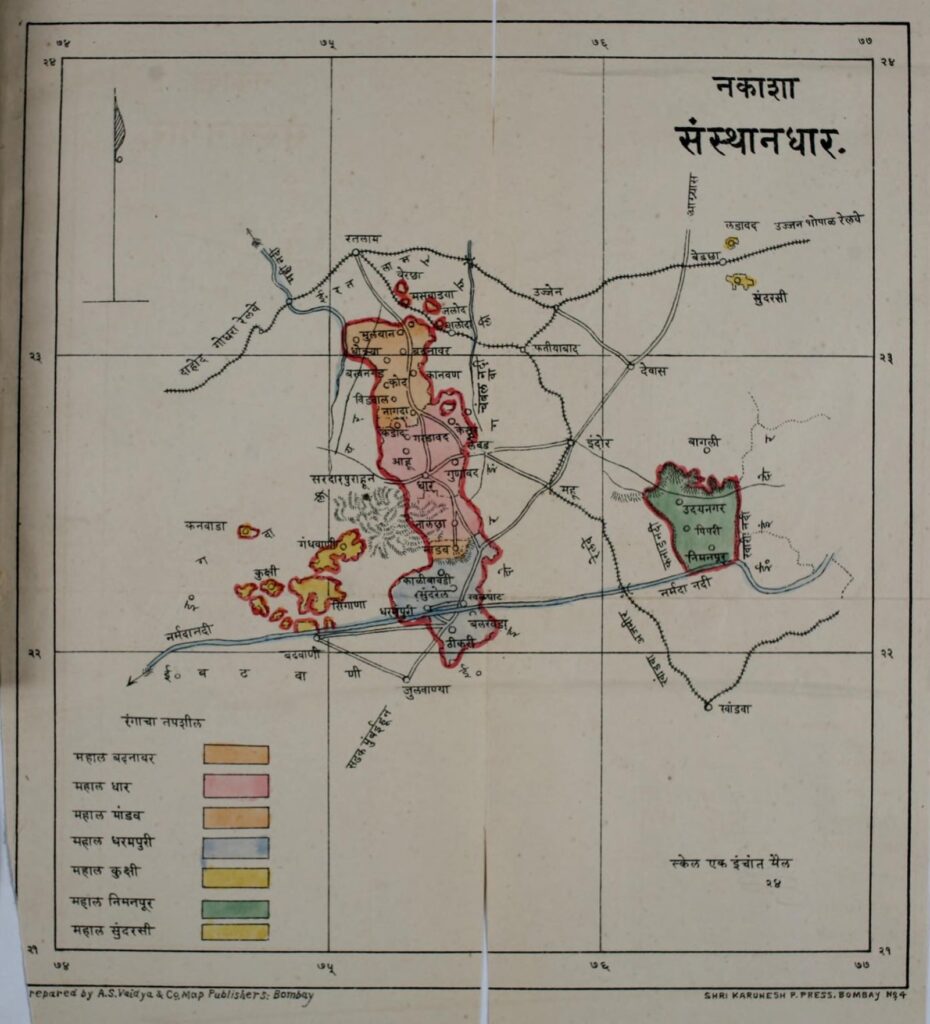
Dhar lay west of Mhow in Malwa, ruled by the Puar (Punwar) Maratha house from its capital at Dhar; the historic site of Mandu was in its territory. The account of 1911 places it in the Bhopawar Agency of Central India, with 1,775 square miles and 142,115 people in 1901: figures for the old state, not the modern district.[2][12]
The rulers
A ruler’s reign and the dates a stamp was issued or valid are different kinds of evidence.[12][13][14][15][35]
| Reign | Ruler | Note |
|---|---|---|
| 1833–early 1857 | Raja Jaswant Rao II | Succeeded Ram Chandra Rao; died of cholera early in 1857 |
| 1857 | Raja Anand Rao III | Adopted son, succeeded as a minor |
| 1857–1 May 1860 | British administration | Dhar captured 25 October 1857 and confiscated 19 January 1858; restored 1 May 1860 |
| 1 May 1860–15 July 1898 | Anand Rao III, Raja, Maharaja from 1877 | Under supervision until 1 October 1864; the first stamps of 1897 belong to his reign |
| 1898–30 July 1926 | Udaji Rao Puar, Raja, later Maharaja | Adopted son; a superintendent under the Political Agent ran the state in his minority, through the end of the stamps; ruling powers December 1907 |
| 1926–1947 and after | Anand Rao Puar IV (Vikram Singh) | Adopted by the Dowager Maharani on 1 August 1926; a council under the Maharani ruled in his minority; ruler at independence |
These political records name the administrations in office. They say nothing about who commissioned the stamps, ordered the printing or applied the oval seal.[14][15][13]
Four years of stamps
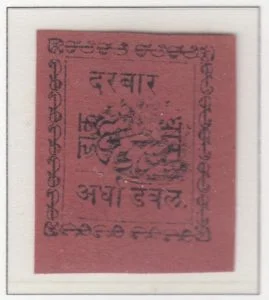
Dhar’s own stamps lasted from 1897 until Indian stamps replaced them on 1 April 1901: locally typeset stamps on coloured paper, then from 1898 an arms design in half anna, one anna and two annas.[1][3]
The named people and the missing makers
Groves, Evans, Douie, Stoney, Dawson and Barefoot are witnesses and researchers, not makers of the stamps. The retired postmaster who ran the revived department is unnamed. No designer, engraver, printing firm, compositor or commissioning official has been securely named; a name read in a seal and a planned supply from Bombay do not fill the gap.[25][35][26][31][32][33][7][1][34][6]
Chronology
| Date | Event |
|---|---|
| March 1848 | Imperial post office opened at Dhar |
| 1871 | Regular Darbar runner service; Dhar in the Indian Postal Guide |
| 1874 | Brahmani-dak contract, renewed yearly |
| 1897 | Darbar department revived under a retired Government postmaster |
| June 1897 | First three typeset stamps: half pice, half anna, one anna (Groves) |
| September and November 1897 | The oval seal described as applied before use |
| September 1898 | Arms stamps first reported |
| 1 August 1900 | Typeset two annas reportedly issued |
| October 1900 | Temporary typeset quarter anna and two annas while the new designs were delayed |
| February 1901 | Closure announced for 31 March |
| 1 April 1901 | Imperial post takes over; Indian stamps replace Dhar’s |
The stamps
The issues and their values, from the research checklist. The settings, shades and papers of each issue are not listed.
| Period | Issue | Values |
|---|---|---|
| 1897–1900 | Typographic Devanagari inscription | ½ pice, ¼ anna, ½ anna, 1 anna, 2 annas |
| 1898–1900 | Arms | ½ anna, 1 anna, 2 annas |
Sources
- [1] John Barefoot, “Some Curious Corners of Dhar”, Stamp Collecting, 8 October 1981, pp. 121–123 and 126–127.
- [2] Encyclopædia Britannica, 11th edition (1911), “Dhar”.
- [3] Smithsonian National Postal Museum, “Feudatory States: A–D”, Dhar.
- [6] M. A. Nayeem, “Signet Seals of Dhar and Hyderabad”, letter to the editor, The Philatelist, vol. 33, March 1967, pp. 171–172.
- [7] L. E. Dawson, “The Indian Feudatory States—X: Dhar”, The Philatelist, vol. 32, August 1966, pp. 328–331.
- [12] Imperial Gazetteer of India, vol. XI, “Dhār State”.
- [13] Government of Madhya Pradesh, Indore Division, History. Dhar restoration paragraph.
- [14] Government of India, Aitchison’s Collection of Treaties, Engagements and Sanads, Southern States of Central India.
- [15] British Library, Dhar Succession, IOR/R/1/1/1567(2).
- [25] G. Barton Groves, “The Postage Stamps of Dhar”, The Philatelic Journal of India I(9), September 1897, p. 223.
- [26] E. B. Evans, “The Stamps of some of the Native States of India”, Dhar, Stanley Gibbons Monthly Journal X, 28 February 1900, pp. 186–187.
- [31] Lt.-Col. F. M. Douie, R.E., “The Stamps of Dhar”, in “The Stamps of the Indian Feudatory States”, The Philatelic Journal of India XXXVIII, no. 5, May 1934, pp. 53–59.
- [32] R. F. Stoney, “The Stamps of Dhar. Type I.”, The Philatelic Journal of India XLI, nos. 11–12, November–December 1937, pp. 77–80 and plate.
- [33] R. F. Stoney, “Dhar Type-set Stamps”, The Philatelic Journal of India XLV, no. 7, July 1941, pp. 86–90.
- [34] D. C. Padgham, “Signet Seals of Dhar”, letter to the editor, The Philatelist, vol. 33, February 1967, p. 145.
- [35] Captain C. E. Luard, Western States (Malwa) Gazetteer, Central India State Gazetteer Series, vol. V, part A, Bombay: British India Press, 1908, Dhar, pp. 389, 400–401, 444–446.
- Wikimedia Commons, “1897ca Half anna Dhar Yv3 Mi3 lilarosa.jpg”.
- Wikimedia Commons, “1900ca 1a Dhar Yv7b Mi7b violett.jpg”.
Notes 0
Add what you know: a cover or stamp in your collection, a date or source, a correction or a question.
No notes yet.
Sign in to add a note.
Notes show straight away. Keep them kind and about the article; anyone can report one that isn't. House rules
