
Dhar’s Post, 1848–1901: Runners, a Contractor and the Darbar Department
Dhar had an Imperial office from 1848, a Darbar runner post from 1871, a Brahmani-dak contractor from 1874 and a revived state department from 1897, until the Imperial post took over on 1 April 1901.
Updated May 20, 2026
In this article
Dhar’s stamps lasted less than four years, but its posts are much older. Two administrations, the Imperial post and the state’s own, worked side by side for half a century.
A postal history older than the stamps
Luard’s Western States Gazetteer of 1908 records an Imperial post office at Dhar from March 1848 and a regular Darbar service set up in 1871. The state network covered 140 miles in 11 stages with 38 runners, leaving out the parganas of Nimanpur and Sundarsi. The Indian Postal Guide of 1871 already lists Dhar in its Malwa (Indore) district.[35][19]
The scheme of 1871 failed. From 1874 a Brahmani-dak contractor carried the mail, on a contract renewed every year, until the Darbar department was revived in 1897 under a retired Government postmaster whose name the gazetteer does not give. It eventually had 15 offices and letter boxes in six important villages; those figures describe the department later on, not on its first day.[35]
Traffic and money
Under the heading “statistics for 1901” the gazetteer records 66,810 articles, 39,228 of them service letters, against income of Rs 1,260 and expenditure of Rs 2,550, leaving a charge to the State of Rs 1,290. The same traffic total appears as the yearly average for 1897–1900, so it is neither a growth rate nor a four-year total.[35]
The yearly payment to the Brahmani-dak contractor is given separately as Rs 1,820, which is not the same thing as the average yearly expenditure of Rs 2,237 in the table. The gazetteer’s regional Brahmani-dak rates are background, not the tariff of the revived department of 1897.[35]
| Period and administration | Line miles | Runners | Yearly expenditure (Rs) | Letters etc. a year |
|---|---|---|---|---|
| 1871–74 (Darbar) | 140 | 38 | 2,652 | 6,000 |
| 1874–96 (contract) | 150 | 25 | 2,237 | 7,000 |
| 1897–1900 (Darbar) | 203 | 27 | 2,550 | 66,810 |
State offices and the Imperial network
The gazetteer lists Imperial offices at Dhar, Kukshi, Bakhtagarh, Badnawar, Multhan, Gujri, Khalghat and Dharampuri before 1901, and 17 more that it dates approximately to 1901. These are Imperial opening years; they cannot stand in for the opening dates of the Darbar offices. The Imperial Gazetteer counts 25 British offices after amalgamation, including combined post and telegraph offices at Dhar and Kukshi.[35][36]
| Approximate year | Imperial offices |
|---|---|
| 1848 | Dhar |
| 1881 | Kukshi |
| 1884 | Bakhtagarh |
| 1885 | Badnawar, Multhan |
| 1886 | Gujri, Khalghat, Dharampuri |
| 1901 | Bagdi, Bidwal, Dotria, Dhamnod, Gandhwani, Kadod, Kali-Baodi, Kanwan, Kesur, Kotkhera, Mandu, Nagda, Nalchha, Singhana, Sundarsi, Thikri, Tirla |
The half pice and the Imperial post
G. Barton Groves, writing in September 1897, gives the half-pice stamp a particular job: paying for letters handed in at a State office for delivery through the Imperial post. Evans later supposed that a half-anna Indian stamp completed the prepayment, but that is his inference, not a printed regulation.[25][26]
Two postal systems on dated objects
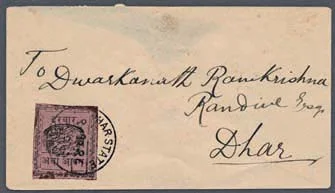
A local envelope in the Park sale bears a half-anna black-on-magenta stamp cancelled DHAR STATE on 9 October 1898, with a delivery strike of 10 October on the back. The two marks show successive stages; the half-anna stamp alone does not tell us the weight.[8]
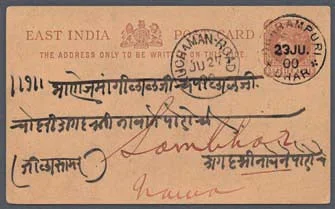
Another lot is a British Indian quarter-anna card to Sambhar, sent from DHARAMPURI/DHAR on 23 June 1900 and marked KUCHAMAN-ROAD on 27 June. The Imperial office served outward mail while the state still had its own stamps, which is why a Dhar collection should include Indian stationery used there, kept apart from the state’s own material.[8]
Feldman’s lot 70222 is an envelope with a strip of four black-on-red half-pice stamps and, on the back, a black-on-yellow two-annas inscription stamp, tied by the bilingual Dhar State circular datestamp. Its RPS London certificate, no. 148674 of 17 May 1989, describes SG 1, a strip of four on part cover with SG 6, as genuine. The certificate gives no rate, route or date of the strike, and the old SG numbers are not the same as StampWorld’s.[18][37]
An envelope from the Peter Rover collection bears a one-anna green inscription stamp tied by a circular Dhar State mark, with another circular mark on the back that the catalogue calls a receiving mark within the state. The pictures show no readable date or full route; it is a different franking, not proof of a one-anna rate.[38]
Closing on 31 March 1901
The Philatelic Journal of India announced in its unsigned Notes of February 1901 that Dhar’s postal system would cease on 31 March, just after reporting the Imperial takeover of Rampur Bussahir from 1 April. A January report had been unsure whether a closure on 1 January was permanent or for that day only. Ewen’s Weekly repeated the coming date on 30 March, and the Stanley Gibbons Monthly Journal of the same day announced the takeover from 1 April, after which State stamps could no longer be used. The Philatelic Journal of Great Britain reported it afterwards on 25 May. All drew on The Philatelic Journal of India; none is the transfer order itself, which has not been found.[39][29][21][20]
The Smithsonian dates the replacement of Dhar’s stamps by Indian stamps to 1 April 1901, and the government gazetteer records the Imperial takeover in 1901.[3][35][36]
Sources
- [3] Smithsonian National Postal Museum, “Feudatory States: A–D”, Dhar.
- [8] Christoph Gärtner, 17th auction, India States: Park collection, 7 March 2011, p. 124, lots 964 and 967.
- [18] David Feldman, Indian States, 21 June 2024.
- [19] Indian Postal Guide (1871), “List of Indian Post Offices”. Alphabetical row for Dhar.
- [20] Philatelic Journal of Great Britain, 25 May 1901.
- [21] Ewen’s Weekly Stamp News, no. 79 (vol. VI; whole no. 165), 30 March 1901, “The Week’s News”, front page.
- [25] G. Barton Groves, “The Postage Stamps of Dhar”, The Philatelic Journal of India I(9), September 1897, p. 223.
- [26] E. B. Evans, “The Stamps of some of the Native States of India”, Dhar, Stanley Gibbons Monthly Journal X, 28 February 1900, pp. 186–187.
- [29] Stanley Gibbons Monthly Journal XI, “New Issues and Discoveries”, Dhar: 30 November 1900, p. 98; 31 January 1901, p. 144; 30 March 1901, p. 192.
- [35] Captain C. E. Luard, Western States (Malwa) Gazetteer, Central India State Gazetteer Series, vol. V, part A, Bombay: British India Press, 1908, Dhar, pp. 389, 400–401, 444–446.
- [36] The Imperial Gazetteer of India, vol. XI, Oxford: Clarendon Press, 1908, “Dhār State”, pp. 287–294.
- [37] David Feldman, 21 June 2024, lot 70222, with RPS London certificate no. 148674 of 17 May 1989.
- [38] David Feldman, 30 May 2025, Peter Rover collection, lot 80307.
- [39] The Philatelic Journal of India V(2), February 1901, “Notes”, p. 38.
Notes 0
Add what you know: a cover or stamp in your collection, a date or source, a correction or a question.
No notes yet.
Sign in to add a note.
Notes show straight away. Keep them kind and about the article; anyone can report one that isn't. House rules
